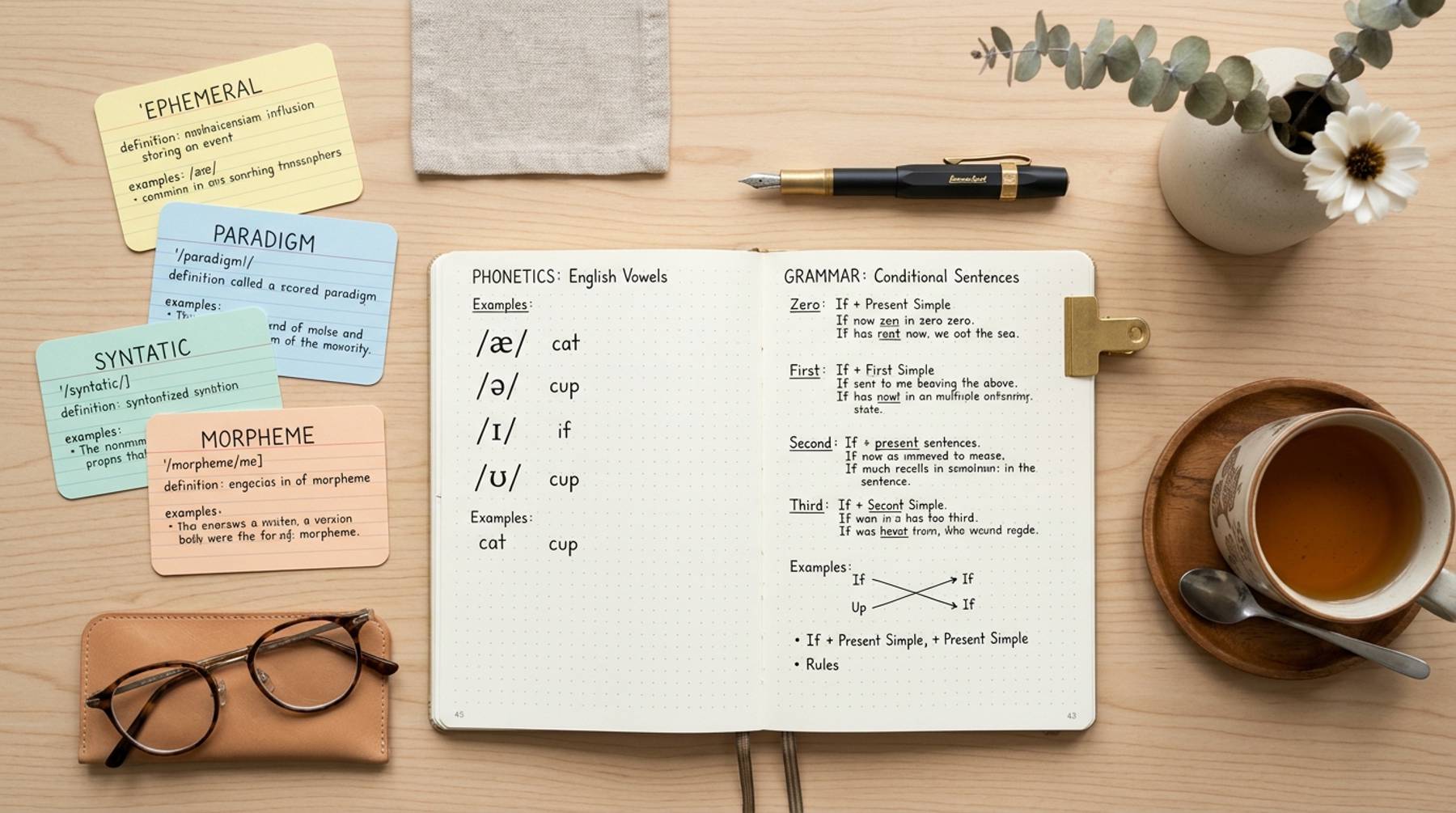
English Study Notes: Review Book

English Study Notes: Review Book
Date: 2026-06-05
Category: english-writing
Overview
A structured English review guide compiled from 219 lessons covering American pronunciation, advanced vocabulary, idioms, grammar accuracy, and executive communication. Each entry focuses on core takeaways, structured reference tables, and critical usage notes.
Study Method
- Target one lesson: Review the concept summary and key distinctions.
- Internalize through audio: Read expressions and example sentences aloud to absorb natural American stress and rhythm.
- Active reuse: Apply target collocations and sentence patterns directly in writing and speech.
Lesson Index
- Avoid This Pronunciation to Sound Educated
- 10 English Proverbs about LOVE
- 10 Ways to Apologize in English with a Perfect American Accent
- Breath or Breathe? 3 Rules
- Advanced English Expressions with a Psychologist
- Advanced Vocabulary for Buying a House in the US
- English Fluency Practice - Buying a House
- 10 English Expressions for Business
- 10 Common English Proverbs
- 10 Useful Idioms From LA Natives
- 12 Advanced Words Instead of “Very”
- 13 Expressions with “TALK”
- 15 Idioms with “Hit”
- Describing a Beautiful Place
- 17 Expressions with “Pick”
- 17 Expressions During a Crisis
- Advanced Words From News Headlines
- 20 Business English Expressions
- 20 Executive Business Expressions
- 20 Conversational Expressions
- 20 Modern American Slang Words
- 20 Ways to Use “Deal”
- 20 Advanced Pronunciation Fixes
- 21 Professional Expressions
- 22 Conversational Expressions in Context
- 25 Essential Business Idioms
- 25 “Out Of” Idioms
- 27 Expressions with the Word “Word”
- 30 Idioms with a Native Speaker
- 3 Grammar Mistakes Native Speakers Make
- 4 Accent Tips for Professionals
- 4 Rules for “OF” vs “OFF”
- 4 Tips for Clear Communication
- 4 Tips for Understanding Fast Speech
- 5 Commonly Mispronounced Words
- 6 Tips for Job Interviews with an Accent
- 7 Advanced Grammar Mistakes
- 8 Business Phrasal Verbs & Linking
- 8 Tips for Understanding Native Speakers
- About Lisa Mojsin
- Leadership Idioms with an Executive Coach
- Acting and Enthusiasm Idioms
- Idioms using the word “Name”
- Emergency Services Vocabulary
- Real Estate and Business Idioms
- Fine Dining and Restaurant Vocabulary
- VIP and Hospitality Vocabulary
- Advanced Vocabulary Quiz
- Business and News Vocabulary: Meta Layoffs
- Economic and Political Vocabulary
- Career and Education Vocabulary
- Real Estate and Housing Vocabulary
- Political and Debate Vocabulary
- AI and the Job Market Vocabulary
- Job Seeking and Professional Idioms
- Corporate Leadership Vocabulary
- Hybrid Work and Office Vocabulary
- Corporate Struggles and Economics Vocabulary
- Emotional Resilience Vocabulary
- Wall Street Journal Vocabulary
- Tense vs. Neutral Vowels (EE vs. IH)
- The T + N Sound in American English
- American Politics and Pronunciation
- Real-Life Idioms and the Fast ‘D’ Sound
- The Professional “What Factor”
- 10 Commonly Mispronounced Words
- Recommended Grammar Books for Advanced Learners
- British vs. American Accent: 5 Common Words
- Common Workplace Vocabulary Mistakes
- Advanced Pronunciation Mistakes
- Expanding Basic Vocabulary for Confidence
- Highly Confusing English Word Pairs
- More Confusing English Words
- Farther vs. Further and the American R
- Deep Nuances in Confusing English Words
- English Homographs: Same Spelling, Different Pronunciation
- Swell, Swollen, and Swallow
- The “AH” vs. “UH” Vowel Sounds
- Linking with the word “and”
- A Dangerous Vowel Mistake (And Hollywood Pronunciation)
- Regional Accents vs. The Standard American Accent
- Dropped Syllables in English
- Pronouncing “World” and “Work”
- Popular American Slang Words
- Rules for Using “The”
- Common Homophone Pronunciation Mistakes
- A Pronunciation Test: Same or Different?
- Note on Invalid Transcript
- Advanced Rules for “A” and “An”
- 20 “Hand” Idioms for Fluent English
- 20 “Mind” Idioms for Fluent English
- Real Estate Vocabulary and Daily Expressions
- Advanced News Vocabulary (Protests & Conflict)
- Advanced Idioms from Real Conversation
- Top 10 Common Grammar Mistakes to Fix
- Professional Intonation: Stop Using “Up Talk”
- Vowel Reduction in Unstressed Syllables (The Schwa)
- The 3 Sounds of “CH” in English
- Voiced vs. Voiceless Consonants
- Fixing the “Es-pecial” Mistake
- 15 English Proverbs about Money
- The 10 Negative Prefixes (Vocabulary Test)
- 5 Reasons Word Stress is Critical
- Fixing the “L” Sound (For Portuguese Speakers)
- The “N” vs “NG” Sounds (For Chinese Speakers)
- 8 Classic English Proverbs
- Advanced Vocabulary: Real Conversation (Pets & Business)
- Word Stress: The “Adjective + Noun” Rule
- 16 Commonly Mispronounced Words
- Stop Adding “S” to Uncountable Nouns
- The Ultimate Prepositions Guide
- The Short “I” vs. Long “E”
- The 3 Essential Comma Rules
- Tricky Food Pronunciations & Silent Letters
- Advanced Business Idioms & Phrasal Verbs
- Corporate Communication & Negotiation
- Los Angeles Slang & Casual Conversation
- 15 Expressions About Money & Accuracy
- 35 Expressions with the Word “Heart”
- Advanced Expressions for Money and Wealth
- Reading the News: Advanced Journalistic Vocabulary
- A Blueprint for English Fluency
- Essential Expressions with “Go”
- Upgrading Your Professional Vocabulary
- The Problem with “Awesome”
- Hollywood Accent Secrets: Word Stress
- 8 Daily Habits for a Perfect Accent
- 5 Steps to Perfect Pronunciation
- American Brands: Pronunciation and Origins
- Pronouncing Tricky States and Cities
- 10 Mispronounced Business Words
- Mastering the American “ER” Sound
- Pronouncing Numbers and Dates
- The Rhythm and Melody of American English
- Eliminating Filler Words
- 8 Steps to English Fluency
- The Secret to True Fluency
- Linking: Connecting Words for Fluency
- Fixing Fossilized Grammar Mistakes
- 10 Fluency Tips from a Hollywood Performer
- Man vs. Men: The /ae/ and /e/ Sounds
- Desert vs. Dessert
- Pronouncing “Water” (American Accent)
- Review: Pronouncing Numbers in American English
- Weather and Temperature Vocabulary
- Pronouncing “THE” Correctly
- Money and Finance Vocabulary
- Fixing a Monotone Voice
- The Suffix “-Esque”
- Idioms and Advanced Grammar in Context
- Vocabulary and Idioms for Age
- 12 Advanced English Verbs
- 12 Advanced Descriptive Words
- Understanding Jokes and Wordplay
- 4 Tips for a Better Accent
- Listening for the Letter “O”
- Powerful Vocabulary Building Strategies
- Does Perfect Grammar Matter?
- Real Conversations: 10 Idioms in LA
- 13 Professional English Expressions
- 14 Idioms for Overcoming Difficulty
- 15 Idioms with the Word “Under”
- 16 Casual Idioms in Context
- Idioms for Health and Modern Lifestyle
- 20 Slang Words and Idioms
- 21 Advanced Words and Idioms
- Advanced Business Vocabulary (NYT)
- Idioms in the News: Fast Food Wars
- Professional English & Design Vocabulary
- Descriptive News Vocabulary: Wildfires
- Accent Reduction Coaching
- Public Speaking with a Foreign Accent
- Idioms and the Word “Going On”
- 20 Modern Slang Words
- Linking Consonants: Held T and D
- Controversial Modern Expressions
- 10 Advanced Adjectives (Part 10)
- Advanced Alternatives to “Very” (Part 2)
- Professional Apologies (Part 2)
- 10 Advanced Adjectives for People (Part 6)
- 10 Advanced “-ous” Adjectives (Part 8)
- Easily Confused Phrasal Verbs
- 23 Phrasal Verbs with “GET”
- Advanced Newspaper Vocabulary
- Conversational Fluency with Drake (Part 2)
- Fitness & Body Vocabulary with Isaiah
- Newspaper Vocabulary: The Lottery Winner
- Public Speaking & Communication Tips
- 16 Workplace Expressions
- Confident Intonation & Uptalk
- Speaking Like a Leader
- The “L” Sound After Long Vowels
- Dropping the ‘T’ After ‘N’
- Word Stress: Nouns vs. Adjectives
- Should You Speak English Fast or Slowly?
- Advanced Vocabulary Test
- Relaxed Vowels: The Hollywood Method
- Polyglot Wisdom with Steve Kaufmann
- Upgrading “Very”: 10 Advanced Words
- Rhythm & Reduction: Or, Than, From
- Rhythm & Reduction: Pronouns & “And”
- The HiNative App & Foreign Language Diaries
- Pronouncing “Daughter” and “Water”
- Confident Professional English
- Political Vocabulary & Expressions
- 13 English Proverbs About Work
- Advanced Vocabulary: Tech & Loneliness
- Wall Street Vocabulary
- Professional Voice Tips from Siri
- Why English Vowels Are Confusing
- Real-Life Linking & Reduction
- 20 Commonly Mispronounced Words
- Actor Training: The Repetition Method
- The American “T” Sound (Fast D)
- Advanced English Words (Part 3)
- Advanced English Words (Part 5)
- Advanced English Words (Part 7)
- Advanced English Words (Part 9)
- Complete Course Review: Accurate English
Avoid This Pronunciation to Sound Educated
Summary
Articulate complete consonant clusters without omitting sounds, such as the /sk/ in asterisk or /ksθ/ in sixth, and avoid adding non-existent letters like pronouncing height with a final /θ/ instead of /t/. Distinguish subtle phonetic and semantic differences in confusable pairs like moot versus mute and prostate versus prostrate.
Pronunciation Guide
| Word | Correct pronunciation | Common mistake | Meaning / natural example |
|---|---|---|---|
| Asterisk | AS-tuh-risk | AS-tuh-risks | A star symbol (*). “Please put an asterisk next to an item you consider urgent.” |
| Prostate | PRAH-state | prostrate | A part of the male reproductive system. “That test is used to diagnose prostate cancer.” |
| Prostrate | PRAH-strate | prostate | Lying face down on the ground. “I saw a man prostrate on the ground.” |
| Arctic | ARK-tik | AR-tik | The area around the North Pole. “His grandfather was an arctic explorer.” |
| Height | HYT | HYTH | How tall something is. “I need to adjust the height of this chair.” |
| Sixth | SIKSTH | SIKS | Number six in a sequence. “We threw a big party for his sixth birthday.” |
| Realtor | REEL-ter | REE-luh-ter | A real estate agent. “The realtor showed us some houses last weekend.” |
| Supposedly | suh-PO-zed-lee | suh-PO-zab-lee | Assumed to be true but doubtful. “He supposedly graduated from college.” |
| February | FEB-roo-air-ee | FEB-yoo-air-ee | The second month. “Valentine’s Day is on February 14th.” |
Usage Notes And Common Mistakes
- Moot vs. Mute: “Moot” means irrelevant to the discussion (e.g., “a moot point”). “Mute” means unable to speak or making no sound. A very common mistake even among native speakers is saying “mute point” instead of the correct “moot point”.
- Height vs. Length/Strength: “Length” and “strength” end in a “TH” sound, which causes people to incorrectly add a “TH” to “height”. Remember that “height” ends with a sharp “T” sound.
Reusable Sentence Patterns
| Pattern | Use it for | Natural example |
|---|---|---|
| Please put an asterisk next to… | Highlighting important items in a document. | Please put an asterisk next to the budget figures. |
| It’s a moot point. | Ending a debate when the outcome no longer matters. | I disagree with your plan, but it’s a moot point now since the deadline passed. |
10 English Proverbs about LOVE
Summary
English love proverbs serve as cultural shorthand for complex relationship advice and function as fixed, holistic units. Situational context dictates the choice between contradictory truths, such as ‘absence makes the heart grow fonder’ versus ‘out of sight, out of mind.’
Vocabulary And Expressions
| Simple phrase | Advanced expression | Meaning / usage | Natural example |
|---|---|---|---|
| Ignoring flaws | Love is blind | When you love someone, you don’t see their faults. | You know what they say, love is blind; she can’t see what a bad person he is. |
| There are other people | There are other fish in the sea | Used to comfort someone after a breakup, meaning they will find someone else. | Don’t worry about the breakup, you’ll meet a great guy soon. There are other fish in the sea. |
| Looks aren’t everything | Beauty is only skin deep | A person’s character matters more than their physical appearance. | She’s very attractive, but when you get to know her you realize beauty is only skin deep. |
| Everyone has different tastes | Beauty is in the eye of the beholder | Different people find different things beautiful. | Jenny is beautiful to him, but I think she’s plain. It just proves beauty is in the eye of the beholder. |
| Different people like each other | Opposites attract | People who are very different often fall in love. | She loves to socialize, but he prefers staying home. Opposites attract. |
| Distance makes love stronger | Absence makes the heart grow fonder | You love someone more when you are apart from them. | Ever since her boyfriend moved away, she can’t stop thinking about him. Absence makes the heart grow fonder. |
| Distance ruins love | Out of sight, out of mind | If you don’t see someone, you forget about them. | When he went away for a year, she lost interest. Out of sight, out of mind. |
| Pain will pass | Time heals all wounds | Emotional pain and sadness fade as time passes. | I know the breakup is painful, but remember that time heals all wounds. |
| Heartbreak is worth it | It’s better to have loved and lost than never to have loved at all | Experiencing love is valuable, even if it ends in sadness. | Even though it ended badly, I don’t regret it. It’s better to have loved and lost than never to have loved at all. |
| Dating takes time | You have to kiss a lot of frogs to find your prince | You must date many wrong people before finding the right partner. | Online dating is frustrating, but you have to kiss a lot of frogs to find your prince. |
Usage Notes And Common Mistakes
- Fixed Expressions: Proverbs are fixed idioms. Do not change the vocabulary inside them (e.g., do not say “there are more fish in the ocean”). Say them exactly as written.
- Context: “There are other fish in the sea” and “Time heals all wounds” are specifically used to comfort someone who is grieving a relationship.
10 Ways to Apologize in English with a Perfect American Accent
Summary
Authentic American apologies use an open /ɑː/ vowel in sorry (‘SAH-ree’) paired with structures like ‘sorry that I [past tense]’ or ‘sorry for [gerund]’. Convey accountability by explicitly admitting fault with phrases such as ‘I was wrong to…’ or ‘I shouldn’t have…’
Grammar and Structure Rules
When giving a reason for your apology, use one of two structures:
- Subject + Verb (Past Tense):
- I’m sorry (that) I said that.
- I’m sorry I came late.
- For + Gerund (Verb-ing):
- I’m sorry for saying that.
- I’m sorry for coming late.
Reusable Sentence Patterns
| Pattern | Use it for | Natural example |
|---|---|---|
| I’m [truly/so/very] sorry for [verb+ing] | General sincere apologies. | I’m truly sorry for hurting your feelings. |
| I [sincerely] apologize for [verb+ing] | Formal or professional apologies. | I sincerely apologize for forgetting the meeting. |
| It was wrong of me to [verb] | Taking full responsibility for a bad action. | It was wrong of me to blame you. |
| I shouldn’t have [past participle] | Expressing regret about a past action. | I shouldn’t have spoken to you that way. |
Pronunciation Guide
| Word / Phrase | Correct pronunciation | Important rule |
|---|---|---|
| Sorry | SAH-ree | Use an open ‘ah’ sound, not ‘so-ree’. |
| Apologize | uh-PAH-luh-jize | Stress the second syllable with an open ‘ah’. |
| Hurting | HER-ding | The ’t’ between ‘r’ and a vowel often becomes a fast flap ’d’. |
| Shouldn’t have | SHUD-ent-uv | Often casually pronounced as “shouldn’t of”. |
Usage Notes And Common Mistakes
- Sorry vs. Apologize Formality: “I’m sorry” is used universally. “I apologize” or “my apologies” is slightly more formal, making it excellent for business or written contexts.
- Slipped my mind: This is a very natural idiom to use when you forget an appointment, a birthday, or a small task. It implies the forgetting was an honest accident.
Breath or Breathe? 3 Rules
Summary
The noun breath uses a short /ɛ/ vowel (as in bed) and ends with an unvoiced /θ/. In contrast, the verb breathe adds a final ’e’, uses a long /iː/ vowel (as in please), and ends with a voiced /ð/.
Vocabulary And Expressions
| Simple phrase | Advanced expression | Meaning / usage | Natural example |
|---|---|---|---|
| Stop breathing normally | Out of breath | Breathing heavily after exercise or exertion. | That was really difficult; I’m out of breath. |
| Rest and breathe normally | Catch my breath | To rest until your breathing returns to normal. | I need a few minutes to catch my breath. |
| Very amazing / beautiful | Breathtaking / Takes my breath away | So beautiful that you stop breathing in shock. | The view from my hotel was breathtaking. |
| Don’t bother talking | Save your breath | Stop talking because it won’t make a difference. | He’s not listening to you, save your breath. |
| Something new and better | A breath of fresh air | A refreshing new change or approach. | The new manager is a breath of fresh air compared to the old one. |
Pronunciation Guide
| Word | Correct pronunciation | Common mistake | Meaning / natural example |
|---|---|---|---|
| Breath | BRETH (voiceless th) | BREE-th | (Noun) The air taken in and out. “Take a deep breath.” |
| Breathe | BREE-TH (voiced th) | BRETH | (Verb) The action of inhaling/exhaling. “Breathe in and out.” |
Common Mistakes
| Mistake | Correct version | Why |
|---|---|---|
| Take a deep breathe. | Take a deep breath. | “Breath” is the noun object here. |
| I can’t breath. | I can’t breathe. | “Breathe” is the verb needed after “can’t”. |
Advanced English Expressions with a Psychologist
Summary
Differentiate the noun form of complex (first-syllable stress) from its adjective form (second-syllable stress), and distinguish neutral evaluation (critique) from negative judgment (criticize). Common expressions for high-pressure performance include hit the mark, be on, and difficult to take.
Vocabulary And Expressions
| Simple phrase | Advanced expression | Meaning / usage | Natural example |
|---|---|---|---|
| In many ways | In a multitude of ways | In various, numerous ways. | The experience impacted me in a multitude of ways. |
| Notice subtly | Pick up | Notice something difficult to see or feel. | I’m surprised nobody else picked up that he was angry. |
| Subtle / relaxed | Low-key | Subtle, or referring to a relaxed person/event. | It’s not a big party, just a low-key gathering. |
| Exactly | The very | Emphasizing one particular specific thing. | Beethoven lived in this very house. |
| Unemployed | Out of work | Not having a job currently. | He was out of work for two years. |
| Evaluate | Critique | Give a detailed evaluation (not necessarily bad). | Could you please critique my speech? |
| Judge negatively | Criticize | Point out faults and negative aspects. | The politician was criticized for his bad decisions. |
| Finish on time | Hit a deadline (meet) | To finish something by the required time. | I hope we can hit the deadline this Friday. |
| Exactly what’s needed | Hit the spot | Perfectly satisfying (often for food/drink). | I was so thirsty, that cold drink really hit the spot. |
| Examine closely | Scrutinize | Look at every detail very carefully. | The actor’s every move is being scrutinized by the media. |
| A lot / intensely | To a very high degree | To a large extent. | It’s done to a very high degree of detail. |
| Succeed / be perfect | Hit the mark | Succeed in pleasing people or meeting expectations. | They need to look good and be ready to hit the mark. |
| In performance mode | To be on | Ready to perform; acting engaged and perfect. | My job requires me to be on all the time. |
| Hard to tolerate | Difficult to take | Hard to deal with emotionally. | When people are brutal, it’s difficult to take. |
| Over and over | Time and again | Repeatedly over a long period. | I’ve asked you to do that time and again. |
| Completely | Altogether | (One word) On the whole; entirely. | I don’t altogether agree with you. |
Pronunciation Guide
| Word | Correct pronunciation | Important rule |
|---|---|---|
| Complex (noun) | COM-plex | Stress first syllable (e.g., apartment complex). |
| Complex (adjective) | com-PLEX | Stress second syllable (e.g., a complex industry). |
| Critique | cri-TEEK | Stress second syllable. |
Advanced Vocabulary for Buying a House in the US
Summary
US real estate transactions rely on industry terminology including escrow, fund, closing costs, condo, and fixer. In professional communication, use key as an adjective meaning crucial, x amount as a placeholder for unknown numerical quantities, and workplace idioms like putting out fires and on top of it.
Vocabulary And Expressions
| Simple phrase | Advanced expression | Meaning / usage | Natural example |
|---|---|---|---|
| All types of people | All walks of life | Various social classes or professions. | I get to meet people from all walks of life. |
| Very important | Key | (Adjective) Crucial to success. | Good communication is key in my profession. |
| Finalizing a sale | Closing skills | The ability to get a buyer/seller to say yes. | A salesperson needs good closing skills; he’s a good closer. |
| New buyers | First-time buyers | People buying a house for the first time. | They were first-time buyers and almost lost the deal. |
| Third-party account | Escrow | A neutral company holding money during a sale. | We opened escrow on a house. |
| An unknown number | X amount | An unspecified variable or amount. | You have X amount of days for that to fund. |
| Provide money/loan | To fund | Bank sending the loan money to escrow. | We made sure everything was getting funded. |
| Handle crises | Put out fires | Dealing with urgent emergencies at work. | I spent the workday putting out fires. |
| In control / aware | On top of it | Managing a situation successfully. | Good job, you’re really on top of it. |
| Forbidden | A no-no | Something unacceptable or not allowed. | Cheating on a test is a major no-no. |
| Perfect condition | Move-in ready | A house requiring no repairs. | Buyers nowadays are looking for move-in ready homes. |
| Needs repairs | A fixer (-upper) | A house that requires a lot of work. | We can only afford a fixer-upper. |
Usage Notes And Common Mistakes
- X amount: Say the literal letter “X”. You can also say “X, Y, and Z” to refer to a list of unspecified tasks or things.
- Key: When used as an adjective, it does not take an article. Say “Communication is key” (NOT “Communication is a key”).
English Fluency Practice - Buying a House
Summary
Real estate property metrics distinguish square footage (interior living area) from lot size (total parcel land). Market conditions and mortgage financing are described using terms such as inventory, lagging, holding, listings, HOA, pre-approval, underwritten, and credit score.
Vocabulary And Expressions
| Simple phrase | Advanced expression | Meaning / usage | Natural example |
|---|---|---|---|
| Desirable | Sought after | Highly desired and in demand. | Houses in good school districts are highly sought after. |
| Land size | Lot / Lot size | The area of land a house is built on. | The closer you get to the beach, the smaller the lot. |
| Staying stable | Holding | Prices maintaining their current level. | Real estate prices will continue to hold. |
| Houses for sale | Listings | Properties currently advertised for sale. | There are 14 listings in this neighborhood. |
| Houses available | Inventory | The total supply of houses for sale. | Inventory is low right now. |
| Falling behind | Lagging | Developing or moving more slowly than expected. | Inventory is lagging behind demand. |
| Workable / doable | Feasible | Possible and practical to do. | A townhome is more financially feasible for me. |
| Monthly building fee | HOA (Homeowners Assoc.) | Fee paid for outside maintenance of condos. | What is your top HOA fee budget? |
| Didn’t hear | Didn’t catch | A polite way to ask someone to repeat their name. | I’m sorry, I didn’t catch your name. |
| Financially verified | Underwritten | Bank has deeply researched your financials for a loan. | He put in an offer that has been underwritten. |
| Bank letter | Pre-approval letter | Letter stating you qualify to borrow a certain amount. | I have been pre-approved for $700,000. |
| Polite word for man | Gentleman | Respectful term for a male. | The gentleman outside is another buyer. |
| Submit an offer | Put in an offer | To formally propose buying a house. | We’d like to put in an offer. |
| Ready to go | Ready to rock and roll | Fully prepared to begin an activity. | They’re underwritten and ready to rock and roll. |
| Detailed analysis | Deeper dive | A closer, more detailed examination. | We decided to take a deeper dive into the financials. |
Pronunciation Guide
| Word | Correct pronunciation | Important rule |
|---|---|---|
| Gentleman / Gentlemen | JEN-tul-min | Singular and plural sound identical because the final syllable is unstressed. |
Usage Notes And Common Mistakes
- Get vs. Catch: If someone never told you their name, say “I didn’t get your name.” If they said it but you didn’t hear it, say “I didn’t catch your name.”
- Pre-approved vs. Underwritten: Pre-approval is a light check; underwriting is a “deeper dive” into a buyer’s financials.
10 English Expressions for Business
Summary
Corporate communication utilizes compound nouns like turnover rate, downturn, and turnout, alongside phrasal verbs like turn down (reject) and turn in (submit). Pronouncing the American ’tur-’ prefix requires smoothly blending the /t/ and /r/ without inserting extraneous vowel sounds.
Pronunciation Guide
| Word | Correct pronunciation | Important rule |
|---|---|---|
| Turn | CHURN / T-URN | The “T” before “ur” is pronounced halfway between a “T” and a “CH”. |
| Turtle | TER-dul | Start with the “tur” sound, hit a fast flap “D” for the “t”, and hold the “L” up. |
| Colleague | CAH-leeg | Stress the first syllable with an open “AH” sound. |
Vocabulary And Expressions
| Simple phrase | Advanced expression | Meaning / usage | Natural example |
|---|---|---|---|
| Employee quit rate | Turnover rate | The percentage of employees leaving a company. | That company has a very high turnover rate. |
| Economic decline | Downturn | A period when business/economy is doing poorly. | There’s an increase in unemployment during a downturn. |
| Attendance | Turnout | The number of people who attend an event. | We had a great turnout at the conference. |
| Make money | Turn a profit | To generate financial profit. | They expect to turn a profit next quarter. |
| Reject | Turn down | To refuse an offer or applicant. | I turned down the job offer for a higher salary. |
| Submit | Turn in | To submit a document or item. | Please turn in your paperwork to HR. |
| Resulted / Happened | Turn out (verb) | The unexpected end result. | We hesitated, but it turned out to be a great decision. |
| Improve | Turn a corner | To begin improving after a bad period. | The company turned a corner when they launched the product. |
| Ask for advice | Turn to (someone) | To go to someone for help or support. | When I need help, I turn to my co-worker. |
| Alternate | Take turns | To alternate doing a task. | My colleague and I take turns working on Saturdays. |
Usage Notes And Common Mistakes
- Turnout vs. Turn out: Turnout (noun) is attendance. Turn out (verb) is the result. (e.g., “The turnout was low, but it turned out to be a good meeting.”)
- Colleague pronunciation: A very common mistake is stressing the second syllable or using an “o” sound. It is CAH-leeg.
10 Common English Proverbs
Summary
Traditional English proverbs encapsulate cultural truths and moral advice while presenting phonetic challenges. Distinguish the /ɜːr/ vowel across phonetically similar words like early, bird, word, and worm, alongside irregular pronunciations such as leopard (/ˈlɛp.ərd/) and iron (/ˈaɪ.ərn/).
Vocabulary And Expressions
| Simple phrase | Advanced expression / Proverb | Meaning / usage | Natural example |
|---|---|---|---|
| Don’t plan too early | Don’t count your chickens before they hatch | Wait until you actually have something before making plans based on it. | I might buy a new car if I get the bonus, but I do not want to count my chickens before they hatch. |
| Deeds matter | Actions speak louder than words | What you do is more important than what you say. | You promise you’ll finish by Friday, but actions speak louder than words. |
| Be early | The early bird gets the worm | If you wake up or act early, you will be successful. | Let’s arrive early to get the best seats; the early bird gets the worm. |
| Jealousy | The grass is always greener on the other side (of the fence) | Other people’s lives always seem better than our own. | You think her job is easy, but the grass is always greener on the other side. |
| Don’t risk everything | Don’t put all your eggs in one basket | Don’t put all your resources or efforts into one single place/plan. | Apply for several jobs so you don’t put all your eggs in one basket. |
| Looks deceive | You can’t judge a book by its cover | Don’t judge the value of something simply by its appearance. | He doesn’t look impressive at first, but don’t judge a book by its cover; he has a PhD. |
| Like parent | The apple doesn’t fall far from the tree | A child has a similar character to their parents (often used negatively). | That politician is corrupt, and his father was the same; the apple doesn’t fall far from the tree. |
| People don’t change | A leopard doesn’t change its spots | A person’s true character never changes. | Be careful trusting him again; a leopard doesn’t change its spots. |
| Act quickly | Strike while the iron is hot | Take advantage of a good opportunity while it lasts. | The value will increase soon; we need to strike while the iron is hot. |
| Don’t hurt your provider | Don’t bite the hand that feeds you | Don’t make someone angry if they are paying or helping you. | I want to yell at my boss, but I shouldn’t bite the hand that feeds me. |
Pronunciation Guide
| Word | Correct pronunciation | Common mistake | Meaning / natural example |
|---|---|---|---|
| Word | WURD (rhymes with bird) | WARD / rounding lips | Do not round lips for the “O”. “Actions speak louder than words.” |
| Leopard | LEP-urd | LEO-pard / LAIR-pard | The “eo” is just an “eh” sound. “A leopard doesn’t change its spots.” |
| Iron | I-ern | I-ron / I-own | The “r” is pronounced before the “o”. “Strike while the iron is hot.” |
10 Useful Idioms From LA Natives
Summary
Casual American discourse uses lifestyle idioms like 24/7, going on [number], and what’s not to love, with financial figures framed informally as seven figures or drop million. In relaxed connected speech, the medial /t/ is frequently elided in numbers like twenty-four (’twenny-four’).
Vocabulary And Expressions
| Simple phrase | Advanced expression | Meaning / usage | Natural example |
|---|---|---|---|
| All the time | 24/7 | 24 hours a day, 7 days a week; constantly. | Living on a boat is like being on vacation 24/7. |
| Cut the grass | Mow the lawn | Cutting the grass in front/behind a house. | I don’t have to mow the lawn anymore. |
| Almost | Going on | Approaching a certain age or length of time. | I’ve lived here going on six years. |
| From here | Originally from the area | Born or raised in this specific location. | Are you originally from the area? |
| Finish at | End up | To finish or find yourself in a place unexpectedly. | I stuck a pin in a map and ended up in Arizona. |
| Regret | Look back | To regret a past decision. | I moved from a small town and I’ve never looked back. |
| Perfect | What’s not to love? | A rhetorical question meaning it is perfect; there’s nothing to dislike. | It has a big kitchen and it’s clean; what’s not to love? |
| One million dollars | Seven figures | A number with 7 digits (e.g., $1,000,000+). | They can spend seven figures on a boat. |
| My social group | The circle I run in | The group of people you spend time with. | Rich celebrities? That’s not a circle I run in. |
| Spend a lot of money | To drop (money) | Slang for spending a large amount of cash. | He dropped five million dollars to buy a boat. |
| Good income | Fair source of income | A good salary; a lot of money. | You’ve got to have a fair source of income for that. |
12 Advanced Words Instead of “Very”
Summary
Replace the overused intensifier very with precise, high-register adverbs like woefully, exceedingly, and utterly. Pronunciation requires employing a flap /ɾ/ for the medial double ’t’ in utterly and reducing unstressed vowels, such as the ‘a’ in particularly (/pərˈtɪk.jə.lər.li/).
Vocabulary And Expressions
| Simple phrase | Advanced expression | Meaning / usage | Natural example |
|---|---|---|---|
| Very bad/sad | Woefully | Used for something extremely negative or inadequate. | We were woefully unprepared for the test. |
| Very good/difficult | Exceedingly | Better or more than standard. | You did exceedingly well in that class. |
| Very obvious | Undeniably | Absolutely true; impossible to deny. | He is undeniably qualified for the job. |
| Completely | Utterly | Complete or entire (often with extreme feelings). | That is utterly absurd. |
| Very much/suddenly | Dramatically | In a big, sudden, or intense way. | Your English has dramatically improved. |
| Very hard to believe | Unimaginably | Hard to comprehend or imagine. | It is unimaginably hard to do this. |
| Very expensive/hard | Inconceivably | Cannot be conceived or imagined. | The tickets were inconceivably expensive. |
| Very much | Extremely | To a large extent. | The process was extremely straightforward. |
| Very/Especially | Particularly | More than usual (often negative: not particularly). | That’s a particularly dangerous job. |
| Very large/different | Vastly | Large in size, amount, or degree. | Humans are vastly more social than other mammals. |
| Very helpful/popular | Tremendously | Great, excellent, or intense. | The new software is tremendously helpful. |
| Very clear | Unmistakably | Cannot be mistaken; obvious. | The change was unmistakably evident. |
Pronunciation Guide
| Word | Correct pronunciation | Common mistake |
|---|---|---|
| Utterly | UD-er-ly | Pronouncing hard T’s. Use a fast flap “D” instead. |
| Dramatically | dru-MAT-ik-ly | Saying “dra-”. The “dr” sounds like “jra” or “dru”. |
| Particularly | par-TIC-yu-ler-ly | Saying “par-tic-u-LAR-ly”. Reduce the “a” to “er”. |
| Vastly | VAST-ly | Use a big open American “A” (like apple). |
13 Expressions with “TALK”
Summary
Distinguish between manipulative personas such as a flattery-driven sweet talker and a persuasive, polished smooth talker, utilizing both separable and inseparable phrasal verbs with talk. Phonetically, words like talk, walk, and call require an open American /ɔː/ or /ɑː/ vowel sound rather than a rounded diphthong.
Vocabulary And Expressions
| Simple phrase | Advanced expression | Meaning / usage | Natural example |
|---|---|---|---|
| Persuade to do | Talk into | To convince someone to do something. | The agent talked us into buying the house. |
| Persuade not to do | Talk out of | To convince someone NOT to do something. | His friends talked him out of jumping. |
| Be condescending | Talk down to | To speak to someone as if they are stupid or inferior. | He thinks he’s smarter, so he talks down to me. |
| Interrupt / talk loudly | Talk over | To speak while someone else is still talking. | Please stop talking over me and let me finish. |
| Discuss a problem | Talk it over | To discuss a situation to get advice/opinion. | I’d like to talk it over with my wife first. |
| Casual chat | Small talk | Light, informal conversation with strangers. | We engaged in small talk before the interview. |
| Reply rudely | Talk back | To answer disrespectfully (usually children to adults). | I wasn’t allowed to talk back to my parents. |
| Empty promises | All talk | Someone who says they’ll do things but never does. | She doesn’t keep her promises; she’s all talk. |
| Words don’t matter | Talk is cheap | It’s easy to say things; actions matter more. | He said he’d finish, but talk is cheap. |
| Manipulator | Smooth talker | Someone who manipulates using clever words. | Don’t trust him; he’s a smooth talker. |
| Flatterer | Sweet talker | Someone who says nice things to get what they want. | He tells girls what they want to hear; he’s a sweet talker. |
| Talk too much | Talk someone’s ear off | To exhaust someone by talking continuously. | Don’t ask about politics, he’ll talk your ear off. |
| Tired of talking | Talked out | Exhausted from talking too much. | After giving the lecture, I’m all talked out. |
Pronunciation Guide
| Word | Correct pronunciation | Common mistake |
|---|---|---|
| Talk | TAHK | The ‘L’ is silent. Open mouth wide for an American ‘AH’ sound. |
| Sentences | SEN-ten-sez or SEN-en-sez | Dropping the ‘T’ to say ‘sen-en-sez’ is common in fast natural speech. |
15 Idioms with “Hit”
Summary
Common idioms built on hit span academic diligence (hit the books) to sudden success (hit the jackpot). Differentiate the relaxed short /ɪ/ in hit, bit, and fit from the tense /iː/ in heat, beat, and feed, and hold the final unreleased /t/ before consonant-initial words (e.g., hit the).
Vocabulary And Expressions
| Simple phrase | Advanced expression | Meaning / usage | Natural example |
|---|---|---|---|
| Exactly right | Hit the nail on the head | To have exactly the correct answer or assessment. | When you said the battery was dead, you hit the nail on the head. |
| Study hard | Hit the books | To begin studying intensely. | If I don’t hit the books, I’ll fail. |
| Big success | Hit the jackpot | To win money or have a massive, lucky success. | You got the job? You really hit the jackpot! |
| Leave | Hit the road | To depart or leave a place. | We’d better hit the road before traffic gets worse. |
| Get very angry | Hit the ceiling (or roof) | To explode with anger. | Your boss will hit the ceiling when he finds out. |
| Go to sleep | Hit the sack | To go to bed. | I have to wake up early, so I’d better hit the sack. |
| Drink alcohol | Hit the bottle | To start drinking heavily. | He was doing okay, but he started to hit the bottle again. |
| Unfair attack | Hit below the belt | To say something inappropriately personal/cruel. | When he’s angry, he hits below the belt. |
| Become famous | Hit it big | To become a massive success. | He was popular here, but he hit it big in New York. |
| Flee an accident | Hit and run | Causing a car accident and driving away illegally. | The hit and run driver was in a blue car. |
| Stop / Slow down | Hit the brakes | To stop doing something. | Let’s hit the brakes on this project. |
| Perform perfectly | Hit it out of the park | To do something exceptionally well. | Your presentation was amazing; you hit it out of the park. |
| Flirt | Hit on (someone) | To express romantic interest aggressively. | Was he friendly, or was he hitting on me? |
| Connect instantly | Hit it off | To become friends immediately upon meeting. | We met on a blind date and hit it off right away. |
| A huge success | A hit | Something extremely popular (song, movie, idea). | Your delicious cake will be a hit at the party. |
Pronunciation Guide
| Word/Sound | Correct pronunciation | Rule |
|---|---|---|
| Hit vs. Heat | HIT vs. HEET | “Hit” uses a relaxed throat and tongue. “Heat” is tense. |
| Hit the | HI-(stop)-the | If ‘T’ is followed by a consonant, hold the ‘T’ (don’t release it). |
| Hit it | HID-it | If ‘T’ is followed by a vowel, it becomes a fast flap ‘D’. |
Describing a Beautiful Place
Summary
Nuanced aesthetic descriptions employ precise adjectives like stunning, captivating, and picturesque, contrasting feelings of high-energy excitement (exhilarated) with calm invitation. Watch irregular pronunciations: extraordinary drops the ‘a’ (/ɪkˈstrɔːr.dən.er.i/), while ancient pronounces ‘ci’ as an /ʃ/ sound.
Vocabulary And Expressions
| Simple phrase | Advanced expression | Meaning / usage | Natural example |
|---|---|---|---|
| Very beautiful | Stunning | Extremely impressive or beautiful. | You look stunning in that dress. |
| Excitingly beautiful | Spectacular | Beautiful in a dramatic, impressive way. | We got a hotel room with a spectacular view. |
| Mixed styles | Eclectic | A combination of different styles/elements. | He has eclectic taste in music. |
| Very special | Extraordinary | Unusual, not ordinary, exceptional. | You’re making extraordinary progress in English. |
| Beautiful views | Scenic | Having beautiful or impressive natural scenery. | Let’s take the scenic road on the way home. |
| Balanced perfectly | Symmetrical | Both sides are exactly the same or balanced. | The four buildings are perfectly symmetrical. |
| Very detailed | Intricate | Very complicated with fine details. | Her wedding dress has intricate details. |
| Very exciting | Exhilarating | Making you feel happy, excited, and alive. | The roller coaster ride was exhilarating. |
| Welcoming | Warm and inviting | Making you feel happy and welcome to be there. | You decorated your living room in a warm and inviting way. |
| Exact | Precise | Very accurate and paying attention to detail. | Please make sure your measurement is precise. |
| Crowded & noisy | Bustling | Noisy and crowded with a lot of energetic people. | New York is a bustling city. |
| Immediately noticeable | Striking | Noticeable because it is so beautiful or amazing. | She is strikingly beautiful. |
| Holds your attention | Captivating | So interesting and charming you can’t look away. | The architecture and views are truly captivating. |
| Like a picture | Picturesque | Visually attractive, especially in a quaint way. | We visited a picturesque little town. |
| Very old | Ancient | From a very long time ago in history. | Jerusalem is an ancient city. |
Pronunciation Guide
| Word | Correct pronunciation | Common mistake |
|---|---|---|
| Extraordinary | ex-TROR-di-ner-ee | Do not say “extra-ordinary”. The first ‘a’ is completely silent. |
| Ancient | AYN-shent | The ‘c’ sounds like an ‘sh’, and the ‘a’ is a long ‘ay’. |
17 Expressions with “Pick”
Summary
Prepositional shifts alter the meaning of pick, differentiating pick at (eat listlessly), pick on (harass), and pick over (scrutinize), while pick up spans paying a bill, acquiring a skill, contracting an illness, improving mood, or resuming an activity. Phonetically, preserve the short, relaxed /ɪ/ in pick to prevent confusion with the tense /iː/ in peak.
Vocabulary And Expressions
| Simple phrase | Advanced expression | Meaning / usage | Natural example |
|---|---|---|---|
| Bully / criticize | Pick on | To bully or treat someone unfairly. | Why do you always pick on me when something goes wrong? |
| Eat without interest | Pick at | To play with food without eating much. | She’s not hungry; she’s just picking at her food. |
| Examine carefully | Pick over | To examine items to reject the bad ones. | The customers had already picked over all the sale items. |
| Analyze flaws | Pick apart | To deeply analyze something looking for flaws. | The lawyer picked apart the witness’s testimony. |
| Recover from failure | Pick yourself up | To recover emotionally/physically after a setback. | Life can knock you down, but you must pick yourself up. |
| Resume an activity | Pick back up | To resume something after stopping. | Let’s pick back up where we left off. |
| Romantic intro line | Pickup line | A sentence used to flirt with a stranger. | She laughed at his funny pickup line. |
| Pay the bill | Pick up the tab / check | To pay the bill for everyone in a group. | I’m going to go ahead and pick up the check. |
| Tidy a room | Pick up (a room) | To organize and clean up a space. | Make sure you pick up your bedroom. |
| Give someone a ride | Pick up (a person) | To collect someone in your car. | I’ll pick up the children after school. |
| Get arrested | Pick up (by police) | To be apprehended or caught by police. | He was picked up by the police for questioning. |
| Flirt / get a date | Pick up (someone) | To start a romantic conversation with a stranger. | He goes to that club to pick up girls. |
| Improve mood | Pick-me-up | Something that makes you feel energetic or happy. | My morning coffee is a great pick-me-up. |
| Learn by exposure | Pick up (a skill) | To learn something informally by being around it. | I picked up Spanish while traveling in Mexico. |
| Catch an illness | Pick up (a virus) | To catch an infection or illness. | I must have picked up the flu from my grandma’s house. |
| Increase intensity | Pick up (wind/convo) | To become stronger or more intense. | The wind has really picked up. |
| Detect/notice | Pick up on | To notice a feeling or clue through observation. | I picked up on the tension in the room. |
Pronunciation Guide
| Word | Correct pronunciation | Common mistake |
|---|---|---|
| Pick vs. Peak | PIHK vs. PEEK | “Pick” requires a relaxed tongue (short ‘ih’). “Peak” requires a tense tongue (long ’ee’). |
| Picked up | PIKT-up | The ’ed’ sounds like a ‘T’, which connects directly to the ‘u’ in ‘up’. |
17 Expressions During a Crisis
Summary
Navigating workplace disruption requires precise employment terminology like give notice, file for unemployment, accrue PTO, and cash in. Describe sequential timelines using every other, in a row, or going on, and frame psychological responses with idioms such as panic mode, spare time on my hands, and see the light at the end of the tunnel.
Vocabulary And Expressions
| Simple phrase | Advanced expression | Meaning / usage | Natural example |
|---|---|---|---|
| Tell in advance | Give notice | Informing an employer you are leaving (usually 2 weeks). | They gave us a one-day notice. |
| Eat at restaurant | Dine in | Eating food inside the restaurant. | We prefer to dine in, but we have to order takeout. |
| Look at | Check out | To look at, observe, or notice something. | Check out that beautiful sunset. |
| Alternating | Every other | Skipping one in between (e.g., Monday, Wed, Fri). | I exercise every other day. |
| Without stopping | In a row | Doing something consecutively without breaks. | I exercised six days in a row. |
| Customers/business | Traffic | The volume of people visiting a store or website. | Our restaurant traffic slowed down quite a bit. |
| Apply for benefits | File for unemployment | Submitting paperwork to get paid when you lose a job. | He lost his job, so he needs to file for unemployment. |
| Accumulate | Accrue | To grow or accumulate over time (usually money or time off). | I have 50 hours of accrued PTO. |
| Exchange for money | Cash in | To receive money for something you give/have saved. | If I cash that in, that’s what I’ll get. |
| Approximately | Roughly | About, approximately. | It takes roughly two hours to get there. |
| Dollars (slang) | Bucks | Casual slang for dollars. | They’ll send you 500 bucks a week. |
| Not very | Not that [adjective] | A casual way to say “not so much” or “not very.” | Is it painful? It’s not that bad. |
| State of panic | In panic mode | The current condition or state of feeling intense fear. | Everyone is in panic mode right now. |
| Extra free time | Spare time on my hands | Having extra time available to you currently. | Everyone has a lot of spare time on their hands. |
| Have hope | See the light at the end of the tunnel | Having hope that a bad situation will soon end. | They finally see the light at the end of the tunnel. |
| Exactly the same | No exception / no different | A stronger way to say “not an exception.” | This situation is no exception. |
Usage Notes And Common Mistakes
- Two-week notice: Do not say “two weeks notice.” “Notice” is the noun, so “two-week” acts as an adjective and is singular.
- Every other: Do not say “every second day.” Say “every other day.”
Advanced Words From News Headlines
Summary
Journalistic headlines use punchy metaphorical verbs like derail, overshadow, echo, and cloud, alongside evaluative adjectives such as fragile, somber, and scarce. Distinguish phonetically similar verb pairs like seize (take by force) and cease (stop).
Vocabulary And Expressions
| Simple phrase | Advanced expression | Meaning / usage | Natural example |
|---|---|---|---|
| Take by force | Seize | To capture or control by force/law (pronounced with Z). | The police seized the stolen goods. |
| Stop | Cease | To stop doing something (pronounced with S). | The noise finally ceased. |
| Temporary stop of war | Ceasefire | A temporary pause in fighting. | Both sides agreed to a ceasefire. |
| Permanent stop of war | Truce | A longer or permanent agreement to stop fighting. | They called a truce after years of conflict. |
| Lessened / quieted | Muted | Made quieter, less intense, or less noticeable. | The joy is muted by doubt over long-term peace. |
| Thinking carefully | Weighing options | Thinking carefully about choices before deciding. | She weighed the pros and cons before buying. |
| Ruin a plan | Derail | To cause a plan or career to fail unexpectedly. | The bad weather derailed their travel plans. |
| Tax on imports | Tariff | A specific tax placed on imported/exported goods. | The government imposed new tariffs on steel. |
| Make less noticeable | Overshadow | To make something seem less important by comparison. | The scandal overshadowed his career success. |
| Repeat/Agree | Echo | To repeat or agree with someone’s words or ideas. | Her concerns echoed those of the public. |
| Make unclear | Cloud | To make something difficult to understand or see. | Fear is clouding your judgment. |
| Exceed | Top | To go over a certain amount or expectation. | The damage topped $1 million. |
| Very serious/sad | Somber | Very serious, gloomy, or depressing. | The mood in the room was somber after the bad news. |
| Lack of something | Scarcity / Scarce | Not enough of something. | There is a scarcity of clean water. |
| Took a long time | Years in the making | Something that took years to develop or happen. | The new policy was years in the making. |
| Block / prevent | Stymie | To block or prevent the progress of something. | Health problems stymied his career growth. |
| Rule / control | Reign | To rule, dominate, or be in control (spelled r-e-i-g-n). | Confusion reigned during the emergency. |
| Threatening to happen | Loom | To appear large, threatening, and likely to happen soon. | An economic crisis is looming. |
Pronunciation Guide
| Word | Correct pronunciation | Common mistake |
|---|---|---|
| Seize vs Cease | SEEZ vs. SEES | The ‘z’ vibrates; the ’s’ does not. |
| Fragile | FRA-jul | In American English, it ends in “jul”. In British English, it ends in “jile” (like mile). |
| Reign | RAYN | The ‘g’ is completely silent. |
| Uncertainty | un-SER-ten-tee | Hold the ‘T’s; do not drop them. |
20 Business English Expressions
Summary
Elevate corporate speech by replacing colloquial phrases with formal business descriptors like subpar (poor quality) and high grossing (lucrative). Project management and operational milestones rely on idioms and prepositions such as sign off on, up in the air, get going, pay up front, and move up in the company.
Vocabulary And Expressions
| Simple phrase | Advanced expression | Meaning / usage | Natural example |
|---|---|---|---|
| Below average | Subpar | Not as good as expected; poor quality. | The quality of that work is subpar. |
| Area of specialty | In the field | Working in a specific industry or profession. | How long have you been in the field? |
| Right skills | Skill set | A specific group of skills for a job. | He doesn’t have the skill set for the job. |
| Get a promotion | Move one’s way up | To get promoted within the same company. | He moved his way up in the company. |
| Urgent | Time sensitive | Needing to be done right away; cannot wait. | This document is time sensitive. |
| Make understood | Get my point across | To successfully communicate an idea to others. | Did I get my point across clearly? |
| Makes lots of money | High grossing | Generating significant financial revenue. | That is a high grossing store. |
| Approve | Sign off on | To officially approve a document or budget. | Did the boss sign off on the budget? |
| Pay in advance | Up front | Paying before the work begins. | You need to pay 50% up front. |
| Spend less | Cut costs | To figure out ways to reduce business expenses. | Let’s figure out a way to cut costs. |
| Become successful | Taking off | Suddenly becoming very successful or popular. | Their business is really taking off. |
| Existed | Been around | Having existed for a certain amount of time. | Our company has been around for 30 years. |
| Good social skills | People skills | The ability to communicate well with others. | He’s a good consultant because he has people skills. |
| Undecided | Up in the air | Uncertain; a plan that is not yet finalized. | The plan to start construction is up in the air. |
| Don’t change plans | Stick to (our plans) | To continue with the original plan. | Let’s stick to our original plans. |
| Cancel a commitment | Back out of | To withdraw from an agreement or project. | They backed out of the project. |
| Start | Get going | To begin doing something without delay. | Let’s get going on the project. |
| Tell boss I’m quitting | Give notice | Informing an employer you will leave. | I gave my two-week notice yesterday. |
| Skip one | Every other | Alternating (e.g., working Monday, skipping Tuesday). | I work every other Saturday. |
| Making no progress | Not getting anywhere | Failing to improve or make progress. | We’re arguing but we’re not getting anywhere. |
| Making progress | Getting somewhere | Finally improving or making progress. | We are finally getting somewhere. |
Pronunciation Guide
| Phrase | Correct pronunciation | Common mistake |
|---|---|---|
| Point across | POIN-uh-cross | The ’t’ in ‘point’ is dropped when speaking quickly. |
| You’d cut costs | YOOD cut costs | “You would” contracts to “You’d”. |
| Two-week notice | TWO-week notice | Do not say “two weeks”. It acts as an adjective here. |
20 Executive Business Expressions
Summary
Executive communication emphasizes soft skills and emotional intelligence through expressions like get triggered, get in the way of, and innately. Professional trajectory and workplace alignment are articulated using terms like go by, make a shift, get on the same page, and going through the motions.
Vocabulary And Expressions
| Simple phrase | Advanced expression | Meaning / usage | Natural example |
|---|---|---|---|
| Job name | Job title | The official name of your job position. | What is your job title? |
| Also called | Go by | The name/title you use or prefer to be called. | I go by the term ‘business coach’. |
| Prevent | Get in the way of | To prevent something from happening or succeeding. | Don’t let emotions get in the way of your goals. |
| Naturally | Innately | Instinctively; something you are born knowing how to do. | People don’t innately know how to do this. |
| Express carefully | Phrase (something) | To express something in a particular way. | Be careful how you phrase your criticism. |
| Become highly emotional | Get triggered | To have a strong emotional reaction (anger/fear) to something. | If I’m very direct, they might get triggered. |
| Take control | Take over | To assume control of a situation. | When we get emotional, the amygdala takes over. |
| Disconnected | Offline | Disconnected; not functioning or available. | It takes our executive brain function offline. |
| Good judgment | Common sense | The ability to think logically and practically. | All our common sense goes away when emotional. |
| Communicate | Deliver a message | To express yourself or communicate information. | He doesn’t know how to deliver a message effectively. |
| Agree / align | Get on the same page | To have the same understanding or agreement. | It’s important to get on the same page. |
| Interpersonal skills | Soft skills | Non-technical skills (communication, leadership). | This falls into the category of soft skills. |
| Working without care | Going through the motions | Doing a job without effort or interest. | He doesn’t care; he’s just going through the motions. |
| Getting promoted | Moving up | Getting promotions inside a company. | He is moving up through the company rapidly. |
| Change / transition | Make a shift | To change from one position or mindset to another. | You have to make the shift from expert to leader. |
| Get involved in | Get into | To enter a situation (often a difficult one). | They do not know what they are getting into. |
| Smart / intelligent | Sharp | Very intelligent or quick-witted. | You’ll learn these skills quickly because you’re sharp. |
| This is your role | Where you come in | The point where your specific role or help is needed. | It’s not enough, and that’s where you come in. |
Pronunciation Guide
| Phrase | Correct pronunciation | Common mistake |
|---|---|---|
| Entrepreneur | ahn-truh-pruh-NUR | Saying it with an “en” sound instead of the French “ahn”. |
| How to | HOW-doo / HAR-oo | Fast speech turns the ’t’ into a soft ’d’ or flap ‘r’. |
| Conflict (noun) | CON-flict | Stress the first syllable for the noun. |
| Conflict (verb) | con-FLICT | Stress the second syllable for the verb. |
20 Conversational Expressions
Summary
Natural conversational English describes interpersonal rapport using phrases like people person, hit it off, and make conversation. Personal pursuits and transitions use constructions like big [enthusiast], got into, and ended up, supported by vivid adjectives like absolutely massive, choppy, and year-round.
Vocabulary And Expressions
| Simple phrase | Advanced expression | Meaning / usage | Natural example |
|---|---|---|---|
| Have the chance to | Get to | Having the opportunity to do something enjoyable. | I get to meet people from all over the country. |
| Very social person | People person | An extrovert who naturally enjoys talking to others. | You need to be a good people person. |
| Small talk | Make conversation | Speaking to strangers to be polite or friendly. | He has a talent for making conversation with strangers. |
| Finally | Lastly | Used to introduce a final point (instead of “in conclusion”). | And lastly, you need to know how to park a boat. |
| Connect immediately | Hit it off | Becoming friendly with someone the moment you meet. | Him and I hit it off immediately. |
| Huge fan/enthusiast | A big (noun) | Being very passionate or interested in an activity. | I’m a big snowboarder. |
| Resulted in | Ended up (+ing) | How a situation finished or resulted. | We ended up going out to lunch together. |
| Become interested | Get into | Becoming passionate or involved in a new hobby. | In college, I got really into cliff jumping. |
| Very large | Absolutely massive | Huge; incredibly large. | Lake Tahoe is absolutely massive. |
| Rough waves | Choppy | Having many small, rough waves (or disconnected speech). | The lake gets choppy in the afternoons. |
| Number two | The second (+est) | The item immediately following the absolute most/best. | It’s the second deepest lake in the US. |
| Yes (casual) | Yup | A very common, casual way to say “yes”. | Yup, we have the cleanest water. |
| All year | Year-round | Happening throughout the entire year. | The homes are lived in year-round. |
| Vacation | To vacation | Used as a verb: to spend a holiday somewhere. | They started wanting to vacation in Lake Tahoe. |
| Short trip | Getaway | A short, spontaneous trip or escape. | It’s a close getaway for San Francisco residents. |
| Crazy / unbelievable | Insane | Crazy or unbelievable (often relating to price/events). | 75 million dollars? That’s insane! |
| Negative aspect | Downside (to) | A bad or negative aspect of a situation. | The one downside to living there is the heat. |
| Many | Multiple | More than one; many. | We had multiple 100-degree days. |
| At least that | If not more | Meaning “at least that much, possibly more.” | We had 100 days over 100 degrees, if not more. |
Pronunciation Guide
| Phrase | Correct pronunciation | Common mistake |
|---|---|---|
| Get to | GET-too | Make sure to link the words smoothly without pausing. |
20 Modern American Slang Words
Summary
Modern American informal slang characterizes atmosphere and awareness with terms like chillin’, lit, and woke, while negative emotions are described using salty, shook, and done with it. Digital communication relies on internet slang like ghosting, canceled, and hyperbole such as I’m dead.
Vocabulary And Expressions
| Simple phrase | Advanced expression | Meaning / usage | Natural example |
|---|---|---|---|
| Relaxing | Chillin’ | Relaxing, hanging out, having a good vibe. | Everything’s going good; I’ve just been chillin’. |
| Perfect / flawless | On fleek | Looking perfect (often used for eyebrows/hair/outfits). | Your eyebrows are on fleek. |
| Bitter / upset | Salty | Being upset or bitter over something minor. | He was salty because he lost the game. |
| Insult subtly | Throw shade | Making a subtle, indirect insult about someone. | He was throwing shade at me in front of the boss. |
| Amazing party | Lit | Exciting, fun, or amazing (usually describing an event). | Is that party going to be lit? |
| Show off | Flex | To show off your wealth, body, or belongings. | He’s just flexing his new car. |
| Scared / shocked | Shook | Extremely shocked, surprised, or scared. | When the dog fell in the water, he was shook. |
| Give up | I’m done with it | To be completely finished or over a situation. | I can’t take this anymore; I’m done with it. |
| Socially aware | Woke | Being aware of social injustices, lies, or truth. | He’s very woke; he doesn’t believe the media. |
| Ignore suddenly | Ghost (someone) | To abruptly cut off all communication with someone. | I was texting him, and then I got ghosted. |
| Laughing very hard | I’m dead / weak | Laughing so hard that you feel “dead” or “weak”. | That meme was so funny; I’m dead. |
| Dismiss someone | Bye Felicia | A dismissive way to tell someone annoying to leave. | You’re annoying me; Bye Felicia. |
| Do perfectly | Slay | To do something incredibly well; to look amazing. | You slayed that outfit! |
| Greatest Of All Time | GOAT | Acronym for Greatest Of All Time (sports/music). | Michael Jordan is the GOAT. |
| Boycott socially | Canceled | Publicly rejecting someone for doing something wrong. | He said something terrible, so he is canceled. |
Usage Notes And Common Mistakes
- Shook: This is grammatically incorrect (the proper word is “shaken”), but “shook” is the accepted slang term.
- Ghost: Usually a noun, but in modern slang, it is used as a verb (“I ghosted him” / “I was ghosted”).
20 Ways to Use “Deal”
Summary
The word deal spans commercial agreements (close the deal, done deal), financial bargains (a good deal, sweeten the deal), and situational complications (deal with it, deal breaker, no big deal). Context determines whether it functions as a transaction, an incentive, or an emotional coping mechanism.
Vocabulary And Expressions
| Simple phrase | Advanced expression | Meaning / usage | Natural example |
|---|---|---|---|
| I agree | It’s a deal | An expression used to finalize an agreement. | You want $5,000? Okay, it’s a deal. |
| Let’s negotiate | Let’s make a deal | An invitation to negotiate and compromise. | Let’s make a deal; how about $5,500? |
| A good price | A good/great deal | Buying something at a very favorable price. | You got a really good deal on that car. |
| A lot of | A great deal of | A large amount of something. | He has a great deal of money. |
| Finalized | A done deal | An agreement that is completely finalized. | After you sign the contract, it’s a done deal. |
| Manipulate for profit | Wheel and deal | Dishonestly manipulating business for self-profit. | He made his money by wheeling and dealing. |
| Manipulative seller | Wheeler dealer | A salesperson who is dishonest and manipulative. | Stay away from him; he’s a wheeler dealer. |
| Make an offer better | Sweeten the deal | Adding something extra to make an offer attractive. | The seller sweetened the deal by leaving the furniture. |
| Reason to cancel | Deal breaker | A specific issue that causes a negotiation/relationship to end. | Not wanting kids was a deal breaker for her. |
| Finalize the contract | Close the deal | To reach a final agreement in business. | We finally closed the deal after months of talks. |
| Suspicious agreement | Shady deal | An agreement that seems dishonest or illegal. | He was involved in many shady deals. |
| Not a problem | No big deal | Something that is not inconvenient or not serious. | It’s no big deal; I can drive you to the airport. |
| Don’t overreact | Don’t make a big deal out of it | Advising someone not to turn a small issue into a crisis. | Relax, don’t make a big deal out of it. |
| Handle a situation | Deal with (something) | To handle, manage, or accept a difficult situation. | You need to learn to deal with difficult people. |
| Distribute cards | Deal cards | Giving out playing cards in a game. | It’s your turn to deal the cards. |
| Car seller | Car dealer / dealership | The person or place that sells cars. | There is a Toyota dealership near my house. |
| Authentic/excellent | The real deal | A person or thing that is genuine, authentic, and excellent. | That jazz musician is amazing; he’s the real deal. |
Pronunciation Guide
| Word | Correct pronunciation | Common mistake |
|---|---|---|
| Deal | DEE-ul | Do not abruptly stop the tongue. Use a dark ‘L’ and a prolonged vowel. |
| Salesman | SAYLZ-mun | Reduce the “man” sound to “mun.” |
20 Advanced Pronunciation Fixes
Summary
Advanced phonetic accuracy requires suppressing silent letters in salmon (silent ’l’), bomb (silent ‘b’), and extraordinary (silent ‘a’). Recognize irregular consonant values like the /k/ sound for ‘ch’ in chaos and choir, the /ts/ sound in pizza, and note the four-syllable American aluminum versus the five-syllable British aluminium.
Vocabulary And Expressions
| Word | Correct pronunciation | Common mistake / spelling trick |
|---|---|---|
| Broccoli | BRAH-klee | The second ‘o’ is completely silent. |
| Salmon | SA-mun | The ’l’ is completely silent. |
| Aluminum | uh-LOO-mi-num | American spelling ends in -um. British is -ium (aluminium). |
| Chaos | KAY-ahs | The ‘ch’ makes a ‘K’ sound. |
| Bombing | BAH-ming | The second ‘b’ is completely silent. |
| Choir | KWY-er | The ‘ch’ makes a ‘K’ sound, followed by a ‘W’ sound. |
| Close (verb) | CLOZE | Used as a verb, the ’s’ vibrates like a ‘z’. |
| Close (adj) | CLOCE | Used as an adjective, the ’s’ is soft like a snake. |
| Extraordinary | ex-TROR-di-ner-ee | The first ‘a’ is completely silent. |
| Foreign | FOR-in | The ‘g’ is silent, and the ending is reduced to “in.” |
| Heir | AIR | The ‘h’ is completely silent. (Female: heiress). |
| Hierarchy | HY-er-ar-kee | Pronounce the “r” clearly in the middle. |
| Lease | LEES | Rhymes with “peace,” not “please.” |
| Pizza | PEET-suh | The ‘zz’ makes a ’ts’ sound. |
| Protein | PRO-teen | The “ei” makes a single “ee” sound. |
| Series | SEE-reez | Do not confuse with “serious.” |
| Southern | SUH-thern | The “ou” makes an “uh” sound, unlike “South.” |
| Thermometer | ther-MAH-mi-ter | The stress falls on the second syllable (“MOM”). |
| Of | UV | The ‘f’ sounds like a ‘v’. |
| Receipt | re-SEET | The ‘p’ is completely silent. |
| Recipe | REH-si-pee | The ’e’ at the end is pronounced as “ee.” |
Usage Notes And Common Mistakes
- Series vs Serious: Series (SEE-reez) is a noun for a TV show. Serious (SEER-ee-us) is an adjective for a grave situation.
- Of vs Off: Of uses a soft ‘v’ sound (UV). Off uses a hard ‘f’ sound (AWF).
21 Professional Expressions
Summary
Professional business communication utilizes networking and discourse idioms such as reach out blind, reiterate, and have a word with you. Long-term career resilience and outcomes are framed with terms like recession-proof, people skills, nest egg, pan out, and go with the flow.
Vocabulary And Expressions
| Simple phrase | Advanced expression | Meaning / usage | Natural example |
|---|---|---|---|
| Contact without knowing | Reach out blind | To contact someone without any prior knowledge or connection to them. | One of the most difficult aspects is having to reach out blind. |
| Accept the situation | Go with the flow | To accept a situation without trying to change or control it. | You have to be flexible and go with the flow. |
| Economy-safe | Recession-proof | Not affected by a bad economy. | The medical field is almost recession-proof. |
| The absolute max | As [adj] as it gets | The maximum level of something. | It’s about as stable as it can get. |
| Social abilities | People skills | The ability to communicate and interact well with others. | You need both technical background and people skills. |
| Be defensive | Have a guard up | To be cautious and protect oneself from getting hurt or manipulated. | They are skeptical and usually have a guard up. |
| Work out / happen | Pan out | To happen or develop in a certain way (often used negatively). | My plan to go to optometry school didn’t pan out. |
| Plus extra | And then some | And even more; in addition to what was already mentioned. | Doctors go to medical school, and then some. |
| Between 30 and 40 | Thirty-something | Between the ages of 30 and 40. | I didn’t want to be thirty-something when I graduated. |
| Somewhat small | Smallish | Quite small; kind of small. | I came from a smallish town in Ohio. |
| Except for | Apart from | Besides; other than that. | Apart from the weather, the biggest difference is the diversity. |
| Say again | Reiterate | To say something again to emphasize it. | Let me reiterate the importance of this meeting. |
| To such an extent | So much so that | To a very great extent. | There are beautiful views, so much so that I take pictures constantly. |
| Traffic light | Stoplight | A red, yellow, and green light that controls traffic. | I come to a stoplight and just appreciate the view. |
| Amaze someone | Take one’s breath away | To be extremely beautiful, amazing, or spectacular. | The view took my breath away. |
| Imagine your future | See yourself doing | To imagine your future goals or career. | What do you see yourself doing in five years? |
| Successful future | Bright future ahead of you | Having a strong likelihood of success in the future. | You work hard, so you have a bright future ahead of you. |
| Savings for later | Nest egg | Money saved for the future, especially for retirement. | I want to build up a nest egg. |
| Smart people agree | Great minds think alike | A proverb used when two people have the same thought or idea. | We had the same idea-great minds think alike! |
Usage Notes And Common Mistakes
- -ish suffix: The suffix -ish can be added to numbers, times, and adjectives to mean “approximately” or “kind of.” Examples: four-ish (around 4 o’clock), forty-ish (around 40 years old), brownish (kind of brown).
- Stoplight: Interchangeable with traffic light and red light.
22 Conversational Expressions in Context
Summary
Major life transitions and independent initiatives are expressed through idioms like start from scratch, fend for myself, and trial and error. Conversational narratives describe emotional reactions using freak out and wholeheartedly, while urban driving introduces terms like split lanes, road rage, and get out of your way.
Vocabulary And Expressions
| Simple phrase | Advanced expression | Meaning / usage | Natural example |
|---|---|---|---|
| Bold decision | Power move | An important, confident action that has a big impact. | I made a power move and moved to California. |
| Old, damaged | Beat up | Old, damaged, or in poor condition (often describing a car). | I bought an old, beat up minivan. |
| Start from nothing | Start from scratch | To start over completely from the beginning. | The business failed, so we had to start from scratch. |
| Take care of oneself | Fend for oneself | To take care of yourself without help or support. | Since my parents passed away, I’ve had to fend for myself. |
| Panic | Freak out | To panic, get scared, or lose emotional control. | Don’t freak out, but we have a big problem. |
| Trying and failing | Trial and error | Finding a solution by trying methods and learning from mistakes. | I learned how to build websites through trial and error. |
| Almost entirely | Pretty much | Almost; nearly. | We’re pretty much finished with the project. |
| Determine to do | Put one’s mind to | To decide to do something and try very hard to achieve it. | You can do anything if you put your mind to it. |
| Completely | Wholeheartedly | Without hesitation; completely; with your whole heart. | I agree with you wholeheartedly. |
| Motivate / cause | Lead (led) to | To motivate or cause someone to do something. | What led you to move to Los Angeles? |
| Travel around | Get around | To travel or move from place to place. | It’s hard to get around LA without a car. |
| Recreational Vehicle | RV | A large vehicle you can live or sleep in (camper/motorhome). | I sold my car and my RV. |
| Unique | Like none other | Very special; unique; incomparable. | The feeling of freedom on a motorcycle is like none other. |
| Move aside | Get out of your way | To move out of someone’s path so they can pass. | In LA, drivers will actually get out of your way. |
| Driving lines | Lanes | The divisions on a highway/road for traffic. | It’s legal for motorcycles to split lanes in California. |
| Hit lightly | Bump into | To hit something very lightly (like a car fender). | Someone bumped into my car in the parking lot. |
| Angry driving | Road rage | Extreme anger and aggressive behavior between drivers. | There’s a lot of road rage in big cities like New York. |
| Continuously all year | All year long | Continuously throughout the entire year. | You can ride a motorcycle all year long in California. |
Pronunciation Guide
| Phrase | Correct pronunciation | Common mistake |
|---|---|---|
| Wholeheartedly | hole-HAR-tid-lee | Don’t forget the ’ed’ sound in the middle. |
| Cost (past tense) | COST | Do NOT say “costed.” |
25 Essential Business Idioms
Summary
Corporate discourse relies on conventional idioms for project lifecycles: initiating actions (get the ball rolling, green light, pull the trigger), addressing complications (elephant in the room, put out fires, drop the ball), and balancing financial and strategic priorities (bottom line, big picture, cross the t’s and dot the i’s).
Vocabulary And Expressions
| Simple phrase | Advanced expression | Meaning / usage | Natural example |
|---|---|---|---|
| Think creatively | Think outside the box | To think in an original, creative way, not limited by rules. | We need to think outside the box to solve this. |
| Most advanced | Cutting edge | The newest, most advanced, or innovative technology/design. | They are on the cutting edge of new technology. |
| Estimate | Ballpark figure | An approximate estimate; not an exact number. | Just give me a ballpark figure of the cost. |
| Start | Get the ball rolling | To start a process or project. | Let’s get the ball rolling on this new campaign. |
| Main point | The bottom line | The final result; the most important aspect or main point. | The bottom line is we don’t have the budget. |
| Risk everything on one plan | Put all your eggs in one basket | To rely entirely on one option or strategy. | Apply to multiple jobs; don’t put all your eggs in one basket. |
| In agreement | On the same page | To be in agreement and working towards the same goal. | I just want to make sure we’re on the same page. |
| Do more than required | Go the extra mile | To put in extra effort beyond what is expected. | She always goes the extra mile for her clients. |
| Pay attention to details | Cross the t’s and dot the i’s | To pay careful attention to every small detail. | The lawyers are crossing the t’s and dotting the i’s. |
| Obvious ignored issue | Elephant in the room | An obvious problem or issue that everyone is ignoring. | We need to address the elephant in the room. |
| Exactly right | Hit the nail on the head | To identify something accurately; to be exactly right. | Your analysis really hit the nail on the head. |
| Check everything | Cover all the bases | To do everything necessary to ensure success. | We need to cover all the bases to avoid mistakes. |
| Decide as we go | Play it by ear | To make decisions as a situation develops, without a firm plan. | Let’s just play it by ear tomorrow. |
| Try to keep up | Play catch up | To try to reach the same level as competitors, or meet deadlines. | We fell behind, so now we’re playing catch up. |
| Handle urgent crises | Put out fires | To deal with urgent problems or crises constantly. | I spent the whole morning putting out fires. |
| Get permission | Get the green light | To get approval or permission to start something. | We finally got the green light to launch the app. |
| Undecided | Up in the air | Uncertain; not yet determined or decided. | Our vacation plans are still up in the air. |
| Get distracted | Go down the rabbit hole | To get lost in details or distractions (often online). | I went down a rabbit hole researching that topic. |
| Easy success | Pick low-hanging fruit | To pursue the easiest tasks or opportunities first. | Let’s pick the low-hanging fruit to boost revenue. |
| Get fired | Get the axe | To lose your job; to be fired. | He was shocked when he got the axe yesterday. |
| Make a bad mistake | Drop the ball | To make a mistake or miss an opportunity at a crucial moment. | We really dropped the ball on that client presentation. |
| Very busy | Have a lot on my plate | To have many responsibilities, tasks, or problems. | I can’t help you right now; I have a lot on my plate. |
| Take shortcuts | Cut corners | To reduce quality, time, or cost in a way that harms the result. | The builders cut corners, and now the roof leaks. |
| Overall situation | The big picture | The overall perspective or broad situation. | You need to step back and look at the big picture. |
| In the future | Going forward | From this point onward in the future. | Going forward, we will require weekly reports. |
| Make the final decision | Pull the trigger | To commit to a course of action; make a final decision. | It’s time to pull the trigger on this investment. |
25 “Out Of” Idioms
Summary
In fast connected speech, out of reduces to /aʊt əv/ or informal ‘outta’ (/aʊtə/). The phrase anchors diverse idiomatic expressions describing functional or physical deficiency (out of order, out of breath, out of shape) as well as informational and situational states (out of the blue, out of the loop, out of the picture).
Vocabulary And Expressions
| Idiom | Meaning / usage | Natural example |
|---|---|---|
| Out of the question | Impossible; unacceptable. | Buying a new car is out of the question. |
| Out of the blue | Suddenly and unexpectedly. | He called me out of the blue after ten years. |
| Out of line | Behaving inappropriately or disrespectfully. | Your comments at the meeting were out of line. |
| Out of my league | Someone/something that is superior to you. | I can’t date her; she is totally out of my league. |
| Out of nowhere | Suddenly appearing unexpectedly. | That truck came out of nowhere! |
| Out of order | Broken; not working correctly. | The elevator is out of order. |
| Out of place | Feeling uncomfortable or not fitting in. | I wore a suit to the beach and felt very out of place. |
| Out of shape | Not physically fit; unhealthy. | I need to go to the gym; I’m out of shape. |
| Out of the loop | Not informed; not having the information others have. | Nobody told me about the meeting; I’m out of the loop. |
| Out of breath | Difficulty breathing after heavy exercise. | I ran up the stairs and now I’m out of breath. |
| Out of character | Behaving differently than normal personality. | It was completely out of character for him to yell. |
| Out of the way | Inconvenient; far away. | That restaurant is a bit out of the way. |
| Out of this world | Amazing; fantastic. | Her mother’s cooking is out of this world. |
| Out of touch | Not communicating anymore. | We’ve been out of touch since college. |
| Out of turn | Speaking when you have no right or permission to. | I’m sorry, I spoke out of turn. |
| Out of pocket | Paying with your own money (not insurance/company). | I had to pay $500 out of pocket for the repairs. |
| Out of the ordinary | Strange; unusual; different. | Did you notice anything out of the ordinary? |
| Out of your mind | Crazy; insane. | You must be out of your mind to quit that job. |
| Out of practice | Losing skill due to lack of recent practice. | I used to speak French well, but I’m out of practice. |
| Out of the picture | No longer involved in a situation or relationship. | Her ex-boyfriend is finally out of the picture. |
| Out of my budget | Too expensive. | That house is out of my budget. |
| Out of my hands | Beyond my control; I cannot change it. | I wish I could hire you, but the decision is out of my hands. |
| Out of the frying pan into the fire | Going from a bad situation to an even worse one. | Quitting now would be jumping out of the frying pan into the fire. |
| Out of control | Chaotic; unmanageable. | The wild party got completely out of control. |
| Out of [something] | Having no more left (time, gas, milk). | We need to go to the store; we’re out of milk. |
Pronunciation Guide
| Phrase | Correct pronunciation | Slang pronunciation |
|---|---|---|
| Out of | OUT-uv (Fast ‘D’ sound for the T, ‘V’ sound for the F) | OW-duh (Outta) |
27 Expressions with the Word “Word”
Summary
The noun word anchors idioms of commitment and trust (give you my word, man of his word, take it to the bank) alongside confrontation and distortion (break your word, have a word with you, put words in my mouth). Complementary advanced descriptors include connotation, outlandish, rowdy, and in awe.
Vocabulary And Expressions
| Simple phrase | Advanced expression | Meaning / usage | Natural example |
|---|---|---|---|
| I promise | I give you my word | Promising someone that what you are saying is true. | I’ll pay you back tomorrow, I give you my word. |
| Reliable man | Man of his word | A person who keeps their promises and can be trusted. | You can trust him; he is a man of his word. |
| Break a promise | Break your word | Failing to do what you promised to do. | You promised you’d help me; don’t break your word. |
| Assume wrongly | Put words in my mouth | Claiming someone said something they didn’t actually say. | I didn’t say I hated the movie; don’t put words in my mouth. |
| Negative meaning | Negative connotation | A negative feeling or idea associated with a word/phrase. | That phrase has a very negative connotation. |
| Strange / bizarre | Outlandish | Looking or sounding very strange, bizarre, or unusual. | The politician made some outlandish claims. |
| Final argument | Have the last word | Having to say the final thing in an argument to feel you won. | My sister is stubborn and always has to have the last word. |
| Speak privately | Have a word with you | Speaking in private, usually about something serious/negative. | My boss said, “Can I have a word with you in my office?” |
| Recommend | Put in a good word | Recommending someone positively to a person in power. | I’ll put in a good word for you with the manager. |
| Retail store | Retail | The sale of goods to the public (like a clothing store). | I worked in clothing retail for three years. |
| Curse word | Four-letter word | A bad word, curse word, naughty word, or dirty word. | He got in trouble for using a four-letter word. |
| Believe me | Take my word for it | Trusting that what someone is saying is true. | Take my word for it, that restaurant is terrible. |
| Guaranteed | Take it to the bank | Meaning a statement is guaranteed, absolutely true, or legitimate. | He will win the election, you can take it to the bank. |
| Real / truthful | Legit | Short for legitimate; real, authentic, or legal. | Don’t worry, the offer is completely legit. |
| Believe them | Take someone at their word | To believe someone based only on what they say. | I take him at his word that he didn’t steal it. |
| Verbal recommendation | Word of mouth | Hearing about something from people talking, not advertising. | The restaurant became popular solely by word of mouth. |
| Haven’t heard anything | I haven’t heard a word | Having zero information, or hearing total silence. | Do you know what happened? I haven’t heard a word. |
| Noisy / unruly | Rowdy | Noisy, disorderly, and difficult to control. | The kids were getting very rowdy. |
| Speechless | I have no words | Being so shocked or amazed that you cannot speak. | That sunset is so beautiful, I have no words. |
| Amazed | In awe | Having a strong feeling of amazement or respect. | I was in awe of his musical talent. |
| Charismatic speaker | Have a way with words | Being a smooth, charismatic speaker who says the right things. | He has a way with words and is very persuasive. |
| Charming | Smooth | Charming and having excellent social skills. | He’s very smooth when talking to clients. |
| Pay attention | Mark my words | Used to tell someone to remember a prediction or warning. | Mark my words, that company will be bankrupt in a year. |
Alternative Expressions
When Drake explained the meaning of “break your word”, he used three excellent alternatives that you can use interchangeably: 1. You didn’t hold true to your promise. 2. You didn’t follow through with it. 3. You didn’t deliver on your word.
Pronunciation Guide
| Word | Correct pronunciation | Common mistake |
|---|---|---|
| Word | WERD | Eliminating the ‘o’ entirely. Do not say “w-OH-rd” with rounded lips. |
30 Idioms with a Native Speaker
Summary
Professional routines and career evaluations utilize idioms like nine-to-five job, downtime, and pros and cons. Experiences of betrayal, rejection, and setback are captured by cut down at the knees, let down, and throw under the bus, balanced by lifestyle idioms like live it up and lay low.
Vocabulary And Expressions
| Simple phrase | Advanced expression | Meaning / usage | Natural example |
|---|---|---|---|
| Most importantly | First and foremost | Most importantly; primarily; more than anything else. | First and foremost, it’s definitely a tough job. |
| Regular job | Nine-to-five job | A typical, stable, full-time office job. | I didn’t want a typical nine-to-five job. |
| Please explain | How so? | Asking someone to explain what they just said. | “It made me who I am.” “How so?” |
| Have an advantage | Have an edge | To have an advantage over the competition. | His background in football gives him an edge. |
| Certainly | No doubt about it | Absolutely; certainly true. (The ‘b’ in doubt is silent). | He is the best player, no doubt about it. |
| Disappointed | Let down | Disappointed; or (as a noun) a big disappointment. | I used to leave auditions feeling very let down. |
| Devastated | Cut down at the knees | To be severely disappointed or abruptly stopped. | I was hopeful, only to be cut down at the knees. |
| Make an effort | Put in (work) | To make an effort or spend time doing something. | I’m proud of the hard work that I put in. |
| Get the role | Get the part | To be hired for an acting role in a play/film. | If I get a phone call saying I got the part, I’m happy. |
| Similarity | Crossover | Having similar elements or a shared connection. | There is definitely some crossover between acting and modeling. |
| Have the exact traits | Fit the mold | To have the exact characteristics that are desired. | I do modeling because I fit the mold they need. |
| Betray someone | Throw under the bus | To betray or sacrifice someone to save yourself. | I can’t believe my coworker threw me under the bus. |
| Best word I have | For lack of a better term | The best word you can think of at the moment. | Just try to look cool, for lack of a better term. |
| Give an impression | Come across | To give a specific impression to others. | He comes across as a very friendly guy. |
| Have the chance to | Get to | To have the opportunity or privilege to do something. | I get to do things on camera I wouldn’t normally do. |
| Daily routine | Day-to-day life | Your ordinary, everyday routine. | I wouldn’t do that in my day-to-day life. |
| Party hard | Live it up | To party, spend money, and enjoy life extravagantly. | When he goes to Vegas, he likes to live it up. |
| Stay quiet/calm | Lay low | To stay quiet, avoid attention, and not party. | Tonight, I just want to stay home and lay low. |
| Bad habit | Vice | A destructive habit (smoking, gambling, drinking). | I’m not a guy who needs drinks or any other vice. |
| Negative consequences | Repercussions | Negative consequences or effects of an action. | You can act crazy without there being any repercussions. |
| Wait constantly | Hurry-up-and-wait | Being rushed to do something, only to end up waiting. | Acting is a lot of hurry-up-and-wait. |
| Undecided | Up in the air | Not yet decided; uncertain. | The schedule is always up in the air. |
| Follow the plan | Stick to it | To do what was planned without changing. | Even if they have a schedule, it’s hard to stick to it. |
| Inactive time | Downtime | Free time; a period of inactivity. | There is a lot of downtime on a movie set. |
| Normal reality | Part of the game | An accepted, unavoidable reality of a situation. | Rejection is hard, but it’s part of the game. |
| Positives and negatives | Pros and cons | The advantages and disadvantages of something. | What are the pros and cons of moving to LA? |
| Be more important | Outweigh | To be more important or significant than something else. | For me, the pros definitely outweigh the cons. |
| Continue doing | Stick with it | To continue doing something instead of quitting. | I love acting, so I’m going to stick with it. |
Pronunciation Guide
| Phrase | Correct pronunciation | Common mistake |
|---|---|---|
| Doubt | DOUT | The ‘b’ is completely silent. Do not say “dow-bt”. |
| Pros and cons | PROZ and CAHNS | “Pros” uses a round ‘O’, but “cons” uses a wide ‘ah’ sound. |
3 Grammar Mistakes Native Speakers Make
Summary
Spoken colloquial English frequently violates prescriptive grammar: lay is colloquially substituted for the intransitive resting verb lie, less replaces fewer for countable nouns, and contracted there’s precedes plural subjects. Professional and academic writing strictly demands adhering to the formal standards.
Grammar Rules And Exceptions
1. Lay vs. Lie
The Rule: - Lay is a transitive verb. It requires an object. (Example: I lay the book on the table). - Lie is an intransitive verb. It does not take an object. (Example: I lie down on the sofa).
The Native Speaker Mistake: - Native speakers almost always use “lay” when they should use “lie.” - Incorrect (but common): “I want to lay down.” - Why it happens: The past tense of “lie” is “lay” (lie, lay, lain), which is incredibly confusing even for native speakers. The strict grammar rule is relaxing in spoken English.
2. Less vs. Fewer
The Rule: - Less is used for non-countable nouns (less money, less water, less time). - Fewer is used for countable nouns (fewer people, fewer cars, fewer friends).
The Native Speaker Mistake: - Native speakers frequently use “less” for countable nouns. - Incorrect (but common): “There were less people at the party.” / “10 items or less.” - Why it happens: People simply prefer the sound of “less.” The “grammar police” will correct this, but the average person does not care.
3. There is vs. There are
The Rule: - There is is for singular nouns (There is a car). - There are is for plural nouns (There are five cars).
The Native Speaker Mistake: - In fast spoken English, native speakers use “There’s” for plural nouns. - Incorrect (but common): “There’s a lot of people here.” - Why it happens: Saying “There are” requires pronouncing two ‘R’ sounds in a row, which is difficult. Saying “There’s” is faster and easier for the mouth. However, in written English, native speakers will properly write “There are.”
Usage Notes And Common Mistakes
- Professional Environment: Do not use these native-speaker mistakes in formal writing or job interviews. Companies want to hire people who write properly.
- The Grammar Police: “The grammar police” are people who aggressively correct other people’s grammar mistakes. Do not be the grammar police; people find it very annoying.
4 Accent Tips for Professionals
Summary
Professional phonetic clarity prioritizes mastering core occupational terms over accent eradication. Articulate every consonant in difficult clusters (such as /kt/ in expectations), apply correct syllable stress to distinguish minimal pairs like career versus carrier, and avoid false-cognate pronunciations of international vocabulary.
Four Rules For Clear Professional Speech
1. Master Words Used Regularly at Work
If you use the same 20 words every day at your job, you must make sure they are pronounced flawlessly. Mispronouncing common words leads to confusion and a loss of professional confidence. - Example: “Real estate agent” should link the L and the E: real-estate.
2. Pay Attention to Consonant Clusters
English has many words with multiple consonants back-to-back (clusters). Do not skip consonants or add extra vowel sounds between them. - Example: “Expectations” has a strict ‘ct’ sound. Do not drop the hard ‘c’ (k sound). - Example: “Doctor” and “Architect” both have clear ‘ct’ sounds in English.
3. Pay Attention to Syllable Stress
In English, stressing the wrong syllable can make a word completely incomprehensible to a native listener. - Accuracy: Stress the first syllable (AC-cu-ra-cy). - Develop: Stress the second syllable (de-VEL-op). - Career vs. Carrier: Career stresses the second syllable (ca-REER). Carrier stresses the first syllable (CAR-ri-er). - Eligible vs. Illegible: Eligible stresses the first (EL-i-gi-ble). Illegible stresses the second (il-LEG-i-ble). - Record (Noun vs. Verb): Noun stresses the first (REC-ord). Verb stresses the second (re-CORD).
4. Be Careful With International Words
Many academic, medical, and scientific words are spelled similarly across multiple languages. Do not assume the pronunciation is the same as your native language. - Example: The brand “Toyota” or “Porsche” is pronounced differently in the US than in Japan or Germany. - Example: The “-ism” suffix (tourism, capitalism). In English, an extra vowel sound is inserted between the ‘z’ and ’m’ sound (tour-iz-um).
Pronunciation Guide
| Word | Correct pronunciation | Syllable stress rule |
|---|---|---|
| Accuracy | AC-cu-ra-cy | First syllable stress |
| Develop | de-VEL-op | Second syllable stress |
| Career | ca-REER | Second syllable stress |
| Eligible | EL-i-gi-ble | First syllable stress |
| Illegible | il-LEG-i-ble | Second syllable stress |
| Record (Noun) | REC-ord | First syllable stress |
| Record (Verb) | re-CORD | Second syllable stress |
| Tourism | TOUR-iz-um | Don’t forget the hidden vowel sound before the ’m’ |
4 Rules for “OF” vs “OFF”
Summary
The preposition of is pronounced with a reduced schwa and a voiced /v/ sound (/əv/ or /ʌv/). In contrast, off features an open /ɔː/ vowel and ends in a voiceless, aspirated /f/ sound (/ɔːf/).
Vocabulary And Expressions
Rule 1: The word “OF” uses a ‘V’ sound.
In the entire English language, the word “of” is the only time the letter ‘F’ is pronounced with a ‘V’ sound. - It is pronounced like “UV” or “AHV”. - Your vocal cords must vibrate. - Example: A piece of cake. A cup of coffee.
Rule 2: The word “OFF” uses a strong ‘F’ sound.
The word “off” uses a traditional, voiceless ‘F’ sound. The vowel sound is a wider “AW” sound. - It is pronounced like “AWF”. - Your vocal cords do not vibrate on the ‘F’. - Example: Turn off the light. Take off your shoes.
Rule 3: Reducing “OF” in fast speech.
When native speakers speak quickly, the word “of” often reduces to just a schwa sound (“uh”). - “A cup of coffee” sounds like “A cuppa coffee.” - “A lot of people” sounds like “A lotta people.”
Rule 4: “OFF” is never reduced.
Unlike “of”, the word “off” is an important stress word (often part of a phrasal verb). It is never reduced to an “uh” sound. It must always be pronounced fully as “AWF”. - “Turn it off” is always fully pronounced.
Pronunciation Guide
| Word | Correct pronunciation | Common mistake |
|---|---|---|
| Of | UV / AHV / UH | Pronouncing it with a hard ‘F’ sound. |
| Off | AWF | Pronouncing the vowel too short. |
4 Tips for Clear Communication
Summary
Effective communication centers on clarity and confidence rather than accent suppression. Master domain-specific vocabulary, guard against native-language cognate pronunciation interference, and practice delivering speech in rhythmic, cohesive thought-groups rather than isolated words.
Four Tips For Clear Speech
1. Master Words Related to Your Career/Passion
Make a list of the 30-50 words you use constantly in your field. Ensure your pronunciation of these specific words is flawless. If you mispronounce core words, people will struggle to understand your overall point. - Use tools like YouGlish to listen to native speakers pronounce these specific words in context. - Example: For Jacobo (an author of a historical novel about Rome), he had to master the pronunciation of Romance, Romans, and novel.
2. Be Careful With Similar-Looking Words
Words that are spelled similarly in English and your native language are dangerous. You might subconsciously use your native pronunciation. - Pay special attention to the TU and TI sounds. In English, they often make a “CH” or “SH” sound, whereas in Latin languages, they make a hard “T” sound. - Spanish vs English (Multi): Spanish uses an “OO” sound. English uses an “UH” sound (MULL-tie). - Spanish vs English (Culture): Spanish uses a hard T. English uses a “CH” sound (CUL-chur). - Spanish vs English (Situation): Spanish uses a hard T. English uses a “CH” sound (sit-yoo-A-shun). - Spanish vs English (Virtual): English uses a “CH” sound (VIR-choo-ul).
3. Practice in Thought Groups and Sentences
Do not just practice a word in isolation. Once you learn the correct pronunciation, immediately practice it in a full sentence. Link the words together naturally. - Instead of: “I wrote… a… novel.” - Link them: “I wrote a pilot based on a novel.” (Link the words: wrote-a, based-on-a).
4. Don’t Obsess About Your Accent
Unless you are an actor trying to play an American character, you do not need a perfect American accent. Obsessing over every vowel sound will make you nervous, and your speech will become stiff and unnatural. - Remember: “It’s no good unless you’re understood.” - Professional speech is clear speech. Your confidence should come from your knowledge of your subject, not the perfection of your accent.
Pronunciation Guide
| Word | Correct English pronunciation | Common mistake for Latin-language speakers |
|---|---|---|
| Romans | RO-minz | Stressing the second syllable |
| Romance | ro-MANCE | Stressing the first syllable |
| Novel | NAH-vul | Pronouncing the ‘o’ like “no”, or the ‘v’ like a ‘b’ |
| Multi | MULL-tie | Pronouncing the ‘u’ like “moo” |
| Culture | CUL-chur | Pronouncing a hard ‘T’ instead of ‘CH’ |
| Situation | sit-yoo-A-shun | Pronouncing a hard ‘T’ instead of ‘CH’ |
4 Tips for Understanding Fast Speech
Summary
Comprehending rapid speech requires recognizing phonetic linking and reductions: terminal consonants link to initial vowels (e.g., first of all), identical adjacent consonants merge into a single prolonged sound (e.g., good dog -> ‘goo-dog’), and unstressed pronouns routinely drop initial /h/ (e.g., he, his, her). Training the ear with targeted captioning reinforces these auditory patterns.
Four Rules For Understanding Fast Speech
1. Listen for the Key Words in Thought Groups
When native speakers talk quickly, they reduce minor words (prepositions, pronouns, articles) and emphasize only the important words (nouns, verbs, adjectives). - Example: “If you told me about the issue, I would have helped you fix it.” - If you only hear “told”, “issue”, “helped”, and “fix”, you can still understand the sentence perfectly. Do not stress over the small, reduced words.
2. Link Final Consonants to Initial Vowels
When a word ends in a consonant and the next word begins with a vowel, native speakers drag the consonant onto the next word. - First of all becomes Firs-tov-all. (Note: “of” sounds like “uv”). - Get up late sounds identical to Get a plate. - Picked out becomes Pick-tout. (The ’ed’ sounds like a ’t’). - Worked out becomes Work-tout.
3. Merge Identical Consonant Sounds
When one word ends with a consonant and the next word begins with the exact same consonant sound, native speakers do not pause to say it twice. They pronounce it once, but hold the sound slightly longer. - Good dog becomes Goo-dog. (Do not say the ’d’ twice). - She’s sad becomes She-sad. - Let’s stop becomes Let-stop. - Black cat becomes Bla-cat.
4. Watch for Dropped Consonants (Reduced Pronouns)
In fast, connected speech, native speakers often completely drop the ‘H’ sound in pronouns like he, his, and her. - It’s his house becomes It’s-is-house. - What did he say? becomes What-diddy-say? (or even Wuddy-say?). - I love her becomes I-love-er. - Did you talk to her? becomes Did-you-talk-to-er?
Usage Notes And Common Mistakes
- Listening practice: Listen to podcasts at a slightly slower speed (0.75x) to train your ear to hear the reduced sounds and merged consonants. Once you recognize the pattern, speed it back up to 1.0x.
- Phrasal verb stress: When using phrasal verbs, the second word (the preposition) is usually stressed more than the verb. (e.g., I worked OUT yesterday).
5 Commonly Mispronounced Words
Summary
Irregular orthography leads to frequent vowel errors: says and said take a short /ɛ/ rhyming with bed, while foreign is pronounced /fɔːr.ɪn/ or /fɔːr.ən/ (‘for-in’). Additionally, the ‘ai’ spelling represents an unstressed schwa /ən/ in mountain and a short /æ/ in plaid.
Vocabulary And Expressions
1. Says
- Common Mistake: Pronouncing the “ay” sound, like “say-z”.
- Correct Pronunciation: “SEZ”. It rhymes with fez or pez. The “A” sound completely disappears.
- Example: She says she is tired. (She sez).
2. Said
- Common Mistake: Pronouncing the “ai” sound, like “say-d”.
- Correct Pronunciation: “SED”. It rhymes with bed and red.
- Example: Yesterday, he said hello. (He sed).
3. Foreign / Foreigner
- Common Mistake: Pronouncing the “eign” like “rain” (for-rain).
- Correct Pronunciation: “FOR-in”. Think of the number 4 (four) and the letter N (en).
- Example: I want to learn a foreign language.
4. Mountain
- Common Mistake: Pronouncing the “ai” sound in the second syllable (moun-tayn).
- Correct Pronunciation: “MOUN-tin” or “MOUN-tn”. The second syllable is heavily reduced, and the “T” is often held or swallowed by native speakers. The “ai” sound is completely lost.
- Example: He climbed the mountain.
5. Plaid
- Common Mistake: Pronouncing the “ai” sound, like “played”.
- Correct Pronunciation: “PLAD”. It rhymes with sad and mad.
- Definition: A clothing pattern consisting of crisscrossed horizontal and vertical bands in multiple colors (often seen on flannel shirts).
- Example: He is wearing a plaid shirt.
6 Tips for Job Interviews with an Accent
Summary
Interview success with a foreign accent depends on flawless pronunciation of interviewer names, job titles, and industry-specific terminology. Rehearse responses aloud to regulate cadence and pacing, and address an accent directly and confidently as evidence of bilingual dedication.
Six Interview Preparation Tips
1. Master the Interviewers’ Names
Find out who will be interviewing you in advance. English names can be tricky (e.g., Joan vs. Joanne, Craig vs. Greg). Practice pronouncing their names perfectly. Walking into the room and saying their name correctly immediately builds confidence.
2. Master Your Industry Vocabulary
Make a list of 20 to 40 words specific to your field, including your exact job title. If you mispronounce your own job title, the interviewers will struggle to understand you. - Example: A doctor must pronounce “pain specialist” clearly, not “pen specialist.” - Example: A manager must pronounce the “J” in “general manager,” not “heneral manager.” - Action: Have a native speaker or a coach record these words for you so you can listen and repeat.
3. Practice Answering Out Loud
Write down all the possible questions you might be asked. Do not just think about the answers in your head-you must practice saying them out loud. Record yourself. If you stumble or sound unclear, repeat the answer until it is smooth.
4. Pay Attention to Your Speed
When we get nervous, we naturally speed up. If you speak too quickly with a strong accent, the interviewers will not understand you. Force yourself to slow down, especially when delivering key words and important information.
5. Be Confident and Positive
Behave as if you are the absolute right person for the job. Do not let insecurity about your accent ruin your posture or your energy. If you believe in your qualifications, the interviewers will believe in them too.
6. Mention Your Dedication to Improvement
If you feel your accent is an issue, confidently bring it up. Tell them that you are actively working on your English and pronunciation. This shows the interviewers that you are ambitious, driven, and committed to self-improvement. It makes a fantastic impression.
7 Advanced Grammar Mistakes
Summary
Common spoken grammatical errors include using a direct personal object with suggest (which requires suggest that or suggest to someone), pluralizing hyphenated compound adjectives (e.g., write two-bedroom apartment, not two-bedrooms), and adding plural ’s’ to non-countable nouns like advice, homework, and information. Additionally, avoid duplicating modal auxiliaries (will or would) in conditional ‘if’ clauses.
Grammar Rules And Corrections
1. Using “Suggest” with Pronouns
- Incorrect: I suggested him to buy the other one.
- Rule: You cannot use a direct object pronoun immediately after “suggest.”
- Correct: I suggested that he buy the other one. (Or: I suggested buying the other one).
2. Using “Suggest” with Infinitives
- Incorrect: I suggest you to do it.
- Rule: Do not use “to” after suggest. “Suggest” requires the subjunctive form (the base infinitive form without ’to’ or ’s’).
- Correct: I suggest that you do it. / I suggest that he go there. (Not “goes”).
3. Using “Suggest” with Negatives
- Incorrect: I suggest you don’t be late anymore.
- Rule: For negative suggestions, use “not” instead of “don’t.”
- Correct: I suggest you not be late anymore. (Or: I suggest not being late).
4. Compound Adjectives with Numbers
- Incorrect: I’m looking for a two-bedrooms apartment. / I have a six years old son.
- Rule: When a number and a noun act as an adjective before another noun, the describing noun must be singular and hyphenated.
- Correct: I have a two-bedroom apartment. / I have a six-year-old son. / It is a million-dollar house.
5. Non-Countable Nouns
- Incorrect: I would appreciate getting some advices from you.
- Rule: Non-countable nouns (advice, homework, information, vocabulary) never take an ‘S’.
- Correct: I would appreciate getting some advice from you.
6. “Looking Forward To”
- Incorrect: I’m really looking forward to go there.
- Rule: The phrase “looking forward to” must be followed by a gerund (an -ing verb).
- Correct: I’m really looking forward to going there. / I’m looking forward to meeting you.
7. “Used To” vs. “Am Used To”
- Incorrect: In my country, we are used to eat rice for breakfast.
- Rule:
- Past habit: I used to + base verb (I used to eat rice).
- Current habit: I am used to + gerund verb (I am used to eating rice).
- Correct: In my country, we are used to eating rice. (It is our current habit).
8. Conditionals (Will and Would)
- Incorrect: I will give it to you when we will see each other. / If you’ll go, I’ll go too. / If you would have tried it, you would have liked it.
- Rule: Do not use “will” or “would” twice in conditional sentences. The “if/when” clause takes the present or past perfect tense.
- Correct: I will give it to you when we see each other. / If you go, I will go too. / If you had tried it, you would have liked it.
8 Business Phrasal Verbs & Linking
Summary
American speech rhythm is created through smooth consonantal linking, connecting terminal consonants (particularly /t/ and /d/) to following initial vowels. In two-word phrasal verbs, stress consistently falls on the second word (the preposition or particle), driving natural sentence cadence.
Pronunciation and Linking Rules
Why Linking is Important
- It makes you sound advanced and fluent.
- It forces you to use natural rhythm and melody by stressing the key words.
- It actually makes difficult consonants easier to say because moving a final consonant to the beginning of the next word is physically easier for your mouth.
The T/D Linking Rule
When a word finishes with a T or D sound, and the next word begins with a vowel, drag the consonant to the start of the vowel word. - Most of becomes mo-stov. - Turned off becomes turn-doff.
Note on Phrasal Verbs: Always stress the preposition (the second word) more than the verb itself.
Vocabulary And Expressions
| Phrasal Verb | Past Tense (Linked) | Meaning | Natural Example |
|---|---|---|---|
| Pay off | Paid off (pai-doff) | 1. To have good results from effort. 2. To finish paying a loan completely. | 1. Our hard work paid off. 2. We finally paid off our car loan. |
| Lay off | Laid off (lai-doff) | To lose your job (usually due to budget cuts, not performance). | Many people were laid off due to budget cuts. |
| Wrap up | Wrapped up (wrap-tup) | To finish something completely (a meeting, a project). | We will wrap up the meeting in a few minutes. |
| Burn out | Burned out (burn-dout) | To become physically or mentally exhausted from working too hard. | He burned out from working 60 hours a week. |
| Miss out | Missed out (miss-tout) | To lose a good opportunity because you didn’t act quickly enough. | We didn’t take action, so we missed out on the investment. |
| Price out | Priced out (price-tout) | To be unable to buy something because the price has increased too much. | If we don’t buy a house now, we will be priced out of the market. |
| Call in | Called in (call-din) | To call your workplace to tell them you cannot come in (usually “call in sick”). | Several employees called in sick today. |
8 Tips for Understanding Native Speakers
Summary
Native conversational comprehension requires tuning into full ’thought groups’ rather than parsing isolated words. Because native speech relies heavily on reductions, linking, and idioms, listeners should focus on stressed content words (nouns and main verbs) while letting unstressed function words pass without over-analysis.
Eight Listening Tips
1. Listen for Thought Groups, Not Individual Words
Native speakers do not pause between every word. They group words together grammatically and speak them as one continuous breath. - Example: “What are you talking about” sounds like “Whadareyou talking about.”
2. Focus on Content Words
You do not need to hear every single preposition or pronoun. Focus on the words that hold meaning (nouns, verbs, adjectives). The “function words” (the, a, of, to) are naturally swallowed and reduced in fast speech. - Example: “If you hadn’t told me, I wouldn’t have known about it.” (Only “told” and “known” are heavily stressed).
3. Don’t Try to Understand Everyone
Different ages, professions, and regions use different slang and speaking speeds. Choose the type of speaker that is most relevant to your goals (e.g., business professionals) and focus on understanding them first.
4. Focus on One Accent
Don’t frustrate yourself by trying to understand standard American, deep Southern, British, Australian, and Scottish all at once. Focus your training on the standard accent you need most.
5. Keep Learning Expressions and Idioms
If you hear a sentence where you know every single word, but the sentence still makes no sense, it is an idiom. You must memorize these. - Cold turkey: To quit a bad habit abruptly and completely. (“I decided to go cold turkey.”) - Hold your horses: Wait a moment; slow down.
6. Listen More Than Once
The first time you listen, you will miss things. The second and third times, your brain will start recognizing the linked words and reduced sounds.
7. Listen to Topics You Enjoy
If you are passionate about a topic (like cooking, sports, or tech), your brain is more motivated to focus, learn the vocabulary, and retain the information.
8. Use Audio with Transcripts
Listen to a podcast or audiobook while reading the text. Then, try listening without the text to see how much your ear has trained itself to hear the linked words.
About Lisa Mojsin
Summary
American accent training focuses on the phonetic mechanics routinely omitted from standard ESL curricula: linking, vowel reduction, and word stress. Implementing these systematic rules ensures that non-native professionals and performers achieve immediate phonetic clarity and natural speech cadence.
Leadership Idioms with an Executive Coach
Summary
Executive leadership discourse uses managerial terms like peers, dictatorial, and prodigy to assess organizational hierarchies and talent. High-stakes challenges and intellectual stances are framed using idioms and phrasal verbs such as run into a wall, at stake, lend itself to, subscribe to, and pick up.
Vocabulary And Expressions
| Simple phrase | Advanced expression | Meaning / usage | Natural example |
|---|---|---|---|
| Bossy / demanding | Dictatorial | Expecting people to obey orders without question; bossy. | You can’t be dictatorial if you want people to respect you. |
| Coworkers / equals | Peers | People who are at the same level, age, or social class as you. | He is highly respected by all of his peers. |
| Emphasize strongly | Impress upon | To emphasize a point so someone understands how important it is. | I need to impress upon you the seriousness of this situation. |
| Put away prejudice | Set biases aside | To make an effort not to judge a situation based on personal prejudice. | We need to set our biases aside to make a fair decision. |
| Benefit someone | Do someone good | To be helpful or beneficial for someone’s well-being or reputation. | Taking a long vacation will do you good. |
| Agree with / support | Subscribe to | To agree with a belief, philosophy, or idea. | I don’t subscribe to the idea of a “natural-born” leader. |
| Be suitable for | Lend itself to | To be suitable for something, or to cause something to happen. | This system lends itself to internal conflict. |
| Hit a dead end | Run into a wall | To reach a point where a problem seems impossible to solve. | We were making progress, but then we ran into a wall. |
| Large collection | Body of (research) | A large amount of collected information or work. | A growing body of evidence suggests this is true. |
| Child genius | Prodigy | A child who is exceptionally talented at a young age. | She was a musical prodigy at the age of seven. |
| Based on own merit | In one’s own right | Successful because of one’s own effort, not because of connections. | His father was an accomplished musician in his own right. |
| Spend effort | Put in | The amount of effort or time spent doing something. | It’s the amount of practice you put in that matters. |
| At risk of losing | At stake | When there is a risk that something valuable might be lost. | He works hard because his whole career is at stake. |
| Learn | Pick up | To learn a new concept or skill (often quickly). | I’d love to pick up the guitar. |
Pronunciation Guide
| Word | Correct pronunciation | Common mistake |
|---|---|---|
| Dictatorial | dic-ta-TOR-i-al | Stressing the first ‘a’ |
| Buddies | BUH-deez | Pronouncing it with an ‘ah’ sound like “bodies” |
| Peer | PEER | Pronouncing it with an ‘a’ sound like “pear” or “bear” |
Acting and Enthusiasm Idioms
Summary
Entertainment industry narratives employ enthusiasm idioms like caught the bug, dive head first, and jump right in, alongside regional shorthands such as the industry (film/television) and out here (the West Coast). Phonetically, words like school and cool require a velarized ‘dark L’ [ɫ] rather than a light alveolar tap.
Vocabulary And Expressions
| Simple phrase | Advanced expression | Meaning / usage | Natural example |
|---|---|---|---|
| Become passionate | Catch the bug | To suddenly develop a strong interest or passion for something. | I took one photography class and immediately caught the bug. |
| Start eagerly | Dive head first | To start doing something eagerly without overthinking it. | I didn’t plan it; I just dived head first into the project. |
| Film business | The industry | In Los Angeles, this specifically means the entertainment industry. | Many of my neighbors work in the industry. |
| Extremely successful | Booming | Exploding with success; doing really well financially. | The tourism industry is booming right now. |
| In the West | Out here | Refers to living on the West Coast of the US (California). | I moved out here two years ago for acting. |
| In the East | Back east | Refers to living on the East Coast of the US (New York, etc.). | My family still lives back east. |
| Start immediately | Jump right in | To quickly get involved in something without delaying. | We have a lot to cover, so let’s jump right in. |
| The absolute center | The heart of it | The core, center, or most important part of something. | Let’s get right to the heart of the matter. |
| I think (uncertain) | I want to say… | Used when you are trying to remember a fact but aren’t 100% sure. | “When did we meet?” “I want to say… six months ago.” |
| Continuing a long time | Long-running | Being shown or continuing for a long period of time (like a TV show). | I would love to get cast on a long-running dramatic series. |
| Slowly begin to like | Grow to (love/like) | To develop a liking for something over time that you didn’t like at first. | I hated sushi at first, but I grew to like it. |
| Both / And | Slash | Used to describe someone/something with a dual function. | She is an actress slash model. |
Pronunciation Guide
| Word | Correct pronunciation | Common mistake |
|---|---|---|
| School | SKOO-ul | Pronouncing a hard, flat ‘L’. Native speakers use a “dark L” that creates an extra syllable sound. |
| Theater | THEE-uh-ter | Pronouncing the ‘a’ strongly. |
Idioms using the word “Name”
Summary
The noun name forms idioms denoting recall (bad with names, what’s-his-name, didn’t catch your name), professional reputation (make a name for yourself, name dropper), and fundamental realities or direct accusations (the name of the game, name names).
Vocabulary And Expressions
| Simple phrase | Advanced expression | Meaning / usage | Natural example |
|---|---|---|---|
| Anything you can think of | You name it | Used to say there is a huge variety or everything is available. | They sell laptops, phones, TVs-you name it, they have it. |
| That guy (forgotten name) | What’s-his-name | Used when you casually forget a man’s name. (What’s-her-name for women). | I was talking to what’s-his-name the other day. |
| A few days ago | The other day | Recently; a few days ago. | I ran into my old boss the other day. |
| I assumed / I thought | I figured | I thought, I believed, or it was my guess. | She was crying, so I figured she was upset. |
| I didn’t hear your name | I didn’t catch your name | A polite way to ask someone to repeat their name because you forgot or didn’t hear it. | I’m sorry, I didn’t catch your name. |
| That’s how it is | The name of the game | The accepted reality or essential nature of a specific situation. | In this business, working late is the name of the game. |
| Trick / cheat | Dupe / Scam | To deceive someone into believing a lie or giving you money. | The car salesman duped me into paying too much. |
| Insult someone | Call someone names | To insult someone using disrespectful words (stupid, idiot). | The teacher said there is no name-calling allowed in class. |
| Brag about connections | Name dropping | Mentioning famous/important people you know to impress others. | He’s such a name dropper; he always mentions the celebrities he met. |
| Informal relationship | On a first-name basis | Knowing someone well enough to use their first name instead of “Mr.” or “Mrs.” | My boss and I are on a first-name basis. |
| Completely broke | Not have a penny to one’s name | Having absolutely zero money; being completely broke. | He lost his job and doesn’t have a penny to his name. |
| Forgetful with names | Bad with names | A way to admit you have trouble remembering people’s names. | Please tell me again, I am really bad with names. |
| Identify guilty people | Name names | To specifically identify people involved in something wrong or illegal. | The witness went to the police and started naming names. |
| Telltale | Tattletale | A child (or childish person) who tells authority figures when someone breaks a rule. | Don’t be a tattletale; mind your own business. |
| Become famous/respected | Make a name for oneself | To build a good reputation and become well-known for your skills. | She really made a name for herself as a lawyer. |
| Perfect for you | Has your name written all over it | When an item or opportunity is absolutely perfectly suited for someone. | You have to buy that jacket; it has your name written all over it! |
Pronunciation Guide
| Phrase | Correct pronunciation |
|---|---|
| What’s his name | WHATS-iz-name (drop the ‘H’ sound on his) |
| The other day | THEE-uther-day (link the ‘E’ of ’the’ to the ‘O’ of ‘other’) |
Emergency Services Vocabulary
Summary
Emergency services and crisis operations utilize organizational terms like shift, chain of command, and line of duty. High-stress workplace dynamics and camaraderie are described using phrases like tease, onslaught, at all hours, inebriated, and conversational hedges like for lack of a better term.
Vocabulary And Expressions
| Simple phrase | Advanced expression | Meaning / usage | Natural example |
|---|---|---|---|
| Baby/small child | Toddler | A young child, usually between one and three years old. | That toy is not suitable for toddlers. |
| Move | Shift | To move from one place or position to another. | He shifted from a small town to a big city. |
| Make fun of / joke | Tease | To playfully (or sometimes unkindly) laugh at or joke with someone. | When he was a child, he was teased about his weight. |
| Friendship / trust | Camaraderie | Mutual trust and friendship among people who spend a lot of time together. | I miss the camaraderie of my former coworkers. |
| Used to (past habit) | Would | Used to describe things done repeatedly as a regular habit in the past. | When I was a child, we would swim in the lake every summer. |
| I don’t have the exact word | For lack of a better term | Used when you cannot think of the precise word you need, so you use an approximate one. | We would, for lack of a better term, share our feelings. |
| Unselfishness | Selflessness | Caring about other people more than you care about yourself. | The firefighters showed great selflessness. |
| Hierarchy of authority | Chain of command | The official ranking system that defines who gives orders to whom. | You must report to the chain of command. |
| While working | Line of duty (death/injury) | Happening while officially doing your job, usually in the military or emergency services. | A policeman was injured in the line of duty. |
| All the time / late | At all hours | Happening constantly, often at inappropriate times (like late at night). | My neighbor plays loud music at all hours of the night. |
| Drunk (formal) | Inebriated | A formal or medical way to say that someone is drunk. | The patient was heavily inebriated. |
| Fierce attack | Onslaught | A fierce physical attack or an overwhelming amount of criticism. | The president changed his mind after an onslaught of criticism. |
Pronunciation Guide
| Word | Correct pronunciation | Common mistake |
|---|---|---|
| Inebriated | in-EE-bree-ay-ted | Ensure you link it correctly when speaking fast: “in an inebriated state” (in-an-in-ee-bree-ay-ted). |
| Criticism | CRI-ti-si-zm | All three ‘i’s are short ‘i’ sounds, not ’ee’. |
Real Estate and Business Idioms
Summary
Real estate staging and transactions rely on market phrases such as appeal to a broader audience, multiple offers, over asking, and high volume. Operational momentum and property presentations are characterized as fast-paced, moving forward seamlessly, and leaving clients blown away.
Vocabulary And Expressions
| Simple phrase | Advanced expression | Meaning / usage | Natural example |
|---|---|---|---|
| Lots of people like it | Appeal to a broader audience | To be attractive or interesting to a wider variety of people. | We designed the product to appeal to a broader audience. |
| More than one offer | Multiple offers | Receiving several different offers or bids to buy something. | The house received multiple offers on the first day. |
| Moving very fast | Fast-paced | Happening very quickly; high-energy. | I work in a fast-paced environment. |
| Very expensive/fancy | Luxury / Luxurious | Extremely comfortable, elegant, or expensive. | They filled the room with luxury furniture. |
| Proceed as planned | Move forward | To continue with a plan or action. | They decided to move forward with selling the home. |
| Existed | Been around | To have existed for a certain amount of time. | Our company has been around for 13 years. |
| Tall apartment building | High-rise condo | A condominium (an apartment you own) located in a tall building with many stories. | They live in a high-rise condo in West Hollywood. |
| Partly / not completely | To an extent | Used to say you agree or something is true, but only up to a certain point. | I agree with you to an extent. |
| Provide food/drink | Cater | To professionally provide food and drinks for an event. | The business meeting was catered by a local restaurant. |
| Extremely impressed | Blown away | To be deeply impressed, overwhelmed, or amazed by something. | The homeowner was completely blown away by the design. |
| Very important to me | Meant a lot | Used to express that an action was deeply appreciated or meaningful. | Thank you for the gift; it meant a lot to me. |
| Large quantity | High volume | A large amount or quantity of something. | We have a high volume of sales in the summer. |
| Smoothly | Seamlessly | When things flow perfectly without any problems or interruptions. | We planned everything so the event would go seamlessly. |
| The requested price | Asking / Asking price | The original price the seller requested for an item or property. | We sold the house for $50,000 over asking. |
Pronunciation Guide
| Word | Correct pronunciation | Common mistake |
|---|---|---|
| Luxury | LUG-zhur-ee | Pronouncing the ‘x’ as a sharp ‘ks’. It is a soft ‘g’ sound. |
| Luxurious | lug-ZHUR-ee-us |
Fine Dining and Restaurant Vocabulary
Summary
American hospitality terminology prefers the gender-neutral term server over waiter/waitress and uses industry terms like fine dining, pairings, and dish. Professional standards require workers to bring your A-game, abide by protocols, and navigate stylistic contrasts ranging from unassuming to flashy or outlandish.
Vocabulary And Expressions
| Simple phrase | Advanced expression | Meaning / usage | Natural example |
|---|---|---|---|
| Expensive restaurant | Fine dining | High-end, expensive, and elegant restaurants. | She works in a fine dining establishment. |
| Drink matching | Pairings | Knowing the appropriate wine to serve with a particular meal. | The server has great knowledge of wine pairings. |
| Showy / bright | Flashy | Bright, noticeable, and designed to impress others with wealth. | Los Angeles is much more flashy than New York. |
| Show off | Flaunt | To show off your money, success, or beauty so others notice. | He doesn’t like to flaunt his wealth. |
| Hidden | Concealed | Hidden from view. | The restaurant is concealed in an unassuming building. |
| Modest / humble | Unassuming | Not trying to appear important; modest; quiet. | Despite his great power, he had an unassuming personality. |
| Waiter / Waitress | Server | The modern, professional, gender-neutral term for a restaurant worker. | The word ‘server’ sounds more professional than ‘waiter’. |
| Casual restaurant | Diner | A casual, often 24-hour restaurant that serves American food. (Also means a person eating dinner). | We went to a diner for pancakes at 2 AM. |
| Disappointing | Disheartening | Causing you to lose hope, courage, or enthusiasm. | It is disheartening when customers are rude. |
| Follow the rules | Abide by | To obey a rule or accept a decision, even if you disagree. | We must abide by the rule that the customer is always right. |
| Strange / weird | Outlandish | Looking or sounding strange, unusual, or highly inappropriate. | His outlandish behavior got him kicked out. |
| Discuss logically | Reason with | To discuss a problem logically to reach an agreement. | The angry customer was impossible to reason with. |
| A specific meal | Dish | Food prepared in a particular way (e.g., a seafood dish). | My grandmother cooks my favorite dish. |
| Noticeable difference | Remarkable difference | A very large, surprising, or noticeable difference. | There is a remarkable difference in salaries between states. |
| My hometown | Back home | The city or state where you were born or grew up. | I am going back home for the holidays. |
| Best effort | A-game | Your absolute best effort or highest level of performance. | There is a lot of competition, so bring your A-game. |
| Struggle/balance | Push and pull | A constant struggle to find the right balance between two things. | Life is a constant push and pull between work and family. |
| Below average | Sub-par | Not high quality; worse than expected. | The food at that restaurant was sub-par. |
VIP and Hospitality Vocabulary
Summary
High-end hospitality discourse describes prominent patrons as A-listers, VIPs, or top-tier clientele, and leverages idioms of influence like pull strings and set aside. In informal narrative speech, quotative expressions such as and I go or they’re like frequently replace formal reporting verbs like I said.
Vocabulary And Expressions
| Simple phrase | Advanced expression | Meaning / usage | Natural example |
|---|---|---|---|
| Notice | Spot | To notice someone or something, especially when it is difficult. | Spago is a great restaurant for celebrity spotting. |
| And I said | And I go / And I’m like | Highly casual slang used in storytelling to mean “and I said.” | He goes, “How are you?” and I go, “I’m fine.” |
| Huge movie star | A-lister | The most famous, popular, and highly-paid movie stars. | Tom Cruise and Leonardo DiCaprio are A-listers. |
| Highest level | Top-tier | At the highest level of quality, importance, or prestige. | He works for a top-tier consulting firm. |
| Customer base | Clientele | A group of clients or the specific type of clients a business attracts. | That hotel attracts a wealthy clientele. |
| As you might say | If you will | Used when describing something in a slightly unusual way or searching for the right phrase. | We serve top-tier clientele, if you will. |
| Use your influence | Pull strings | To use your influence or connections to get something done secretly or unfairly. | She was able to pull strings to get him the job. |
| Save for later | Set aside | To keep something (money, a table, time) available for a special purpose. | We set aside some money for a vacation. |
| Without planning | Last minute | Happening at the last possible time; not planned in advance. | I booked a last-minute flight to New York. |
| Very Important Person | VIP | A very important or influential person who receives special treatment. | We received the VIP treatment at the hotel. |
| Honestly / Truly | Genuinely | Used to show that a feeling is honest, real, and authentic. | He seems genuinely interested in the project. |
| Serve their needs | Accommodate | To do what someone wants you to do, often adjusting your own plans to help them. | The restaurant will do everything possible to accommodate Tom Cruise. |
Pronunciation Guide
| Phrase | Usage Note |
|---|---|
| If Tom Cruise called | Used for hypothetical situations (If he did this…). |
| If Tom Cruise were to call | Also used for hypothetical situations; slightly more formal but means the exact same thing. |
Advanced Vocabulary Quiz
Summary
High-register verbs provide precise conceptual nuance across domains: impact (mitigate, undermine, underpin, withstand), rhetoric and communication (gush, disparage, admonish, equivocate), and authority or motivation (harness, inculcate, rally, wield).
Vocabulary Words
| Word | Meaning | Example Sentence |
|---|---|---|
| Mitigate | To make something less severe, serious, or painful. | The doctor mitigated the patient’s pain with medication. |
| Gush | 1. To flow out suddenly. 2. To speak with excessive, overly emotional enthusiasm. | The grandparents gushed over their beautiful new grandchild. |
| Harness | To control and make use of something (like energy or power). | Scientists are finding new ways to harness solar energy. |
| Inculcate | To teach or instill an idea/habit through repetition. | Parents should inculcate good manners in their children. |
| Disparage | To belittle or criticize someone unfairly. | It is unfair to disparage someone just because they have a different opinion. |
| Rally | To come together for a common purpose or to support a cause. | The community rallied to support the victims of the disaster. |
| Admonish | To warn or reprimand someone gently but firmly. | The teacher had to admonish the students for talking. |
| Equivocate | To avoid speaking directly or avoid giving a clear answer. | Politicians often equivocate to avoid criticism. |
| Wield | To hold or control a tool, weapon, or power/influence. | The CEO wields a lot of influence over the company’s decisions. |
| Withstand | To resist or endure something successfully. | The bridge was built to withstand strong earthquakes. |
| Undermine | To damage or weaken something gradually (like confidence or trust). | The constant criticism began to undermine her confidence. |
| Underpin | To serve as a foundation or support for something. | Solid evidence underpinned his claim in court. |
Pronunciation Guide
| Word | Correct pronunciation | Rule/Note |
|---|---|---|
| Gushed | GUSHT | If a verb ends in a voiceless consonant (sh, ch, k, p), the ’ed’ is pronounced as a ‘T’. |
| Admonished | ad-MON-isht | Same rule as above. |
| Equivocate | ee-QUIV-oh-cate | The ‘qu’ makes a ‘kw’ sound. |
| Wield | WEE-uld | When a long vowel is followed by an ‘L’, add a tiny schwa (uh) sound before the L. (e.g., feel -> fee-ul). |
| Withstand | with-STAND | The tongue must move quickly from the ’th’ to the ’s’ without dropping either sound. |
Business and News Vocabulary: Meta Layoffs
Summary
Corporate retrenchment is chronicled through terms like hiring freeze, slash, scrutiny, and reversal of fortune, contrasting with previous high-flying, lavish perks. Phonetically, pronounce Facebook with a short /ʊ/ vowel (as in book, not /uː/) and apply reduced schwa and short /æ/ vowels across Instagram and WhatsApp.
Vocabulary And Expressions
| Simple phrase | Advanced expression | Meaning / usage | Natural example |
|---|---|---|---|
| Employees | Workforce | The total group of people working in an organization or a country. | Women represent almost 50% of the workforce. |
| Stop hiring | Hiring freeze | When a company officially stops hiring new employees to save money. | The company has extended its hiring freeze. |
| Greatly reduce / cut | Slash | To drastically reduce a price, amount, or number of jobs. | The store is slashing prices on all items. |
| Shocking | Stunning | Extremely shocking, surprising, or beautiful. | I was absolutely stunned by the news. |
| Major change in luck | Reversal of fortune | A complete change in a situation, often from very good to very bad. | The company experienced a stunning reversal of fortune. |
| Very successful | High-flying | Highly successful, especially in business or academics. | She quit her high-flying corporate job. |
| Expensive / luxurious | Lavish | Large, impressive, and very expensive. | They had a lavish wedding. |
| Desirable / wanted | Enviable | Highly desirable; making other people jealous or wanting it. | He has an enviable job with great hours. |
| Job benefit | Perk | An extra benefit given to employees in addition to their salary. | Free gym membership is a great perk. |
| Close examination | Scrutiny | Careful, thorough investigation or observation. | His actions came under intense public scrutiny. |
| Damage slightly | Dent | To slightly damage or harm something (like a car or confidence). | The failure dented his confidence. |
| Income | Revenue | The money a business makes from its normal operations. | The company’s revenue increased this year. |
| Rise rapidly | Soar | To increase very quickly to a high level. | The price of gasoline has soared. |
| Struggle to solve | Grapple with | To attempt to deal with a difficult problem or situation. | We are grappling with the issue of homelessness. |
| Develop / end up | Play out | How a situation develops, unfolds, or ends over time. | Let’s wait and see how this plays out. |
Pronunciation Guide
| Word | Correct pronunciation | Common mistake |
|---|---|---|
| FAYS-buk | The double ‘oo’ is an ‘uh’ sound (like ’look’ or ‘book’), not an ‘ooh’ sound. | |
| WUTS-app | The first ‘a’ is an ‘uh’ sound. The second ‘a’ is short ‘a’ (like apple). | |
| Accumulate | uh-KYOO-myoo-layt | The two ‘u’s are pronounced as ‘yoo’, not ‘ooh’. |
Economic and Political Vocabulary
Summary
Grammatically, little denotes scarcity or negative insufficiency (‘almost none’), whereas a little expresses positive quantity (‘some’). Economic volatility and policy interventions are described using vivid action language like whopping, crunch, curb, scramble, ramp up, and pain at the pumps.
Vocabulary And Expressions
| Simple phrase | Advanced expression | Meaning / usage | Natural example |
|---|---|---|---|
| Not enough (negative) | Little | Meaning almost none; a lack of something. | I have little hope that things will improve. |
| Some (positive) | A little | Meaning a small amount, but viewing it positively. | I have a little time, so we can talk now. |
| High gas prices | Pain at the pumps | The financial stress felt when buying expensive gasoline. | Drivers are feeling the pain at the pumps. |
| Worst affected | Hardest hit | The people or places that suffer the most damage or difficulty. | California was the hardest hit by the storm. |
| Huge / Very large | Whopping | Used before a number or amount to emphasize that it is extremely large. | The house sold for a whopping 20 million dollars. |
| Continue violently | Rage / Rage on | To continue with great force or violence. | The battle still rages on. |
| Rush to do something | Scramble | To try very hard to do something difficult quickly or in a panic. | Lawmakers are scrambling to find a quick solution. |
| Increase / Boost | Ramp up | To increase the speed, power, or production of something. | We need to ramp up production of gasoline. |
| Criticize harshly | Slam | To attack someone verbally; to criticize severely. | The president slammed the oil companies. |
| Become three times larger | Triple | To increase by three times the original amount. | Our profits have tripled this year. |
| Severe shortage / crisis | Crunch | A difficult economic situation caused by a lack of money or time. | Families are facing a financial crunch. |
| Short-term | Near-term | Happening in the near future; short-term. | We need concrete, near-term solutions. |
| Deal with | Address | To start trying to solve or deal with a problem. | We must address this issue immediately. |
| Limit / Control | Curb | To control or limit the growth of something harmful. | The government is trying to curb inflation. |
Pronunciation Guide
| Word | Usage Note / Pronunciation |
|---|---|
| Address | Noun: ADD-ress (First syllable stressed: I need your address). Verb: uh-DRESS (Second syllable stressed: We must address the crisis). |
| Ramp up | Make sure to pronounce the ‘p’ clearly before the ‘u’: ramp-pup. |
Career and Education Vocabulary
Summary
Comparative career and earnings outcomes utilize terms like lucrative, out-earn, propel, and wage earner alongside institutional distinctions between community colleges and elite universities. Idiomatic constructions of potential and status include poised to, stand to, and measuring success relative to peers.
Vocabulary And Expressions
| Simple phrase | Advanced expression | Meaning / usage | Natural example |
|---|---|---|---|
| Highly profitable | Lucrative | Producing a large amount of money; highly profitable. | He has a very lucrative business. |
| Make more money | Out earn | To earn more money than someone else. | She out earns all of her male colleagues. |
| Prestigious / top-tier | Elite | Representing the most successful, powerful, or respected group. | Harvard is an elite university. |
| Equals / colleagues | Peers | People who are the same age or have the same social/professional status as you. | He is highly respected by his academic peers. |
| Lasting one year | Yearlong | Lasting for the duration of a full year. | It was a yearlong training program. |
| Ready to / about to | Poised to | Ready, prepared, or about to do something. | She is poised to take on a leadership role. |
| Likely to | Stand to | To be likely to do or get something (usually money or a benefit). | If you invest wisely, you stand to make a profit. |
| Extra work hours | Overtime | Time spent working beyond your normal scheduled hours. | I earned extra money by working overtime. |
| Stop holding on to | Let go of | To stop clinging to a feeling, an idea, or a past event. | You need to let go of your anger. |
| Push forward | Propel | To push or drive someone or something forward. | His ambition propelled him to success. |
| Worker | Wage earner | A person who works for wages/salary, usually to support a family. | He is the primary wage earner in his family. |
Pronunciation Guide
| Word | Correct pronunciation | Rule/Note |
|---|---|---|
| Lucrative | LOO-kruh-tiv | Make sure the ’t’ is a true ’t’ sound, not an American flap T (don’t say loo-cra-div). |
| Graduate | Noun: GRAD-joo-it | The ‘a’ at the end of the noun form is reduced to an ‘ih’ or ‘uh’ sound. |
| Graduate | Verb: GRAD-joo-ayt | The ‘a’ at the end of the verb form is a full long ‘a’ sound. |
Real Estate and Housing Vocabulary
Summary
Housing classifications distinguish modest starter homes and no-frills entry-level houses from expansive McMansions, while financial growth centers on building equity. Grammatically, few indicates an acute shortage (‘hardly any’), whereas a few denotes a modest positive quantity (‘some’).
Vocabulary And Expressions
| Simple phrase | Advanced expression | Meaning / usage | Natural example |
|---|---|---|---|
| I wonder where X is | Whatever happened to X | Used when wondering about someone/something from the past that you haven’t seen lately. | Whatever happened to that actor? |
| Forced out | Squeeze out | To force someone or something out of a situation, usually due to competition/cost. | Small businesses are being squeezed out by large corporations. |
| Most basic / cheapest | Entry-level | The cheapest or most basic version of a product, intended for beginners. | We bought an entry-level car. |
| First house | Starter home | A small, relatively cheap house suitable for people buying their first home. | They bought a starter home in the suburbs. |
| Highly popular | In demand | Greatly desired or sought after by many people. | Nurses are currently in tremendous demand. |
| Sell for (price) | Go for | Used informally to say how much money something costs or sells for. | What do houses in this neighborhood go for? |
| Basic / without luxury | No-frills | Offering basic services or features without any expensive extras. | We flew on a cheap, no-frills airline. |
| An initial opportunity | Foothold | A secure starting position that provides a base for further advancement. | The internship gave him a foothold in the industry. |
| Grow financial value | Build equity | To increase the portion of your home’s value that you actually own (value minus debt). | Owning a house allows you to build equity. |
| Growing rapidly | Booming | Experiencing rapid economic growth, success, and prosperity. | The tech industry is absolutely booming right now. |
| Making strict rules | Prescriptive | Giving exact instructions or rules about how things should be done. | The building regulations are very prescriptive. |
| Officially forbid | Ban | To officially prohibit or forbid something. | The school banned the use of cell phones. |
| Stand-alone house | Detached house | A house that does not share a wall with any other building. | They live in a small detached house. |
| Cheap, massive house | Mcmansion | A slang, negative term for a very large, generic, cheaply built house. | Developers are replacing small homes with mcmansions. |
Pronunciation Guide
| Phrase | Usage / Pronunciation |
|---|---|
| What do they go for? | Spoken naturally, it sounds like: Whut-do-they GO-fer? |
| Steep / Steeply | Meaning a sharp angle (a steep hill) OR very expensive (a steep price). |
Political and Debate Vocabulary
Summary
Political conflict and formal debates are characterized by combative rhetoric like hurl invective, retribution, and deep-seated enmity, with figures cast as specific archetypes. Phonetically in American English, post-nasal /t/ is frequently elided after /n/ in rapid speech (e.g., Atlanta pronounced ‘Atlanna’).
Vocabulary And Expressions
| Simple phrase | Advanced expression | Meaning / usage | Natural example |
|---|---|---|---|
| Throw forcefully / shout | Hurl | To throw something with great force, or to aggressively shout insults. | They hurled insults at each other. |
| Insulting language | Invective | Highly critical, abusive, or insulting language (formal/uncountable). | His speech was filled with invective. |
| Noticeable / shocking | Striking | Attracting attention because it is extreme, unusual, or very noticeable. | The resemblance between the two sisters is striking. |
| Vengeance / punishment | Retribution | Severe punishment inflicted as revenge for a wrong or criminal act. | The victims are demanding retribution. |
| Cause / lead to | Give rise to | To cause something to happen or exist. | His performance gave rise to urgent questions. |
| Challenge / fight | Take on | To challenge someone to a fight, argument, or competition. | I am ready to take you on in a game of chess. |
| Important person | Figure | A person, especially one who is important, notable, or controversial. | He is a controversial figure in politics. |
| Portray as | Cast as | To describe or portray someone in a particular way. | The media cast him as the villain of the story. |
| Intense hatred | Enmity | Deep-seated hatred or intense hostility between enemies. | There is deep enmity between the two groups. |
| Resign / withdraw | Step aside | To withdraw from an important job or position, letting someone else take over. | The CEO decided to step aside for health reasons. |
Pronunciation Guide
| Word / Phrase | Correct pronunciation | Rule/Note |
|---|---|---|
| Hurl | HERL | The vowels in hurl, girl, pearl, and curl all make the exact same “er” sound. |
| Atlanta | at-LAN-nuh | When a ’t’ is between an ’n’ and a vowel, Americans often drop the ’t’ (e.g., in-ner-net for internet). |
| I want to / I want it | I wahn-nuh / I wahn-nit | Dropping the ’t’ after the ’n’ in casual speech. |
AI and the Job Market Vocabulary
Summary
Technological disruption frames automation as replacing mundane and tedious tasks while threatening to wipe out roles as new systems roll out. Economic and social reverberations are described through words like ripple, frenzy, and rewrite the rule book, assessing long-term effects in the long run.
Vocabulary And Expressions
| Simple phrase | Advanced expression | Meaning / usage | Natural example |
|---|---|---|---|
| Boring / ordinary | Mundane | Lacking interest or excitement; dull and ordinary. | Washing dishes can feel like a very mundane task. |
| Boring and long | Tedious | Too long, slow, or dull; tiresome and monotonous. | Copying data by hand is a tedious job. |
| Depend on | Lean on | To depend on or rely on something/someone for support. | I can always lean on my friends for support. |
| Add a comment | Chime in | To join or interrupt a conversation by adding your opinion. | He chimed in with his thoughts during the meeting. |
| Destroy completely | Wipe out | To completely remove, destroy, or eliminate something. | One bad investment wiped out all of his savings. |
| Spread slowly | Ripple | To spread through a group or area slowly, like waves in water. | The news rippled through the company. |
| Panic / excitement | Frenzy | A state or period of uncontrolled excitement or wild behavior. | The holiday sales caused a shopping frenzy. |
| Make stronger | Fuel | To make something (like an emotion or situation) stronger or worse. | His struggles fueled his ambition to succeed. |
| Approximately | Roughly | Approximately; about. | Roughly 30 people came to the meeting. |
| Over a long time | In the long run | Over a long period of time; eventually. | Saving money is smart in the long run. |
| Introduce / launch | Roll out | To officially launch or introduce a new product or service. | The company rolled out a new software program. |
| Change everything | Rewrite the rule book | To completely change the normal, accepted way of doing things. | Her new way of teaching is rewriting the rule book. |
| Increased | Heightened | Made stronger, more intense, or more alert. | The news caused heightened anxiety. |
Pronunciation Guide
| Word | Usage Note / Pronunciation |
|---|---|
| Heightened | HY-tend |
| Few vs. A few | “I have few problems” = Good (almost zero). “I have a few problems” = Bad (some problems). |
Job Seeking and Professional Idioms
Summary
Securing employment relies on establishing a competitive edge to land a job, while caution is warranted against deceptive practices like embellishing resumes or actions considered an interview no-no. Dishonest or suspicious tactics (fishy) risk a breach of trust, causing efforts to backfire or rub interviewers the wrong way.
Vocabulary And Expressions
| Simple phrase | Advanced expression | Meaning / usage | Natural example |
|---|---|---|---|
| An advantage | Competitive edge | An advantage that makes someone more successful than others. | Fluent English will give you a competitive edge. |
| Have the opposite effect | Backfire | When a plan has an unintended, opposite, or negative result. | His attempt to impress the boss completely backfired. |
| Suspicious | Fishy | Seeming suspicious, questionable, or not quite right. | I noticed something fishy about his explanation. |
| Exaggerate | Embellish | To make a story or resume look better by adding untrue details. | He embellished his resume to look more experienced. |
| Annoy unintentionally | Rub the wrong way | To irritate or annoy someone without meaning to. | His arrogance tends to rub people the wrong way. |
| Find a way through | Navigate | To carefully find a way through a difficult or complex situation. | She is trying to navigate the terrible job market. |
| Breaking a promise | Breach of trust | A serious failure to act in a trustworthy or confidential manner. | Stealing company data is a total breach of trust. |
| Unacceptable thing | No-no | Something that is strictly forbidden or highly inappropriate. | Lying on your resume is a big no-no. |
| Get (a job/deal) | Land | To successfully acquire something important, like a job or deal. | She finally landed her dream job. |
| Produce (results) | Yield | To produce or result in something, usually positive. | Hard work will eventually yield success. |
| Succeed in getting | Secure | To successfully obtain or lock down a job, loan, or contract. | He secured a senior role at the bank. |
| Give false info | Misrepresent | To give false or misleading information about yourself or a fact. | You should never misrepresent yourself in an interview. |
| A strong statement | Bold claim | A strong statement that is said with confidence, often lacking proof. | Saying they are the best company in the world is a bold claim. |
Pronunciation Guide
| Phrase | Usage Note |
|---|---|
| Big no-no | Used very commonly in both casual and professional settings for something you absolutely should not do. |
| Rub the wrong way | The full idiom is “to rub someone the wrong way.” (e.g., He rubbed me the wrong way). |
Corporate Leadership Vocabulary
Summary
Corporate leadership transitions and crises center on key executive vocabulary: career shifts like step down, tenure, and wear many hats; market standing such as powerhouse versus amateur facing a moment of truth in a tough landscape; and organizational friction including flounder, brewing tensions, cost-cutting measures, and a wave of layoffs. Strategic engagement further relies on terms such as elaborate, prompt, and court.
Vocabulary And Expressions
| Simple phrase | Advanced expression | Meaning / usage | Natural example |
|---|---|---|---|
| Resign / quit | Step down | To resign from an important position or job. | The CEO stepped down after the scandal. |
| Time in a job | Tenure | The period of time someone holds an important position. | During his tenure as president, he changed the laws. |
| Add details | Elaborate | To explain or discuss something in greater detail. | Could you please elaborate on that subject? |
| Cause to act / reason | Prompt | To cause someone to make a decision or take an action. | What prompted you to say that to me? |
| Developing (usually bad) | Brewing | Used to describe a difficult or unpleasant situation that is slowly developing. | I think trouble is brewing at the office. |
| Beginner / not pro | Amateur | Someone who does something as a hobby, not a professional. | YouTube started as an amateur video site. |
| Extremely strong group | Powerhouse | A person, group, or organization with great energy, strength, or power. | The city has become an economic powerhouse. |
| Crucial test | Moment of truth | A critical moment when someone/something is tested and a decision must be made. | Finally, the moment of truth has arrived. |
| Struggle severely | Flounder | To struggle clumsily or to be in serious difficulty (business/personal). | The economy is floundering due to the recession. |
| Many firings at once | Wave of layoffs | When a company fires a large number of employees at the same time. | The tech industry is experiencing a wave of layoffs. |
| Actions to save money | Cost-cutting measures | Specific plans or actions taken by a company to reduce its expenses. | They implemented cost-cutting measures to survive. |
| Difficult situation | Tough landscape | A difficult general situation or environment (e.g., economic landscape). | Startups are navigating a tough macroeconomic landscape. |
| Try to attract | Court | To try hard to please or attract someone because you want something from them. | TikTok is courting a youthful audience. |
| Have many jobs/roles | Wear many hats | To have many different roles, jobs, or responsibilities within an organization. | Working at a startup means you have to wear many hats. |
Pronunciation Guide
| Word | Correct pronunciation | Common mistake |
|---|---|---|
| Amateur | AM-uh-cher | Do not pronounce the “teur” as “toor”. It is a “cher” sound. |
Hybrid Work and Office Vocabulary
Summary
Navigating return-to-office and hybrid work entails core operational terms like bottom line, hybrid work, bulk, and scale back. Workplace friction and communication hurdles involve handling a conundrum, deciphering gibberish, facing daunting tasks, or being left in the lurch. Office culture also hinges on casual banter, prompt RSVP etiquette, weighing trade-offs (outweigh), and accepting institutional norms (gospel) as realities set in.
Vocabulary And Expressions
| Simple phrase | Advanced expression | Meaning / usage | Natural example |
|---|---|---|---|
| Confusing problem | Conundrum | A confusing, difficult problem or question. | We haven’t found a way to resolve this conundrum. |
| Please reply | RSVP | A request to reply to an invitation (from French: Repondez s’il vous plait). | Please RSVP to the wedding by Friday. |
| Mixed location work | Hybrid work | A working arrangement where employees split their time between the office and home. | Hybrid work has become very popular since the pandemic. |
| All over the country | Nationwide | Happening or existing in all parts of the country. | Police have launched a nationwide search. |
| Profit / total income | Bottom line | The final profit or loss a company makes; the most important factor. | That decision will have a big effect on the bottom line. |
| Sudden increase | Surge | A sudden and powerful upward movement or increase. | Oil prices have surged recently. |
| Move irregularly | Lurch | To make a sudden, unsteady, or irregular movement backward, forward, or sideways. | The train suddenly lurched forward. |
| Reduce | Scale back | To reduce the size, amount, or extent of something. | We need to scale back on our spending. |
| The majority | Bulk | The majority or greater part of something. | The bulk of the work has already been completed. |
| Friendly joking | Banter | Friendly, teasing conversation or joking around with colleagues/friends. | I enjoy bantering with my coworkers during lunch. |
| Absolute truth | Gospel | Something believed to be absolutely true and unquestionable. | Don’t take his word as gospel. |
| Meaningless nonsense | Gibberish | Meaningless, confusing nonsense; words that don’t make sense. | This computer manual is written in complete gibberish. |
| Intimidating | Daunting | Frightening in a way that makes you feel less confident; intimidating. | The job interview process can be daunting. |
| Begin and stay | Set in | When something (often unpleasant) begins and seems likely to continue. | The rainy season has finally set in. |
| Be more important than | Outweigh | To be greater or more important than something else. | My desire for success outweighs my fear of failure. |
Pronunciation Guide
| Word | Usage Note |
|---|---|
| Complex | Noun: COM-plex (I live in an apartment complex). Adjective: com-PLEX (This is a complex problem). |
| Banter | Can be used as a noun (cafeteria banter) or a verb (we bantered). |
Corporate Struggles and Economics Vocabulary
Summary
Corporate contraction and economic downturns are characterized by sharp declines—such as plummet, steep slide, and shedding jobs or subscribers—alongside widespread workplace angst, bleak forecasts, and uncertainty. These dynamics heavily impact the rank and file through severance packages while industry heavyweights navigate unexpected curveballs after growing complacent.
Vocabulary And Expressions
| Simple phrase | Advanced expression | Meaning / usage | Natural example |
|---|---|---|---|
| Get rid of / drop | Shed | To lose, drop, or get rid of something (like jobs, weight, or hair). | The company is shedding a large number of jobs. |
| Drop rapidly | Plummet | To decrease sharply and very quickly. | The stock market plummeted to its lowest point. |
| Depressing / hopeless | Bleak | Not hopeful, encouraging, or promising; depressing. | The medical prognosis was bleak. |
| Mix / cause | Stir | To mix something, or to cause a movement, change, or emotion. | The news stirred a mix of anger and confusion. |
| Anxiety | Angst | Deep anxiety, worry, or dread. | I could hear the angst in your voice. |
| Not sure | Uncertainty | The state of being doubtful or not knowing what will happen. | The future is full of uncertainty. |
| Ordinary workers | Rank and file | The ordinary workers in an organization, excluding the leaders/managers. | The rank and file workers are worried about layoffs. |
| Major leader/player | Heavyweight | A very important, successful, or influential person/company. | Netflix is a heavyweight in the streaming industry. |
| Become lazy/satisfied | Grow complacent | To become so satisfied with your situation that you stop trying to improve. | They grew complacent after their massive success. |
| Rise rapidly | Skyrocket | To increase very quickly by a large amount (prices, numbers). | Housing prices have skyrocketed recently. |
| Most important | Overriding | Dominant; more important than any other considerations. | Our overriding concern is customer safety. |
| Secret / unrevealed | Undisclosed | Information kept secret; not made known publicly. | The company was sold for an undisclosed amount. |
| Unexpected surprise | Curveball | Something highly unexpected or disruptive that surprises you. | Life really threw me a curveball this year. |
| Make worse/stronger | Fuel | To make a situation, emotion, or argument more intense. | His angry words fueled the argument further. |
| Sharp / expensive | Steep | Set at a sharp angle (steep hill), or unreasonably high/expensive (steep price). | There was a steep decline in the stock’s value. |
| Pay given when fired | Severance | Money paid to an employee when they are let go from a company without cause. | She received two months of severance pay. |
Pronunciation Guide
| Word | Correct pronunciation | Common mistake |
|---|---|---|
| Decade | DECK-ayd | Do not stress the second syllable. It is not de-CAYD (that means rotten). |
| Stir vs. Steer | STUR vs. STEER | Stir (mix) has an ’er’ sound. Steer (drive) has an ’ee’ sound. |
| Certainty | SER-tin-tee | The ’t’ in the middle is often held, and the ‘a’ is reduced to an ‘ih’. |
Emotional Resilience Vocabulary
Summary
Navigating psychological adversity requires maintaining a strong sense of oneself by remaining grounded and rooted amid an evolving emotional landscape. Key expressions for confronting setbacks include being able to face storms, refusing to let challenges knock you down, and continuing to thrive. Discourse on personal growth also employs conversational transitions like along the same lines, observing whether someone can look the part, and addressing whether to intervene or look the other way.
Vocabulary And Expressions
| Simple phrase | Advanced expression | Meaning / usage | Natural example |
|---|---|---|---|
| Similarly / on that topic | Along the same lines | In a similar way, or continuing on the same topic of conversation. | Along the same lines, how have you changed recently? |
| To do very well | Thrive | To be happy, successful, and to grow or develop well. | He is really thriving in his new job. |
| Emotional environment | Emotional landscape | The general emotional state or situation of a specific environment. | The emotional landscape of the entertainment industry is brutal. |
| Popular saying | Catchphrase | A short, popular phrase that you hear people say very often. | “Time is money” is a common catchphrase. |
| Emotionally stable | Grounded | Well-balanced, practical, and in control of your emotions. | My family keeps me very grounded despite my success. |
| Appear suitable | Look the part | To have an appearance that is appropriate for a specific role or job. | He didn’t get the acting job because he didn’t look the part. |
| Deeply established | Rooted | Established deeply and firmly; standing strong like a tree. | Even on a hard day, I remain deeply rooted in who I am. |
| Cause to fall | Knock down | When something hits someone or something and causes it to fall. | The wind was so strong it almost knocked me down. |
| Very important | Critical | Extremely important or essential. | It is absolutely critical that you learn this skill. |
| Deal with difficulties | Face storms | To confront and deal with difficult times or challenges in life. | People facing storms need to have strong relationships. |
| Knowing who you are | Sense of oneself | Knowing your own character, strengths, weaknesses, and identity. | She has a very strong sense of herself. |
| At the same time | At once | Simultaneously; happening at the exact same time. | You can’t be in two places at once. |
| People who take care | Caregivers | People (parents, nurses, etc.) who take care of children or the sick. | His grandmother was his primary caregiver. |
| Ignore a bad thing | Look the other way | To ignore what is happening and choose not to help or take action. | When I asked for help, everybody looked the other way. |
| Be important | Matter | To be important, to have meaning, or to have an effect. | Your opinion matters to me. |
Pronunciation Guide
| Word | Usage Note / Pronunciation |
|---|---|
| At once | Can mean “immediately” (Do it at once!) or “simultaneously” (Two things at once). |
| Grounded | GROWN-did (Used to describe someone who is mentally and emotionally stable). |
Wall Street Journal Vocabulary
Summary
High-stakes business diplomacy relies on networking strategies such as floating an idea, working one’s ties, and leveraging bonds that go back decades. Organizations frequently scramble to fend off threats or spare critical assets as market crises loom. Long-term partnerships depend on checking in on allies and sticking together through thick and thin.
Vocabulary And Expressions
| Simple phrase | Advanced expression | Meaning / usage | Natural example |
|---|---|---|---|
| Suggest an idea | Float (an idea) | To suggest or propose a plan/idea to see if people accept it. | The manager floated a new plan to restructure the department. |
| Use connections | Work (one’s) ties | To actively use your relationships or connections to achieve a goal. | He is working his ties in the industry to find a new job. |
| Save from harm | Spare | To protect or save someone/something from harm or negative impacts. | The government intervened to spare the town from flooding. |
| Perfect combination | Match made in heaven | Two people or things that are perfectly suited for each other. | You and your fiance are a match made in heaven. |
| Know for a long time | Go back decades | To have known someone or existed for many years/decades. | My best friend and I go back decades. |
| Use a relationship | Leverage (a bond) | To use a strong relationship or connection to gain an advantage. | She leveraged her friendship with the CEO to get a promotion. |
| Defend against | Fend off | To defend yourself against an attack, threat, or something annoying. | The country is trying to fend off economic sanctions. |
| See how someone is | Check in on (someone) | To contact someone to see how they are doing and offer support. | I check in on my elderly neighbor every day. |
| A powerful person | Titan / Heavyweight | A person or organization with great strength, power, or importance. | He is a titan of the luxury goods industry. |
| Remain loyal | Stick with (someone) | To remain loyal, supportive, or committed to someone/something. | I will stick with my workout routine. |
| Through good and bad | Through thick and thin | To stay with someone through good times and very difficult times. | She stood by me through thick and thin. |
| Rush urgently | Scramble | To move or act quickly and urgently to get something done. | We were scrambling to book a flight after ours was canceled. |
| Threaten to happen | Loom | When something threatening, important, or bad is coming close. | The deadline is looming and I’m feeling stressed. |
Pronunciation Guide
| Word | Correct pronunciation |
|---|---|
| Pharmaceuticals | far-muh-SOO-ti-kuhls (Stress the “SOO”). |
| Aluminum (US) | uh-LOO-mi-num (British: al-yoo-MIN-ee-um). |
Tense vs. Neutral Vowels (EE vs. IH)
Summary
The tense “EE” (/iː/, as in feel, seat, eat) requires wide, tense lips and a high, tense tongue, typically indicated by digraphs like ee, ea, or ie. In contrast, the neutral “IH” (/ɪ/, as in fill, sit, it) requires completely relaxed articulators and typically corresponds to a single letter “i”. A notable American exception is been, which is spelled with ee but pronounced with the neutral /ɪ/ (bin).
Key Rules
- Tense Vowel (EE):
- Lips are slightly wide and tense. Tongue is high and tense in the back of the mouth.
- Example: Eat, feel, seat.
- Spelling hint: Usually spelled with two vowels (EE, EA, IE) like in see, please, believe.
- Neutral Vowel (IH):
- Lips and tongue are completely relaxed and neutral.
- Example: It, fill, sit.
- Spelling hint: Usually spelled with a single letter “I” like in if, this, different.
- The Big Exception:
- The word “been” (b-e-e-n) is spelled with two vowels, but in American English, it is pronounced with the neutral, relaxed vowel “ih” (bin).
Pronunciation Practice
| Tense Vowel (EE) | Neutral Vowel (IH) |
|---|---|
| Eat | It |
| Beat | Bit |
| Feel | Fill |
| Seat | Sit |
| Leave | Live |
The T + N Sound in American English
Summary
When an unstressed vowel elides between /t/ and /n/ in words like written, cotton, button, and curtain, American English uses a nasal plosion rather than a standard /t/ release. The tongue forms the /t/ closure at the roof of the mouth and remains sealed, releasing air abruptly through the nose to articulate the /n/. This creates an abrupt stop without oral aspiration or an intervening vowel sound.
Key Rules
When a word has a T and an N (with an unstressed vowel between them that disappears): 1. Place your tongue up to the roof of your mouth to make the ‘T’ sound. 2. Do not release your tongue to let the air out of your mouth. 3. Instead, hold your tongue in place and release the air forcefully through your nose to make the ‘N’ sound. 4. There is a sudden, abrupt stop of air between the two sounds.
Pronunciation Practice
| Word | Pronunciation Notes |
|---|---|
| Written | wri- (stop) -n |
| Cotton | co- (stop) -n |
| Button | bu- (stop) -n |
| Kitten | ki- (stop) -n |
| Mountain | moun- (stop) -n |
| Curtain | cur- (stop) -n |
| Clinton | clin- (stop) -n |
American Politics and Pronunciation
Summary
American electoral discourse spans foundational political classifications—including blue states, red states, and swing states (or battleground states)—alongside constitutional milestones such as taking the oath of office, being sworn into office, and acronyms like POTUS, FLOTUS, SCOTUS, and GOP. Phonetically, the letter ‘O’ shifts among three distinct values: the diphthong /oʊ/ (hold), the open vowel /ɑː/ (office, Donald), and the neutral /ʌ/ (done).
Vocabulary And Expressions
| Simple phrase | Advanced expression | Meaning / usage | Natural example |
|---|---|---|---|
| Undecided state | Swing state / Battleground state | A US state where both major political parties have similar levels of support. | Florida is a very important swing state. |
| Have a govt job | Hold office / Hold public office | To have a large and powerful job, especially in government. | Some people think he is too old to hold office. |
| Take the oath | Sworn into office | To officially start a government job by taking a formal promise (oath). | The president is sworn into office on January 20th. |
| President | POTUS | Acronym: President of the United States. | POTUS is expected to be in attendance. |
| President’s wife | FLOTUS | Acronym: First Lady of the United States. | FLOTUS will give a speech today. |
| Top US court | SCOTUS | Acronym: Supreme Court of the United States. | SCOTUS will make a decision next week. |
| % who vote | Voter turnout | The percentage of eligible voters who actually cast a vote. | The voter turnout was very high this year. |
| Republican Party | GOP | Acronym: Grand Old Party (traditional nickname for the Republicans). | He is the GOP candidate for the election. |
| Presidency / Office | The Oval Office | The president’s physical office, or a term meaning the presidency itself. | They will compete for the Oval Office. |
Pronunciation Guide
| Word | Usage Note / Pronunciation |
|---|---|
| Democrat / Democracy | DEM-uh-crat (stress 1st). De-MOC-ra-cy (stress 2nd). Dem-o-CRAT-ic (stress 3rd). |
| Biden | BY-din (Hold the ’d’, reduce the ’e’, don’t say by-DEN. Similar to hidden, written, sudden). |
| Donald / Ronald | DAH-nild / RAH-nild (The ‘o’ is an ‘ah’ sound. The ‘a’ is reduced to ‘ih’ or ‘uh’). |
| Hold / Office | H-OH-ld (round lips). AH-ffice (open mouth, ‘ah’ sound). |
| The Oval | Thee-Oval (Use “thee” because the next word starts with a vowel. Reduce the ‘a’ in oval). |
Real-Life Idioms and the Fast ‘D’ Sound
Summary
Everyday conversation leverages pragmatic idioms such as pick your battles, trade in, take it from there, and restrictive qualifiers like everything but or other than that. In connected speech, American English converts an intervocalic /t/ across word boundaries into a voiced alveolar flap (“fast D” [ɾ]), smoothly linking phrases such as a lot easier (pronounced a lod easier). Numerical ranges are naturally framed using starts at about and goes all the way up to.
Vocabulary And Expressions
| Simple phrase | Advanced expression | Meaning / usage | Natural example |
|---|---|---|---|
| Choose what to fight | Pick (your) battles | To choose which things are worth arguing about and which are not. | You shouldn’t argue over every little thing; learn to pick your battles. |
| Exchange old for new | Trade in | To give something old (like a car or phone) to get a discount on something new. | I traded in my old phone to buy a new iPhone. |
| Except for | Everything but | All things except for a specific item. | He eats everything but broccoli. |
| Except for that | Other than that | Except for the thing just mentioned. | He talks a lot, but other than that, he’s a great student. |
| Be alive / be present | Be around | To be present in a place, or to still be alive. | I won’t be around tomorrow. (or) Too bad my grandfather wasn’t around to see me graduate. |
| Continue much longer | Go way past | To continue existing or happening long after someone/something else is gone. | The parrot will outlive me; he’ll go way past me. |
| Very much / far | Way | Used to emphasize an adjective or adverb (much more). | His English is way better than mine. |
| Decide the next step | Take it from there | To do the first step and then decide what to do next based on the result. | Let’s find out how much the repairs cost, and we’ll take it from there. |
| Lowest price | Start at about | The minimum or starting price of an item or service. | The lessons start at about twenty dollars an hour. |
| Maximum price | Go all the way up to | The maximum limit or highest price. | The prices go all the way up to $150 an hour. |
Pronunciation Guide: The “Fast D” (Flap T)
When an American ‘T’ is between two vowel sounds, it often sounds like a fast ‘D’ (or a lightly rolled ‘R’ in some languages). Notice how native speakers link these words together using this sound:
| Written | Pronounced as |
|---|---|
| Shut up | shud-up |
| A lot easier | a lod-easier |
| Cat or dog | cad-er dog |
| Get another | ged-another |
| Eating | ea-ding |
| Started about | star-did-about |
The Professional “What Factor”
Summary
The professional “What Factor” measures how frequently listeners ask a speaker to repeat themselves due to rhythm or pronunciation breakdowns. Overcoming it requires transitioning from syllable-timed delivery—where every syllable receives equal weight—to English stress-timing, which lengthens emphasized content words and reduces function words. Career progression to leadership hinges on mastering this natural sentence melody and connected speech rather than speaking word by word.
Vocabulary And Expressions
| Simple phrase | Advanced expression | Meaning / usage | Natural example |
|---|---|---|---|
| Ambitious | Driven | Highly motivated and determined to succeed. | He is a very driven and ambitious young professional. |
| Make me repeat | The “What” factor | A casual term for how often people say “What?” to you because of your accent. | My goal is to reduce the “what factor” at work. |
| Emphasis | Word stress | Making certain syllables or words louder, longer, and higher in pitch. | Spanish speakers struggle with English word stress. |
Pronunciation Focus: Linking and Stress
Frank demonstrated how Spanish speakers naturally read an English sentence versus how an American reads it.
Incorrect (Word by Word / Robotic): “I… love… work-ing… for… A-do-be.”
Correct (Linked and Stressed): “I love working for Adobe.” (The words flow together smoothly, with emphasis on “love” and the middle syllable of “Adobe”).
10 Commonly Mispronounced Words
Summary
High-frequency pronunciation errors include confusing silicon (/ˈsɪlɪkən/, chips) with silicone (/ˈsɪlɪkoʊn/, sealant) and inserting spurious syllables into mischievous (/ˈmɪstʃɪvəs/, three syllables) or jewelry (/ˈdʒuːlri/, two syllables). Precise speech retains the root vowel change in pronunciation (/prəˌnʌnsiˈeɪʃən/, avoiding -noun-), avoids substituting /k/ into et cetera (/ɛt ˈsɛtərə/), and preserves the velar nasal in strengths. Morphological distinctions require singular parenthesis (/-sɪs/) versus plural parentheses (/-siːz/), and rejecting the nonstandard addition of ’s’ in anyway.
Key Pronunciation Corrections
- Silicone vs. Silicon
- Silicone (SILL-ih-cone): A liquid rubber-like material used for sealing. “I used silicone to seal the sink.”
- Silicon (SILL-ih-con): A chemical used in computer chips. “He got a job in Silicon Valley.” (Don’t say Sili-cone Valley).
- Mischievous
- Correct: MIS-chuh-vus.
- Incorrect: mis-CHEE-vee-us.
- Meaning: Behaving badly but usually in an innocent way (often used for children).
- Et cetera (etc.)
- Correct: et-SET-er-uh.
- Incorrect: ek-SET-er-uh (There is no “X” sound).
- Nuptial / Prenuptial
- Correct: NUP-shul.
- Meaning: Related to marriage or weddings. “They signed a prenuptial agreement.”
- Pronunciation
- Correct: pro-NUN-see-a-shun.
- Incorrect: pro-NOUN-see-a-shun. (The verb is pronounce, but the noun is pronunciation).
- Parenthesis vs. Parentheses
- Singular: pa-REN-the-sis (Ends with an “is” sound).
- Plural: pa-REN-the-sees (Ends with an “eez” sound). “I put the sentence in parentheses.”
- Strengths
- Correct: STRENGTHS (You must pronounce the ‘G’ in the back of your throat).
- Incorrect: STRENTHS (Skipping the G). “Tell me about your strengths.”
- Jewelry
- Correct: JOOL-ree.
- Incorrect: JOOL-er-ee.
- Anyway
- Correct: Anyway. (Never add an “s” to the end).
- Incorrect: Anyways. “I didn’t want to go, but I went anyway.”
Recommended Grammar Books for Advanced Learners
Summary
Advanced grammar mastery targets persistent fossilized errors in prepositions (in April vs. on April 10th), article nuances (a few vs. few), and gerund-infinitive selections (afford to buy vs. resist eating). Specialized reference texts designed to eliminate these blind spots include The Ins and Outs of Prepositions, Three Little Words, The Article Book, and Betty Azar’s Understanding and Using English Grammar.
Key Grammar Challenges
- Prepositions (in, on, at, for, by, to)
- Example: “Her birthday is in April” vs. “Her birthday is on April 10th.”
- Articles (a, an, the)
- Example: “It was last week” (one week ago) vs. “It was the last week” (the final week).
- Example: “I have a few friends” (positive: several) vs. “I have few friends” (negative: not enough).
- Gerunds vs. Infinitives (doing vs. to do)
- Example: “I can’t afford to buy it” (Correct) vs. “I can’t afford buying it” (Incorrect).
- Example: “I can’t resist eating it” (Correct) vs. “I can’t resist to eat it” (Incorrect).
Recommended Books
- The Ins and Outs of Prepositions
- Best for: Mastering difficult preposition rules (in, on, at, etc.).
- Three Little Words
- Best for: A small, quick reference book for learning the rules of articles (a, an, the) with immediate answers at the bottom of the page.
- The Article Book
- Best for: Deep practice specifically focused on articles.
- Understanding and Using English Grammar (by Betty Azar)
- Best for: General advanced grammar, specifically verb tenses, gerunds, and infinitives. Highly recommended to buy with the accompanying workbook.
British vs. American Accent: 5 Common Words
Summary
Systematic pronunciation divergences between American and British English appear in again (US /əˈɡɛn/ vs. UK /əˈɡeɪn/), against (US /əˈɡɛnst/ vs. UK /əˈɡeɪnst/), herb (US silent-h /ɜːrb/ vs. UK aspirated /hɜːb/), and schedule (US /sk-/ vs. UK /ʃ-/). Additionally, unstressed -ile suffixes reduce to a schwa /əl/ in American English (mobile, missile, versatile, fertile) but retain the diphthong /-aɪl/ in British English.
The 5 Words
| Word | American Pronunciation | British Pronunciation | Notes |
|---|---|---|---|
| Again | a-GEN (rhymes with ten) | a-GAYN (rhymes with rain) | “It’s nice to see you a-gen.” |
| Against | a-GENST | a-GAYNST | “Are you for it or a-genst it?” |
| Mobile | MO-bul (rhymes with local) | MO-bile (rhymes with smile) | Americans usually say “cell phone,” not mobile phone. |
| Herb | ERB (Silent ‘H’) | HERB (Pronounce the ‘H’) | “She grows erbs in her garden.” |
| Schedule | SKE-jool (SK sound) | SHE-jool (SH sound) | “I ske-jooled it for next week.” |
Additional Word Patterns
The American pronunciation of mobile (-bul instead of -bile) applies to other words as well: - Missile: American (MISS-ul) vs. British (MISS-ile) - Versatile: American (VER-suh-tul) vs. British (VER-suh-tile) - Fertile: American (FER-tul) vs. British (FER-tile)
Common Workplace Vocabulary Mistakes
Summary
Workplace precision demands distinguishing uncountable noun advice (ending in /s/; never advices) from the verb advise (ending in /z/). Syllable stress dictates meaning in moral (initial stress /ˈmɔːrəl/, ethics) versus morale (final stress /məˈræl/, workplace spirit), as well as career (second-syllable stress /kəˈrɪər/, profession) versus carrier (initial stress /ˈkæriər/, transport provider).
Key Distinctions
1. Advice vs. Advise
- Advice (Noun): Ends with an ‘S’ sound. The ‘I’ is short.
- Rule: It is uncountable! NEVER say “advices.” If you need to count it, say “two pieces of advice” or “some advice.”
- Example: “Thank you for your excellent advice.”
- Advise (Verb): Ends with a ‘Z’ sound. The ‘I’ is long.
- Example: “I strongly advise you not to argue with your boss.”
2. Moral vs. Morale
- Moral (Noun/Adjective): Stresses the first syllable (MOR-ul). Relates to right vs. wrong.
- Example: “It goes against his morals to participate in that activity.”
- Morale (Noun): Stresses the second syllable (muh-RAL). Relates to the general mood or enthusiasm of a group.
- Example: “Recent changes in management have increased employee morale.”
3. Career vs. Carrier
- Career (Noun): Stresses the second syllable (cuh-REER). Relates to your profession.
- Example: “I am fortunate that I have found a career that I love.”
- Carrier (Noun): Stresses the first syllable (CARE-ee-er). Someone or something that transports things (like an airline or delivery service).
- Example: “Which carrier has the least expensive flights to New York?”
Advanced Pronunciation Mistakes
Summary
Discrepancies between English spelling and phonetics frequently cause errors in words like bury (homophonous with berry /ˈbɛri/), choir (/ˈkwaɪər/), cupboard (/ˈkʌbərd/, silent ‘p’), drawer (/drɔːr/, silent ‘w’), and clothes (pronounced /kloʊz/ with silent ’th’). Stress and silent consonants require special care in entrepreneur (final-syllable stress /ˌɑːntrəprəˈnɜːr/), adjective (silent ’d’), iron (/ˈaɪərn/), and gauge (/ɡeɪdʒ/). Ordinal decades (20th, 30th) also require inserting a short /ɪ/ or schwa before the final fricative (/ˈtwɛntiɪθ/).
Vocabulary And Expressions
| Simple phrase | Advanced expression | Meaning / usage | Natural example |
|---|---|---|---|
| Extremely angry | Infuriating | Making someone extremely angry or furious. | What you did is absolutely infuriating. |
| Put under ground | Bury | To place in the ground and cover with dirt. | The dog buried the bone in the yard. |
| Measure / judge | Gauge | To measure an amount, or to judge someone’s feelings. | It is difficult to gauge his mood today. |
| Very unusual | Extraordinary | Very unusual, surprising, or impressive. | He is an extraordinarily talented musician. |
Pronunciation Guide
| Word | Correct Pronunciation | Notes |
|---|---|---|
| Entrepreneur | on-truh-pruh-NUR | Stress the final syllable. Do not say “enter”. |
| 20th / 30th | TWEN-tee-ith | Add a schwa sound (ih) before the “th” for all tens (30th, 40th, etc.). |
| Adjective | AJ-ik-tiv | The ‘D’ is totally silent. |
| Infuriating | in-FYOOR-ee-ay-ting | Connect “fyoor” and “ee”. |
| Bury | BARE-ee | Pronounced exactly like the fruit “berry”. Do not say “burry”. |
| Career | cuh-REER | Stress the second syllable. |
| Carrier | CARE-ee-er | Stress the first syllable. |
| Choir | KWIRE | Sounds like “wire” with a K in front. |
| Clothes | CLOZE | The ’th’ is almost never pronounced. Pronounce exactly like “close the door”. |
| Cupboard | CUB-erd | The ‘P’ is silent, and “board” becomes “erd”. |
| Draw | DRAH | Say “ah”. (To make a picture). |
| Drawer | DROR | The ‘W’ is silent. (Part of a desk). |
| Extraordinary | ek-STROR-dih-nair-ee | Drop the “a” from extra. Connect the words. |
| Failure | FAYL-yer | Ends with a “yer” sound. |
| Gauge | GAYJ | Sounds like “page” with a G. |
| Hollywood | HAH-lee-wood | The ‘O’ is an ‘ah’ sound. The double O is the short “uh” (like book). |
| Hotel | ho-TEL | Stress the second syllable. The ‘T’ is a true T, not a fast D. |
| Iron | I-ern | The ‘O’ is silent. Do not say “i-ron”. |
| Law / Lawyer | LAH / LOY-yer | Law has a big “ah” sound. Lawyer has a “y” sound in the middle. |
Expanding Basic Vocabulary for Confidence
Summary
Elevating professional expression involves replacing overused adjectives like happy with nuanced alternatives (delighted, thrilled, ecstatic, elated) and tired with precise states (drained, wiped out, worn out, beat). Sustainable vocabulary expansion relies on reading outside one’s immediate technical domain, recording idioms from native media, actively questioning native interlocutors, and prioritizing communicative experimentation over perfectionism.
Vocabulary Expansion
Instead of “Happy”
Native speakers rarely just say “I’m very happy.” Try these instead: - Delighted: Very pleased. “I’m delighted to meet you.” - Overjoyed: Extremely happy. “She was overjoyed when she heard the news.” - Thrilled: Extremely happy and excited. “I’m thrilled about the new project.” - Ecstatic: Overwhelmingly happy. “He was ecstatic when he won.” - Elated: Joyfully proud and happy. “The team was elated after the victory.” - Stoked: (Slang, California surfing culture) Very excited. “I’m stoked for the weekend.”
Instead of “Tired”
“I’m very tired” can sound repetitive. Try these instead: - Exhausted: Completely without energy. - Drained: Emotionally or physically emptied of energy. “That meeting left me completely drained.” - Wiped out: Extremely tired. “I’m wiped out after that workout.” - Worn out: Exhausted from continuous use or work. “I feel worn out today.” - Bushed: (Casual) Very tired. - Beat: (Casual) Exhausted. “I’m beat, I’m going to bed.” - Pooped: (Very casual) Tired.
Lisa’s 4 Tips for Improving Fluency
- Read Outside Your Specialty: If you are an engineer, read history or psychology. Reading broadly exposes you to well-rounded vocabulary.
- Write It Down: When watching TV or movies, pause to write down expressions you don’t know, then look them up.
- Ask Native Speakers: Be bold. If someone uses an idiom you don’t know, just ask them what it means. They are usually happy to explain.
- Don’t Be a Perfectionist: Experiment with new expressions. You will make mistakes, and that is a necessary part of the learning process.
Highly Confusing English Word Pairs
Summary
Disambiguating lookalike and homophonous English pairs hinges on meaning and intent: weary (fatigued) differs from wary (suspicious), while misinformation (unintentional error) contrasts with disinformation (deliberate deception). Evaluative adjectives split between negative childish and positive childlike, alongside classic grammatical splits like affect (verb) versus effect (noun). Homophones require rigorous orthographic precision: complement (complete) vs. compliment (praise), principal (leader) vs. principle (rule), counsel (advice) vs. council (committee), canvas (fabric) vs. canvass (campaign), and stationary (unmoving) vs. stationery (paper goods).
Confusing Word Pairs
1. Weary vs. Wary
- Weary (WEE-ree): Physically or mentally exhausted/tired. “I am weary from too much work.”
- Wary (WARE-ee): Cautious, careful, or suspicious. “You should be wary of strangers.”
2. Misinformation vs. Disinformation
- Misinformation: Incorrect information given by mistake, not on purpose.
- Disinformation: Incorrect information given on purpose to manipulate or hide the truth.
3. Childish vs. Childlike
- Childish: (Negative) Immature, silly, inappropriate for an adult. “Stop being so childish!”
- Childlike: (Positive) Innocent, enthusiastic, easily excited. “She has a childlike enthusiasm for Disney.”
4. Affect vs. Effect
(Note: Most native speakers pronounce both as “uh-fect”) - Affect (Verb): To influence or change something. “Don’t let it affect you.” - Effect (Noun): The result of an action. “The medicine had a negative effect on me.”
5. Complement vs. Compliment
(Note: Pronounced exactly the same) - Complement (with an E): To go well with or complete something. “Red wine complements beef.” - Compliment (with an I): To praise someone or say something nice. “She received a compliment on her dress.”
6. Principal vs. Principle
(Note: Pronounced exactly the same) - Principal (ends in PAL): The director of a school, or a primary leader. “He is the high school principal.” - Principle (ends in PLE): A moral rule or belief. “Lying is against my principles.”
7. Dual vs. Duel
(Note: Pronounced exactly the same) - Dual (with an A): Having two parts or roles. “She has dual citizenship.” - Duel (with an E): A fight with weapons between two people to settle an argument.
8. Counsel vs. Council
(Note: Pronounced exactly the same) - Counsel (ends in SEL): Advice, guidance, or a lawyer giving advice. “She sought counsel from her mentor.” - Council (ends in CIL): A group of people chosen to make rules. “The city council made a decision.”
9. Canvas vs. Canvass
(Note: Pronounced exactly the same) - Canvas (One S): A strong fabric used for painting or tents. “I bought a canvas tote bag.” - Canvass (Two Ss): A verb meaning to talk to people in a neighborhood to get opinions or votes. “The politicians canvassed the neighborhood.”
10. Stationary vs. Stationery
(Note: Pronounced exactly the same) - Stationary (with an A): Not moving. “I ride a stationary bike.” - Stationery (with an E): Office supplies like paper and envelopes. “The logo was printed on the company stationery.”
More Confusing English Words
Summary
Syntactic and semantic boundaries separate adverbial every day from adjective everyday, temporal distinctions (sometimes, sometime, some time), and spatial versus figurative expansion (farther vs. further). Critical qualitative distinctions divide historic (momentous) from historical (past-related), economic (monetary) from economical (thrifty), and temporal patterns like continual (intermittent recurrence) versus continuous (unbroken flow). Phonetic contrasts distinguish clothes (/kloʊz/) from cloths (/klɔːθs/) and noun bath (/bæθ/) from voiced verb bathe (/beɪð/).
Confusing Word Pairs
1. Every day vs. Everyday
- Every day (Two words): Happens daily. “I walk my dog every day.”
- Everyday (One word, stressed on “every”): Adjective meaning common, ordinary, or routine. “Please use simple, everyday language.”
2. Sometimes vs. Sometime vs. Some time
- Sometimes: Occasionally. “I sometimes go out to eat.”
- Some time: An amount of time. “It took me some time to finish.”
- Sometime: An unspecified time in the future or past. “Let’s have coffee sometime next week.”
3. Farther vs. Further
- Farther: Physical distance. “The beach is farther than I expected.”
- Further: More or additional (not physical distance). “Do you have any further questions?”
4. Classic vs. Classical
- Classic: High quality, a standard of excellence, or memorable. “That movie is a classic.”
- Classical: A specific historical style of music, architecture, or ancient culture. “Beethoven played classical music.”
5. Historic vs. Historical
- Historic: A famous or important event in history. “The moon landing was a historic event.”
- Historical: Belonging to the past or related to the study of history. “I enjoy reading historical novels.”
6. Economic vs. Economical
- Economic: Related to the economy or finances. “We expect strong economic growth.”
- Economical: Cost-effective; saving money. “Going by train is more economical than flying.”
7. Beside vs. Besides
- Beside: Next to. “She sat beside me.”
- Besides: In addition to, or anyway. “Besides English, she speaks French. I don’t want to go; besides, it’s raining.”
8. Clothes vs. Cloths
- Clothes (CLOZE): Garments you wear. The ’th’ is completely silent. “I washed my clothes.”
- Cloths (CLAW-ths): Pieces of fabric used for cleaning or covering. The ’th’ is pronounced. “I use a cloth to wipe the table.”
9. Continual vs. Continuous
- Continual: Happens repeatedly over time, but with breaks in between. “The continual interruptions made it hard to work.”
- Continuous: Happens constantly without ever stopping. “The rain was continuous for 3 days.”
10. In a way vs. In the way
- In a way: To some extent; sort of. “In a way, I agree with you.”
- In the way: Blocking or obstructing. “Please move, you are in the way of the TV.”
11. Bath vs. Bathe
- Bath (Noun): Unvoiced ’th’ (soft). “I take a bath.”
- Bathe (Verb): Voiced ’th’ (vibrating). The ‘A’ becomes long. “She is bathing her baby.” (Note: A swimsuit is called a “bathing suit.”)
12. Ground floor vs. First floor
- US/Canada: The Ground Floor and the First Floor are the exact same thing (street level).
- UK/Europe: The Ground Floor is street level. The First Floor is one level above the street (which Americans call the Second Floor).
Farther vs. Further and the American R
Summary
In American rhotic pronunciation, the ‘R’ is fully sounded before consonants without over-pressing into the dental fricative /θ/ in transitions like farther and brother. Usage differentiates physical distance (farther) from figurative extent, additional degrees, or verbal actions (further one’s career). Common fixed expressions with the figurative form include look no further, furthermore, and nothing could be further from the truth.
Pronunciation Rules
- The American ‘R’ is never silent: Unlike British English, Americans always pronounce the ‘R’ sound (e.g., born, morning, farther). Don’t say “father” when you mean “farther.”
- The R + TH transition: Moving from the pulled-back tongue position of the ‘R’ to the forward ‘TH’ is tricky. Gently touch your tongue to the back of your front teeth for the ‘TH’. Do not press too hard, or the ‘TH’ will sound like a ‘D’ (e.g., “brudder” instead of “brother”).
Farther vs. Further
- Farther: Physical distance. (Comparative of far).
- Example: “I live farther from the school than you do.”
- Further: Additional, extra, or to advance something.
- Example: “Do you have any further questions?”
- Verb Example: “I would like to further my career.”
Idiomatic Expressions
| Phrase | Meaning / usage | Natural example |
|---|---|---|
| Look no further | You have found what you are looking for; don’t look anywhere else. | If you want a good car, look no further. |
| Nothing could be further from the truth | The truth is the exact opposite of what was just said. | They say he’s a bad guy, but nothing could be further from the truth. |
| Furthermore | In addition; and (formal). | The car looks great; furthermore, it’s cheap. |
Deep Nuances in Confusing English Words
Summary
Discerning subtle lexical boundaries clarifies agency and directionality, such as imply (speaker hinting) versus infer (listener deducing), and emigrate (exiting a country) versus immigrate (entering). Homophones divide functional domains: peak (zenith), peek (quick glance), and pique (stimulate curiosity), alongside evaluative appraise versus communicative apprise. Punctuality contrasts rigid schedules (on time) with adequate margins (in time), while grammatical number governs singular criterion versus plural criteria, and relational scope divides between (two items) from among (groups).
Confusing Word Pairs
1. Appraise vs. Apprise
- Appraise: To estimate the value of an object (like a house or ring). “The bank will appraise the house.”
- Apprise: To inform someone of a situation. “Please apprise me of any changes.” (Always use “apprise someone of something”).
2. Imply vs. Infer
- Imply: To suggest something indirectly (Done by the speaker). “Are you implying that I stole it?”
- Infer: To conclude something based on evidence (Done by the listener). “From your tone, I inferred you were unhappy.”
3. Peak vs. Peek vs. Pique
- Peak (Highest point): “Peak performance.” “Peak season.”
- Peek (A quick look): “I took a peek at the test.”
- Pique (To stimulate interest): “The article piqued my curiosity.”
4. Criterion vs. Criteria
- Criterion: Singular. “One important criterion for the job is communication skills.”
- Criteria: Plural. “The criteria for admission are listed on the website.”
5. Immigrate vs. Emigrate
- Immigrate: To come INTO a country. “They immigrated to the United States.”
- Emigrate: To EXIT a country. “His grandparents emigrated from Italy.”
6. House vs. Home
- House: A physical building. “They bought a new house.”
- Home: A place where you live and feel comfortable (emotional). “This place feels like home.” “I work from home.”
7. On time vs. In time
- On time: Punctual; at the exact scheduled time. “The train arrived on time.”
- In time: Early enough before it’s too late. “We arrived just in time for dinner.”
8. Allusion vs. Illusion
- Allusion: An indirect reference to something. “The song makes an allusion to Greek mythology.”
- Illusion: A false idea or image; not real. “The mirror gave the illusion of more space.”
9. Between vs. Among
- Between: Used for exactly two items/people. “The secret is between John and Maria.”
- Among: Used for more than two items/people. “The prize was shared among the winners.”
English Homographs: Same Spelling, Different Pronunciation
Summary
English homographs share orthography but diverge in pronunciation, stress, and meaning across syntactic classes. Noun-verb pairs exhibit consonant voicing and vowel shifts, as seen in refuse (noun /ˈrɛfjuːs/ vs. verb /rɪˈfjuːz/) and close (adjective /kloʊs/ vs. verb /kloʊz/). Additional radical vowel alternations determine meaning in wind (/wɪnd/ vs. /waɪnd/), bass (/bæs/ vs. /beɪs/), tear (/tɪər/ vs. /tɛər/), lead (/liːd/ vs. /lɛd/), and minute (/ˈmɪnɪt/ vs. /maɪˈnjuːt/).
Homograph Test
1. Refuse
- re-FUSE (Verb with a Z sound): To reject. “He refused the invitation.”
- REF-use (Noun with an S sound): Garbage or trash. “Workers cleared the smelly refuse.”
2. Wind
- Wind (Short i): Moving air. “The wind blows.”
- Wind (Long I, rhymes with find): To twist or turn. “I need to wind the old clock.”
3. Bass
- Bass (rhymes with pass): A type of fish. “I ordered bass for dinner.”
- Bass (rhymes with face): A deep low sound in music. “He likes music with deep bass.”
4. Conduct
- CON-duct (Noun): Behavior. “He was praised for his good conduct.”
- con-DUCT (Verb): To lead or direct. “He will conduct the orchestra tonight.”
5. Console
- CON-sole (Noun): A machine/device. “He plays games on his console.”
- con-SOLE (Verb): To comfort someone who is sad. “She consoled her friend.”
6. Entrance
- EN-trance (Noun): A door or way in. “Let’s meet at the entrance.”
- en-TRANCE (Verb): To charm or amaze magically. “The magician entranced the audience.”
7. Invalid
- IN-vuh-lid (Noun): A sick or weak person needing care. “She is helping the invalid.”
- in-VAL-id (Adjective): Not usable or acceptable. “The expired ticket is invalid.”
8. Object
- OB-ject (Noun): A physical item. “What is that object?”
- ob-JECT (Verb): To disagree. “She objected to the decision.”
9. Minute
- MIN-it (Noun): 60 seconds. “Please wait a minute.”
- my-NOOT (Adjective): Extremely small or tiny. “She noticed the minute details.”
10. Produce
- PRO-doos (Noun): Fresh fruits and vegetables. “I bought fresh produce.”
- pro-DOOS (Verb): To make or create. “He produces music.”
Swell, Swollen, and Swallow
Summary
The verb swell describes expansion from injury, though native speakers favor the adjective swollen or noun swelling over the uncommon past form swelled, while colloquial usage employs swell to mean great. In contrast, swallow denotes the physical ingestion of food or fluid and anchors idioms like swallow your pride and a hard pill to swallow. Both terms also produce idioms regarding arrogance, notably having a swelled head.
Vocabulary Definitions
Swell (Verb)
- Meaning: To get bigger due to injury or illness.
- Forms: Swell (present), Swelled (past), Swollen (participle).
- Usage Note: The past tense (swelled) is rarely used. Native speakers prefer to use the adjective “swollen” or the noun “swelling.”
Swollen (Adjective) & Swelling (Noun)
- Swollen: “His ankle is swollen.” “Her eye is swollen.”
- Swelling: “You may have some swelling after surgery.”
Swallow (Verb / Noun)
- Meaning 1 (Verb): When food or drink goes down your throat. “When I had a sore throat, it hurt to swallow.”
- Meaning 2 (Noun): A type of small bird. “There are swallows in my neighborhood.”
Idiomatic Expressions
| Phrase | Meaning / usage | Natural example |
|---|---|---|
| Have a swollen head | To be arrogant; to think you are more important or intelligent than you really are. | After he won the championship, he got a swollen head. |
| Swallow your pride | To humbly accept a lower position, admit a mistake, or ask for forgiveness when you feel too proud to do so. | You need to swallow your pride and admit that you made a mistake. |
| A hard pill to swallow | A difficult situation or sad fact that you are forced to accept. | Not getting accepted to the university was a hard pill to swallow. |
The “AH” vs. “UH” Vowel Sounds
Summary
The open “AH” sound (/ɑː/, as in lock, cop, fond, body) requires dropping the jaw and opening the mouth wide, commonly orthographically represented by ‘o’. Conversely, the central neutral “UH” sound (/ʌ/, as in luck, cup, fund, buddy) keeps the jaw relaxed with minimal mouth movement and air resonating from the throat. Deceptive spellings occur where ‘o’ represents /ʌ/, as in money, love, come, and glove.
Pronunciation Rules
1. The Open “AH” Sound
- Physical action: Drop your jaw and open your mouth very wide.
- Examples: Lock, Cop, Fond, Body, Donald.
- Spelling: Often spelled with an ‘O’.
2. The Neutral “UH” Sound
- Physical action: Do not move your jaw or open your mouth much at all. The sound comes from the throat. If you open your mouth, your tongue drops and the sound changes.
- Examples: Luck, Cup, Fund, Buddy, Trump.
- Spelling: Often spelled with a ‘U’, but surprisingly often spelled with an ‘O’ (e.g., money, some, love).
Word Comparisons
Practice saying these pairs, ensuring your jaw drops low for the first word, but stays closed and neutral for the second word:
| Open “AH” (Drop Jaw) | Neutral “UH” (Keep Jaw Still) |
|---|---|
| Lock | Luck |
| Cop | Cup |
| Fond | Fund |
| Body | Buddy |
Tricky Spelling Exceptions
Many very common English words are spelled with an ‘O’ but are pronounced with the neutral “UH” sound: - Money (Muh-nee) - Some (Suhm) - Nothing (Nuh-thing) - Other (Uh-ther) - Love (Luhv)
Good Phrases to Practice
To master this, practice phrases that contain both sounds back-to-back: 1. A lot of money: Drop your jaw for “lot”, keep it closed for “money”. 2. I love to jog: Closed for “love”, wide open for “jog”. 3. Another job: Closed for “another”, wide open for “job”. 4. Donald Trump: Wide open for “Donald”, closed for “Trump”.
Linking with the word “and”
Summary
In fixed binomial expressions and natural word pairings, the conjunction and systematically reduces by dropping both its vowel and final dental stop. The resulting articulation contracts entirely into a smooth syllabic [n] sound. Common examples include salt-n-pepper, bacon-n-eggs, mom-n-dad, and rock-n-roll.
The Rule
When “and” connects two words that naturally belong together, don’t say the full word “and.” Instead, just say “n”.
Common Examples
| Written Phrase | Pronounced As |
|---|---|
| Salt and pepper | salt-n-pepper |
| Mom and dad | mom-n-dad |
| Black and white | black-n-white |
| Bacon and eggs | bacon-n-eggs |
| Brother and sister | brother-n-sister |
| Rock and roll | rock-n-roll |
| In and out | in-n-out |
A Dangerous Vowel Mistake (And Hollywood Pronunciation)
Summary
Confusing the lax, neutral vowel /ɪ/ (it, sit, fit, Pitt) with the tense /iː/ (eat, seat, feet, sheet) risks severe miscommunication and accidental vulgarities in minimal pairs like sheet versus shit and beach versus bitch. Producing /ɪ/ requires a relaxed, neutral tongue in the mouth rather than the high, tense posture of /iː/. Additionally, proper articulation of Hollywood /ˈhɑːliwʊd/ requires an open /ɑː/ in the initial syllable and a lax /ʊ/ in -wood.
The Dangerous Vowel Mistake (IH vs. EE)
Many languages do not have the short, neutral “IH” sound (like in hit). Instead, speakers substitute the tense “EE” sound (like in heat). - Relaxed / Neutral (IH): The tongue is relaxed in the back of the mouth. (e.g., it, sit, hit, fit, bit, Pitt). - Tense (EE): The tongue is tense and high in the mouth. (e.g., eat, seat, heat, feet, beat, Pete).
Why it’s dangerous: If you use the tense “EE” sound when trying to say the word sheet, it sounds perfectly fine. But if you try to say sheet and accidentally use the neutral “IH” sound… you will say a very bad word!
Pronouncing “Brad Pitt”
- Brad: The ‘a’ is an “aah” sound (like in sat, van, man). It is not “bread” (like in set, then, men).
- Pitt: The ‘i’ is the relaxed “ih” sound. Do not say “Pete”.
Pronouncing “Hollywood”
- The ‘O’ (Hah-): The ‘O’ is pronounced as a big “ah” sound. “Hah-lee.”
- The ‘W’ (-w-): You must round your lips to create the W, but you must immediately pull them back.
- The Double O (-wood): Do not push your lips forward and say “ooh” (like food or moon). It is the neutral, relaxed sound (like book, foot, understood).
Regional Accents vs. The Standard American Accent
Summary
General American (or “broadcaster speech”) represents a neutral accent devoid of prominent regional markers, characterized by consistent rhoticity and standardized vowels. Distinct American regional dialects deviate through identifiable phonological shifts, such as Boston’s non-rhotic r-dropping (pahk the cah), New York’s raised diphthongal vowels (caw-fee), and California’s open vowel drift and vocal fry. Identifying these linguistic giveaways clarifies the contrast between standardized spoken English and localized accents.
The “Standard American” Accent
When a native speaker tells another native speaker, “You don’t have an accent,” they mean the person speaks with a General American or Neutral accent. - Also known as “Broadcaster speech.” - It means listeners cannot tell which region or city the speaker is from. - It lacks the exaggerated vowel sounds found in places like New York, Boston, or the Deep South.
Vocabulary And Expressions
| Simple phrase | Advanced expression | Meaning / usage | Natural example |
|---|---|---|---|
| Noticeable | Pronounced | Strongly marked; obvious. | Their accent is much less pronounced. |
| Advertising song | Jingle | A short song used in commercials to help you remember a product. | I sang jingles at different recording studios. |
| Text to read | Copy | The text or script used in advertising or broadcasting. | Come over here and read this copy. |
Famous Regional Accents
- New York Accent:
- Known for exaggerating the “aw” sound.
- Words like dog, coffee, walk, and water have a very distinct, heavy “aw” sound.
- Boston (New England) Accent:
- Known for dropping the ‘r’ sound and using a very large “ah” sound.
- The famous test phrase is: “Park my car in Harvard yard.” (Pahk my cah in Hah-vahd yahd).
- California (Surfer/Valley) Accent:
- Generally, California has a neutral accent. However, a specific coastal subculture exaggerates and elongates vowels (e.g., saying “broooo” or “whaaat”).
Dropped Syllables in English
Summary
In standard American English, syncopic reduction completely eliminates unstressed interior vowels, collapsing the written syllable count. Frequently compressed words include chocolate (two syllables: /ˈtʃɔːklɪt/), vegetable (three syllables: /ˈvɛdʒtəbəl/), and restaurant (two syllables: /ˈrɛstrɑːnt/). Similar syncopes govern average (/ˈævrɪdʒ/), camera (/ˈkæmrə/), family (/ˈfæmli/), and interesting (/ˈɪntrəstɪŋ/).
The Disappearing Vowels
You must memorize these common words, as their spelling is misleading. Do not pronounce the vowel that is crossed out!
| Word | Incorrect (Pronouncing all vowels) | Correct Pronunciation |
|---|---|---|
| Chocolate | cho-co-late (3 syllables) | CHOK-lit (2 syllables) |
| Vegetable | veg-e-ta-ble (4 syllables) | VEJ-tuh-bul (3 syllables) |
| Catholic | cath-o-lic (3 syllables) | CATH-lik (2 syllables) |
| Average | av-e-rage (3 syllables) | AV-rij (2 syllables) |
| Basically | ba-sic-al-ly (4 syllables) | BAY-sic-lee (3 syllables) |
| Beverage | bev-e-rage (3 syllables) | BEV-rij (2 syllables) |
| Broccoli | broc-co-li (3 syllables) | BROK-lee (2 syllables) |
| Business | bus-i-ness (3 syllables) | BIZ-niss (2 syllables) |
(Note: “Opera” is also often pronounced as 2 syllables: OP-ruh).
Pronouncing “World” and “Work”
Summary
In initial “WOR-” words like work, word, worry, and world, the ‘o’ does not produce an /ɔː/ sound; it vocalizes identically to were (/wɜːr/). The difficult consonant cluster in world and girl requires executing a throat-based rhotic /r/ immediately followed by raising the tongue tip to the alveolar ridge for the dark ’l’. Smoothly transitioning between these two postures avoids inserting an unnatural vowel between the /r/ and /l/.
Rule 1: The “WOR” combination
When a word starts with “WOR”, the ‘O’ is not pronounced as an ‘O’. Do not round your lips and say “war”. The ‘O’ completely disappears. Instead, pronounce it exactly like the word “were” (w + er).
- Work: Say “were” + “k”. (Not “wark”).
- Word: Say “were” + “d”. (Not “ward”).
- Worry: Say “were” + “ee”. (Not “war-ee”).
- World: Starts with “were”.
Remember: The W requires slightly rounded lips, but the American ‘R’ is made in the back of the throat. Do not roll or trill the ‘R’!
Rule 2: The “RL” combination
When moving from an American ‘R’ (tongue pulled back) to an ‘L’ (tongue touching the front teeth), you must add an invisible, extra vowel sound in between them. Imagine a small “uh” sound between the ‘R’ and the ‘L’.
- World: (Were) + (uh-ld) = Were-uld.
Say it slowly: Were… uld. Now, blend them together smoothly: World.
Popular American Slang Words
Summary
Modern American colloquial speech frequently employs informal markers such as FOMO (fear of missing out), legit (authentically impressive or genuine), and hyperbolic reactions like I can’t even. Social interactions utilize verbs such as crash (to sleep abruptly or arrive uninvited), ditch (to abandon plans or someone), and chill (to relax or describe an easygoing demeanor). Character appraisals and information exchanges further rely on terms like shady for deceitful behavior and spill the beans for disclosing secrets.
Slang Vocabulary
| Slang Word/Phrase | Meaning / usage | Natural example |
|---|---|---|
| Epic | Awesome, memorable, legendary, or amazing. | “That roller coaster was epic!” |
| I can’t even | Used when a situation is so ridiculous, shocking, or overwhelming that you have no words for it. | “Look at what he’s wearing… I can’t even.” |
| FOMO | “Fear Of Missing Out”. The fear that your friends are having fun without you. | “I stayed home on Friday night and had major FOMO.” |
| Legit | Authentic, real, or genuinely excellent. | “That restaurant’s pizza is legit.” |
| Vanilla | Boring, bland, unexciting, or basic (used to describe things or personalities). | “He has a very vanilla personality.” |
| I’m down | “I agree to do that,” “I’m interested,” or “I would love to do it.” | “Do you want to go bowling tonight?” “I’m down.” |
| Simp | (Negative) A guy who is overly nice to a girl, constantly agreeing with her and buying her things just to get her attention. | “He bought her another expensive gift? He’s such a simp.” |
| Off the chain | Extremely good, crazy good, or amazing. | “The music at that party was off the chain.” |
| Bougie | High-maintenance. Someone who only likes the finer, more expensive things in life (high-end restaurants, brand names). | “She’s too bougie to eat at McDonald’s.” |
| A-Game | Your highest level of performance; your very best. | “I have an interview tomorrow, so I need to bring my A-game.” |
| No biggie | “No big deal” / “It’s not a problem.” | “You forgot your pencil? No biggie, borrow mine.” |
| Rent-free | When you can’t stop thinking about someone, or they bother you a lot, they are “living rent-free in your head.” | “Why do you care what he thinks? He’s living rent-free in your head.” |
Advanced Expressions Used in the Video
- To miss out on: To lose a chance or not benefit from something. “Don’t miss out on this opportunity.”
- To be open to: To be willing to consider or do something. “I’m open to getting married.”
- To worship the ground someone walks on: To admire and love someone excessively. “He worships the ground she walks on.”
- The finer things in life: Luxurious, high-quality, expensive things. “They enjoy traveling and the finer things in life.”
- Top dollar: The highest possible price. “People pay top dollar for those concert tickets.”
Rules for Using “The”
Summary
The definite article the is omitted when institutions designate an activity or primary purpose (go to school, in church, in prison), but required when denoting the physical structure (the school, the church). Geographically, the is omitted with individual mountains, single islands, and singular countries (Mount Everest, France, Lake Michigan). Conversely, the is mandatory for mountain ranges (the Rockies), island archipelagos (the Bahamas), political unions or plural nations (the United States, the Netherlands), and bodies of flowing water (the Pacific, the Mississippi).
Rule 1: Everyday Places and Activities
Rule: Do NOT use “the” for everyday places when referring to the activity or routine (school, class, church, bed, work, jail, prison). Exception: Use “the” when referring to the specific physical building or object.
| No “The” (Activity / Routine) | Use “The” (Physical Building/Object) |
|---|---|
| I go to school every day. | The school is on the corner. |
| I am going to bed now. | The bed is very soft. |
| He goes to church on Sundays. | I’ll meet you at the church. |
| He is at work. | The work is difficult. |
| He is in prison. | The prison is secure. |
Note on “Hospital”: - American English: “He is in the hospital.” - British English: “He is in hospital.”
Rule 2: Musical Instruments
Rule: Use “the” when you are talking about playing the instrument. Use “a/an” when talking about the physical object. - “I play the piano.” - “I bought a piano.”
Rule 3: Geography
- Lakes: No “the”. (Lake Tahoe, Lake Michigan).
- Rivers: Use “the”. (The Nile River, The Amazon River).
- Mountains: No “the” for individual mountains. (Mount Everest, Mount Fuji).
- Countries: No “the” for singular countries (Japan, France).
- Exception: Use “the” if the country is plural, or includes a group name/political title (The United States, The United Kingdom, The Netherlands, The Philippines).
Rule 4: Universities
Rule: Do not use “the” for universities (Harvard University, Stanford). Exception: Use “the” if the name includes the word “of” (The University of California).
Rule 5: Time Expressions (Next / Last)
Rule: Do not use “the” with next and last when referring to a time measured from right now. - “I’m going to Italy next week.” - “We had dinner last night.” Exception: Use “the” when telling a story about the past. - “He arrived the next day.”
Rule 6: Numbers and Dates
Rule: Use “the” for ordinal numbers (1st, 2nd, 3rd), but not for cardinal numbers (1, 2, 3). - “This is the first time.” / “I’m on the third page.” - “I finished chapter two.” / “I am on page three.”
Rule for Dates: - Use “the” if the date comes before the month: “It is the 4th of July.” - No “the” if the month comes first: “It is July 4th.”
Common Homophone Pronunciation Mistakes
Summary
Homophones share identical acoustic profiles in American English despite radical spelling divergences, requiring listeners to decode meaning entirely from context. Triads like there, their, and they’re (/ðɛər/) or do, due, and dew (/duː/) collapse into single phonetic forms. Other common absolute homophones include brake and break (/breɪk/), flour and flower (/ˈflaʊər/), weather and whether (/ˈwɛðər/), and knight and night (/naɪt/).
Pronunciation Groups
Group 1: There / Their / They’re
All three words are pronounced exactly the same: “THAIR”. - There: A place. “Over there.” - Their: Possessive. “This is their house.” - They’re: Contraction of “they are.” Do NOT pronounce the ‘A’. It is simply “there”. “They’re happy.”
Sentence: “They’re upset that their luggage wasn’t there.”
Group 2: Do / Due / Dew
All three words are pronounced exactly the same: “DOO”. (Note: In British English, “due” is pronounced “dyoo”, but in American English it is simply “doo”). - Do: Verb. “I do my homework.” - Due: When something is scheduled or required. “My rent is due on the 1st.” / “When is the baby due?” / “My bill is overdue.” - Dew: Water droplets on the grass in the morning. “The grass was wet with morning dew.”
Group 3: One / Won
Both words are pronounced exactly the same: “WUN”. - One: Number 1. - Won: Past tense of “to win”. Do NOT pronounce it “Wohn.”
Sentence: “They won only one game.”
Group 4: So / Sew / Sow
All three words are pronounced exactly the same: “SOH”. - So: “I think so.” - Sew: To make clothes using a needle and thread. “She bought a sewing machine.” (Do NOT say “su”). - Sow: To plant seeds in the ground. “A farmer sows the seeds.”
Advanced Idiom
“You reap what you sow.” - Meaning: You eventually have to face the consequences of your actions. If you do good things, good things will happen to you. If you plant bad seeds, you will harvest bad results.
A Pronunciation Test: Same or Different?
Summary
Phonological discrimination tests contrast identical homophones like piece and peace (/piːs/) against subtly distinct lexical pairs. Vowel differences differentiate beer (/bɪər/) from bear (/bɛər/) and soup (/suːp/) from soap (/soʊp/), while consonant voicing separates adjective loose (/luːs/) from verb lose (/luːz/). Morphological alternation governs noun breath (/brɛθ/) versus voiced verb breathe (/briːð/), alongside the complete shift in suit (/suːt/) versus hotel suite (/swiːt/).
The Test: Are they pronounced the same or differently?
Different Pronunciations
- Beer vs. Bear: (Different). Beer rhymes with ear. Bear rhymes with hair. (Bear means the animal, or the verb “to tolerate: I can’t bear it”).
- Career vs. Carrier: (Different). Career stresses the 2nd syllable (cuh-REER). Carrier stresses the 1st syllable (CARE-ee-er).
- Where vs. Were: (Different). Where rhymes with hair. Were rhymes with her. “Where were you?”
- Loose vs. Lose: (Different). Loose has an ‘S’ sound and a shorter vowel. Lose has a ‘Z’ sound and a longer vowel. “He wears loose clothes to lose weight.”
- He’s vs. His: (Different). He’s uses the tense “EE” sound. His uses the relaxed “IH” sound.
- Peas vs. Peace: (Different). Peas ends with a ‘Z’ sound (longer vowel). Peace ends with an ‘S’ sound (shorter vowel).
- Polish vs. Polish: (Different). Polish (the language/people) uses a long “O”. Polish (nail polish) uses a short “ah” sound.
- Pear vs. Peer: (Different). Pear (fruit) rhymes with hair. Peer (colleague) rhymes with ear.
- Moral vs. Morale: (Different). Moral stresses the 1st syllable. Morale stresses the 2nd syllable.
- Sale vs. Sell: (Different). Sale uses the long “A” sound. Sell uses the short “eh” sound.
- Nobel vs. Noble: (Different). Nobel stresses the 2nd syllable (No-BEL). Noble stresses the 1st syllable (NO-bul).
Same Pronunciations (Homophones)
- Wore vs. War: (Same). “I wore my jacket during the war.”
- Sweet vs. Suite: (Same). “The hotel suite is sweet.”
- Road vs. Rode: (Same). “I rode my bike on the road.”
- Finish vs. Finnish: (Same). “Did the Finnish man finish the test?”
- Air vs. Heir: (Same). An heir is someone who inherits money. “The heir breathed the fresh air.”
- Past vs. Passed: (Same). The “-ed” ending on passed makes a ‘T’ sound. “In the past, I passed the test.”
Regional Difference
- Bean vs. Been:
- British English: They are pronounced the same (Both are “bean”).
- American English: They are different. “Bean” is tense. “Been” is pronounced exactly like the word “bin” (relaxed IH sound).
Note on Invalid Transcript
Date: 2026-06-04
Note to reviewer: The transcript provided for this video consisted entirely of auto-generated Portuguese gibberish. As per the general rules to “not invent information that is not supported,” no study notes have been generated for this specific file.
Advanced Rules for “A” and “An”
Summary
Indefinite articles (a/an) can transform uncountable mass nouns into countable units signifying single instances, containers, or discrete objects. In beverage orders, water or coffee becomes a discrete serving (a water, a coffee), while mass materials become specific items such as paper to a paper (newspaper/document) or iron to an iron (appliance). Similar categorical shifts divide living animals from culinary meats (a chicken vs. chicken) and spatial volume from architectural chambers (room vs. a room).
Nouns that Change Meaning with “A”
Some nouns are uncountable in their general sense, but become countable when referring to a specific item, container, or instance.
| Word | Uncountable Meaning (No “a”) | Countable Meaning (With “a”) |
|---|---|---|
| Milk / Water / Beer / Coffee | The general liquid. (“I drink water.”) | A container (bottle, glass, cup). (“I’d like a water.”) |
| Hair | All the hair on your head. (“She has beautiful hair.”) | A single strand. (“I found a hair in my food.”) |
| Chicken | The meat you eat. (“I had chicken for lunch.”) | The whole animal. (“I baked a chicken.”) |
| Iron | The metal material. (“The pan is made of iron.”) | The electric device for clothes. (“I need an iron to iron my shirt.”) |
| Company | Guests, visitors, or socializing. (“We are having company for dinner.”) | A business organization. (“He started a company.”) |
“A Number Of” vs. “The Number Of”
This is a very common grammar trap. One article changes the meaning and the required verb tense.
- A number of: Means “several” or “many” (an unspecified amount). It requires a plural verb.
- Example: “A number of people have applied for the job.”
- Example: “A number of students are absent.”
- The number of: Refers to a specific statistical amount. It requires a singular verb.
- Example: “The number of people we need to hire is ten.”
- Example: “The number of students has increased.”
20 “Hand” Idioms for Fluent English
Summary
Anatomical idioms centered on hand describe operational control, familiarity, and personal capability. Core expressions include know like the back of one’s hand (intimate mastery), hands are tied (institutional constraint), get out of hand (loss of control), and gain the upper hand (competitive advantage). Interpersonal responsibilities appear in lend a hand (aid), wash one’s hands of (relinquish accountability), and bite the hand that feeds you (turn against a benefactor).
Expressions with “Hand”
| Expression | Meaning / usage | Natural example |
|---|---|---|
| Hand-me-down | A second-hand item passed from an older person to a younger one. | “I wore my brother’s hand-me-down sweaters.” |
| To know something like the back of your hand | To know something extremely well; to be very familiar with it. | “I know these streets like the back of my hand.” |
| My hands are tied | I am unable to help you or do something (usually because of rules). | “I wish I could give you a refund, but my hands are tied.” |
| An extra pair of hands | Extra help. | “I need an extra pair of hands to move this couch.” |
| The situation at hand | The current situation that needs immediate attention. | “Let’s focus on the situation at hand.” |
| To have the upper hand | To have an advantage, power, or control in a situation. | “The taller player has the upper hand in basketball.” |
| To be in good hands | To be safe, secure, and well taken care of. | “Don’t worry about your car, you’re in good hands with this mechanic.” |
| Talk to the hand | (Slang/Rude) “I am not listening to you anymore. Go away.” | “You’re annoying me. Talk to the hand.” |
| Hands down | Without question; easily; unquestionably. | “This is hands down the best dessert I’ve ever had.” |
| The handwriting is on the wall | It is obvious that something bad is going to happen soon. | “I’m looking for a new job. The handwriting is on the wall here.” |
| Put your hands together | To applaud or clap for someone. | “Please put your hands together for our next speaker!” |
| To throw your hands up | To give up out of frustration. | “I couldn’t solve the math problem, so I just threw my hands up.” |
| I gotta hand it to you | I have to admit that you did a good job (giving a reluctant compliment). | “I didn’t think you could fix it, but I gotta hand it to you, you did.” |
| To go hand in hand | To go together perfectly; to be closely connected. | “Peanut butter and jelly go hand in hand.” |
| On hand | Available and accessible right now. | “Do you have any cash on hand?” |
Advanced Vocabulary Used
- To zone out: To lose concentration or stop paying attention. “I was so bored I completely zoned out.”
- To win by a landslide: To win by a huge, overwhelming margin. “Our team won by a landslide.”
- To be “over it”: To no longer care about a situation or person. “I’m so over it.”
20 “Mind” Idioms for Fluent English
Summary
Idiomatic uses of mind conceptualize cognition, emotional state, and decision-making. Key cognitive phrases include make up one’s mind (decide), slip one’s mind (be forgotten), cross one’s mind (transient thought), and maintaining thoughts in the back of one’s mind (latent awareness). Other established idioms span communicative candor (speak your mind), intellectual openness (keep an open mind), emotional serenity (peace of mind), and cognitive astonishment (blow someone’s mind).
Expressions with “Mind”
| Expression | Meaning / usage | Natural example |
|---|---|---|
| Mind games | Psychological manipulation to confuse or intimidate someone. | “Stop playing mind games and tell me the truth.” |
| In the back of my mind | A subconscious thought; something you know but aren’t actively focusing on. | “I was enjoying the party, but in the back of my mind, I knew I had an exam tomorrow.” |
| Great minds think alike | Said when two people have the same smart or funny idea at the exact same time. | “You ordered pizza too? Great minds think alike!” |
| You read my mind | “I was just thinking the exact same thing.” | “I was just about to suggest we leave. You read my mind.” |
| To put your mind to it | To give something all of your effort and focus to accomplish it. | “You can learn English if you just put your mind to it.” |
| Out of sight, out of mind | If you don’t see a problem, you stop worrying about it. | “I hid the junk food in the cupboard. Out of sight, out of mind.” |
| Mind your manners | Be polite; behave properly. | “Mind your manners at the dinner table.” |
| Out of your mind | Crazy; irrational. | “You want to jump out of an airplane? You’re out of your mind!” |
| To take your mind off something | To distract yourself from a problem or worry. | “I like to exercise to take my mind off my stress.” |
| To give someone a piece of your mind | To angrily tell someone exactly what you think about their bad behavior. | “That mechanic ripped me off. I’m going to give him a piece of my mind.” |
| It blew my mind | It shocked, surprised, or amazed me. | “The plot twist at the end of that movie blew my mind.” |
| It slipped my mind | “I completely forgot” (used for minor, harmless mistakes). | “I meant to call you back, but it slipped my mind.” |
| Peace of mind | A feeling of being safe, calm, and free from worry. | “Having good insurance gives me peace of mind.” |
| State of mind | Your current mood or psychological condition. | “I can’t study right now; I’m not in the right state of mind.” |
| To take a load off your mind | To feel relieved because a big worry or problem has been solved. | “Finishing that huge project really took a load off my mind.” |
Advanced Vocabulary Used
- To bluff: To pretend you are going to do something to scare someone, when you actually have no intention of doing it.
- I could really use…: “I want” or “It would benefit me to have.” (“I could really use a nap right now.”)
- To sweep something under the rug: To hide or ignore a problem, hoping people will forget about it.
- To blow off steam: To do a physical activity to get rid of stress or anger.
- A go-getter: A highly motivated, ambitious person who gets things done.
Real Estate Vocabulary and Daily Expressions
Summary
Residential real estate terminology features architectural and interior specifications like Jack and Jill bathroom (a dual-access en-suite), stackable washer and dryer, recessed lighting, and curb appeal. Marketing and sales transactions center on properties being staged with rented furniture, arriving as turnkey (or move-in ready), entering escrow, and budgeting for HOA fees. Everyday property descriptions balance positive terms like cozy or natural light against standard assets characterized as run-of-the-mill.
House & Real Estate Vocabulary
| Word / Phrase | Meaning |
|---|---|
| Cozy | Giving a feeling of comfort, warmth, and relaxation. |
| To stage (a home) | To temporarily decorate a house with rented furniture to make it look beautiful for buyers. |
| Jack and Jill bathroom | A bathroom located between two bedrooms, with doors opening into both rooms. |
| Stackable washer and dryer | A washing machine and dryer designed to be stacked vertically to save space. |
| Burner | The round heating elements on top of a stove. (“This stove has 8 burners.”) |
| Chef’s Kitchen | A very large, high-end kitchen with professional appliances. |
| Kitchen Island | A freestanding cabinet and countertop in the middle of a kitchen. |
| ADU (Accessory Dwelling Unit) | A small, separate guest house in the backyard (often a converted garage). |
| Cosmetic (fixes) | Minor, aesthetic fixes (like paint or lights) that don’t affect the structure of the house. |
| Loungy / Lounge | A relaxed, comfortable space meant for lying back and relaxing. |
Advanced Expressions
- You’re more than welcome: An enthusiastic invitation. “You are more than welcome to join us for dinner.”
- To put something on the back burner: An idiom meaning to make a task a low priority and delay dealing with it. “I put my hobby on the back burner while studying for exams.”
- Plenty of / Ample: More than enough. “We have ample space.” “There is plenty of food.”
- Room vs. Rooms:
- Countable: “There are no rooms left in the hotel.”
- Uncountable: “There is no more room (space) in my suitcase.”
- To entertain (guests): To host people at your house, providing food and hospitality. “I love to entertain on the weekends.”
- To rent vs. To rent out:
- To rent: Usually means you are paying money to live somewhere. (“I rent an apartment.”)
- To rent out: Means you are the owner, and someone else is paying you. (“I am renting my house out to college students.”)
Pronouncing Numbers
- Specific Millions: Do NOT add an ’s’ to “million” if you give a specific number. “It costs 2.3 million” (Not “millions”).
- Hundreds shortcut: Native speakers rarely say “Four thousand five hundred.” They say “Forty-five hundred” (4500).
Advanced News Vocabulary (Protests & Conflict)
Summary
Reporting on civil unrest, protests, and law enforcement utilizes specific terminology such as escalate, march, chant, and violent clashes between demonstrators and security forces. State interventions are defined by issuing a curfew, using tear gas or riot gear, attempting to disperse crowds, and detaining individuals in custody. Associated institutional terms include civil unrest, agency acronyms like ICE, and the dynamic of tensions being launched or diffused.
News Vocabulary
| Word/Phrase | Meaning | Example |
|---|---|---|
| To launch | To start something new or important (a project, an event). | “The company launched a new product.” |
| ICE | Immigration and Customs Enforcement (a US government agency). | “Protesters gathered outside the ICE office.” |
| To escalate | To become bigger, more serious, or more intense. | “The small argument escalated into a huge fight.” |
| To chant | To shout words repeatedly in a group rhythm. | “The fans chanted the team’s name.” |
| Word spread | News or information was shared with many people. | “As word spread about the sale, people rushed to the store.” |
| To pick up | To resume after stopping, or to gain strength. | “The wind picked up, and the storm got worse.” |
| Roughly | About; approximately. | “The trip will take roughly two hours.” |
| Personnel | The employees or staff of an organization. | “All military personnel must report to the base.” |
| A clash | A fight or conflict between two groups. | “There was a clash between the police and the protesters.” |
| To disband | To break up a group and make them leave. | “The police disbanded the crowd.” |
| Pockets of… | Small, isolated groups or areas of something. | “There are still pockets of snow in the mountains.” |
| To break out | To start suddenly (used for fires, fights, or diseases). | “A fire broke out in the kitchen.” |
| To spill onto | To move quickly from one place and spread into another. | “The crowd spilled onto the main street.” |
| Thoroughfare | A main road or major street where many people travel. | “The parade blocked the city’s main thoroughfare.” |
Tricky Pronunciation
- Launch vs. Lunch: Launch uses a big, open “AW” sound. Lunch uses a short, neutral “UH” sound.
- Address (Noun vs. Verb):
- Noun: Stress the 1st syllable, use a wide ‘A’. (A-dress). “What is your email address?”
- Verb: Stress the 2nd syllable, reduce the ‘A’ to ‘uh’. (uh-DRESS). “We need to address the problem.”
- Personnel vs. Personal:
- Personal: Stress the 1st syllable. (PER-son-al).
- Personnel: Stress the 3rd syllable. (per-son-NEL).
- Tear Gas: Tear rhymes with ear (the water that comes from your eye when crying).
Advanced Idioms from Real Conversation
Summary
Natural idiomatic conversation employs dynamic phrasal constructions like make a move for major life relocations, pick up for acquiring new skills, and hit the ground running for beginning endeavors at full momentum. Tackling difficult challenges is characterized by confronting a steep learning curve, deciding to go all in rather than throw in the towel, and practicing until actions become second nature. Decisions can be reasoned through analytical contrast (as opposed to) or executed spontaneously (on a whim).
Natural American Expressions
| Expression | Meaning / Usage | Natural Example |
|---|---|---|
| To make a move | To make a conscious, big decision to relocate or act. (Emphasizes the decision, not just the physical act of moving). | “I made the move to Las Vegas about a year ago.” |
| To pick up (a hobby) | To start learning or doing something new. | “I picked up boxing almost full-time.” |
| As opposed to | In contrast to; rather than; instead of. | “Why did you choose boxing as opposed to something else?” |
| Pretty much | Almost completely; very close to being true. | “I’ve been a boxing fan pretty much since I was a kid.” |
| To dabble in | To do something casually or as a hobby, without serious commitment. | “I like to dabble in photography in my free time.” |
| To dive right into | To start doing something with a lot of energy and without hesitation. | “I decided to dive right into the new project.” |
| A lot is on the line | There is a high risk; there are significant consequences if you fail. | “A lot is on the line when you compete.” |
| The ins and outs | The specific details, rules, and facts about how something works. | “I had to learn the ins and outs of the business.” |
| To inch one’s way into | To make very slow, gradual progress toward something difficult. | “He inched his way into the top ranks of the company.” |
| Everything that goes into it | All the different components, effort, and factors involved in a task. | “I learned the footwork, the bag work, and everything that goes into it.” |
| It’s been a journey | Used to describe a significant experience with many challenges, ups and downs, and personal growth. | “Graduating from college has been a journey.” |
| Like a high | A strong feeling of pleasure or excitement from an activity (not drugs). | “I get a high from skydiving.” |
| A rush | A sudden, intense feeling of excitement or energy throughout your body. | “Before the competition, my body is in a rush.” |
| To keep a level head | To remain calm in a stressful or difficult situation. | “You must keep a level head during negotiations.” |
| To be in the moment | To be fully present and focused on the current experience without distractions. | “I need to be in the moment when I box.” |
| Cake | A shortened version of “a piece of cake” (very easy). | “If you can survive being punched, the rest of the world is cake.” |
| There’s only so much… | There is a limit or maximum amount of something you can handle or do. | “There’s only so much friendship you can build in one year.” |
| Once | As soon as; when. | “Once I get a raise, I’ll buy a car.” |
Grammar: Special Emphasis with Auxiliary Verbs
Native speakers often show strong agreement by repeating the auxiliary verb of the previous sentence.
- Statement: “It’s been a long time.” (It has been…)
- Response: “It has.” or “It sure has.”
- Statement: “It was cold last night.”
- Response: “It was.” or “It sure was.”
- Statement: “They’ve been gone a long time.”
- Response: “They sure have.”
Top 10 Common Grammar Mistakes to Fix
Summary
Correcting frequent fossilized grammar mistakes requires removing indefinite articles before uncountable nouns (such nice weather, not such a), selecting objective pronouns as direct objects (invited my wife and me), and pairing look forward to with a gerund (hearing, not hear). Temporal precision dictates since for starting points and for for durations, while prepositional structures mandate explain to me (never explain me) and despite without of. Additionally, avoid future modals in standard conditional clauses (if it rains, not if it will rain) and enforce singular agreement with every.
The Corrections
1. “Such a” with Uncountable Nouns
- Incorrect: We had such a nice weather last week.
- Correct: We had such nice weather last week.
- Rule: Do not use “a/an” with uncountable nouns (like weather, advice, furniture) or plural nouns. You only use “such a” with singular countable nouns (such a nice day).
2. Subject vs. Object Pronouns
- Incorrect: They invited my wife and I to dinner.
- Correct: They invited my wife and me to dinner.
- Rule: “Me” is an object pronoun. If you remove “my wife and,” you would never say “They invited I to dinner.” You would say “They invited me.” Therefore, it must be “my wife and me.”
3. Have to vs. Don’t Have to vs. Must Not
- Incorrect: My doctor told me I have to exercise and I don’t have to smoke.
- Correct: My doctor told me I have to exercise and I must not smoke.
- Rule: “Don’t have to” means it is your choice (you are not required to do it, but you can if you want). “Must not” means it is forbidden.
4. Either… Or (Not Or… Or)
- Incorrect: I plan to study or biology or mathematics.
- Correct: I plan to study either biology or mathematics.
- Rule: In English, we do not repeat “or.” We use “either… or” to present two options.
5. Matching Auxiliary Verbs with “Neither”
- Incorrect: “I don’t speak French.” -> “Neither am I.”
- Correct: “I don’t speak French.” -> “Neither do I.” (Or “I don’t either.”)
- Rule: The auxiliary verb in your response must match the tense of the statement.
- I can’t do it -> Neither can I.
- I won’t do it -> Neither will I.
- I haven’t done it -> Neither have I.
6. Pluralizing Uncountable Nouns
- Incorrect: Do I have to do all of these difficult homeworks?
- Correct: Do I have to do all of this difficult homework?
- Rule: Homework, vocabulary, furniture, advice, and luggage are uncountable. They never take an “s”, and you must use “this” instead of “these.”
7. Present Perfect vs. Past Simple with Specific Times
- Incorrect: Have you ever been to NY? Yes, I’ve been there three years ago.
- Correct: Yes, I was there three years ago.
- Rule: If you specify exactly when something happened (last week, three years ago, yesterday), you must use the Past Simple, never the Present Perfect.
8. Let vs. Allow (The “To” Infinitive)
- Incorrect: Please let me to help you.
- Correct: Please let me help you.
- Rule: We do not use “to” after the verbs let, have, and make. (e.g., I made him go. I let her drive.) Most other verbs require “to” (e.g., I allowed him to go. I permitted her to drive.)
9. Have someone DO something
- Incorrect: You should have someone else to do it.
- Correct: You should have someone else do it.
- Rule: “To have someone do something” means to arrange for them to do it. It does not take a “to”. (This is different from “I have to do it,” which means obligation).
10. Remember vs. Remind
- Incorrect: I forgot his name, please remember me his name.
- Correct: I forgot his name, please remind me of his name.
- Rule: Remember is the opposite of forget (an internal mental action). Remind is when someone else helps you to remember something.
Professional Intonation: Stop Using “Up Talk”
Summary
Declarative English statements require falling intonation to project authority, conviction, and executive presence, reserving rising intonation exclusively for questions. The vocal habit of “up talk”—elevating pitch at the end of affirmative sentences—inadvertently signals insecurity, self-doubt, or a need for external validation. Cultivating confident workplace communication relies on grounding sentences with a definitive, downward pitch trajectory.
The Basic Rule of Intonation
- Rising Intonation (Pitch goes UP up): Used for asking questions.
- Example: “Is he from China? up”
- Example: “Has the meeting started yet? up”
- Falling Intonation (Pitch goes DOWN down): Used for statements, facts, and giving orders.
- Example: “He’s from mainland China. down”
- Example: “The meeting has already started. down”
The Problem: “Up Talk”
“Up Talk” is a bad habit where a speaker uses rising intonation at the end of a normal statement, making it sound like a question.
Example of Up Talk: “The meeting is at 12:00? up And you should bring a pen? up”
Why is Up Talk bad?
- It makes you sound like you are asking for permission.
- It makes you sound insecure and unsure of what you are saying.
- It is highly associated with immature speech patterns (often used by young teenagers or certain influencers).
- In a professional environment, 85% of supervisors reported that up talk would hurt an employee’s chances of getting a promotion. It destroys your authority.
How to Sound Like a Leader
When making a statement, giving an opinion, or giving an instruction at work, your pitch MUST go down at the end of the sentence. Tell, don’t ask.
Practice saying these sentences with a strong, confident, falling pitch down at the end:
- “Let’s start the meeting. down” (If you go up, it sounds like: Is it okay if we start?)
- “I need you to do this for me. down” (You are telling, not asking).
- “You made a few mistakes on this. down”
- “We need to finish it by Friday. down”
- “I believe this is our best option. down”
Vowel Reduction in Unstressed Syllables (The Schwa)
Summary
As a stress-timed language, English demands articulating stressed vowels with full clarity while systematically reducing unstressed vowels (a, e, i, o, u) into the weak neutral schwa /ə/ (“uh”). Attempting to pronounce every vowel according to its spelling destroys natural cadence and clarity. High-frequency reductions appear in banana (/bəˈnænə/), problem (/ˈprɑːbləm/), police (/pəˈliːs/), and support (/səˈpɔːrt/).
The Rule of Stress and Reduction
- Find the stressed syllable: The vowel in this syllable is pronounced clearly and is held longer.
- Reduce the unstressed syllables: The vowels in these syllables lose their spelling sound and become a short, weak “uh” sound.
If you pronounce every vowel equally, you will sound very unnatural.
Examples of Vowel Reduction
1. Words with “A”
- Banana: The stress is on the middle syllable (ba-NA-na). The first and last ‘a’ reduce to ‘uh’.
- Pronunciation: buh-NA-nuh. (Not: ba-na-na).
- Japan: The stress is on the second syllable. The first ‘a’ reduces.
- Pronunciation: juh-PAN. (Not: ja-pan).
- Brazil: The stress is on the second syllable. The ‘a’ reduces.
- Pronunciation: bruh-ZIL. (Not: bra-zil).
2. Words with “E”
- System: The stress is on the first syllable. The second ’e’ reduces.
- Pronunciation: SIS-tuhm. (Not: sis-tem).
- Problem: The stress is on the first syllable. The ’e’ reduces.
- Pronunciation: PRAH-bluhm. (Not: prob-lem).
- Sweden: The stress is on the first syllable. The ’e’ reduces.
- Pronunciation: SWEE-duhn. (Not: swee-den).
3. Words with “I” / “O” / “U”
- Belgium: The stress is on the first syllable. The ‘i’ and ‘u’ blend into one reduced sound.
- Pronunciation: BEL-juhm.
- Finland: The stress is on the first syllable. The ‘a’ reduces.
- Pronunciation: FIN-luhnd.
- Jordan: The stress is on the first syllable. The ‘a’ reduces.
- Pronunciation: JOR-duhn.
Practice Sentences
Exaggerate the stress on the capitalized syllables, and make the reduced vowels very short “uh” sounds.
- “That’s a SPE-shuhl MEH-thuhd.” (Special method)
- “That’s a MAH-duhrn SIS-tuhm.” (Modern system)
- “The DAWK-tuhr said it was a CAH-muhn PRAH-bluhm.” (Doctor / common / problem)
- “LIN-kuhn and EH-di-suhn are FAY-muhs uh-MEHR-i-kuhns.” (Lincoln / Edison / famous Americans)
The 3 Sounds of “CH” in English
Summary
The English digraph “CH” yields three distinct phonemes determined by linguistic etymology: standard /tʃ/ in words of Old English origin (child, champion, archery); French-derived soft /ʃ/ (chef, chic, Chicago, machine); and Greek-derived velar stop /k/ (character, chemistry, echo, stomach, orchestra). Additionally, the digraph remains completely silent in loanwords such as yacht (/jɑːt/).
1. The Standard “CH” Sound (ch)
This is the most common pronunciation (like in child, teacher, much).
- Chief: A leader.
- Chick: A baby bird.
- Arch: A curved structure.
- Archery: The sport of shooting a bow and arrow.
- Champion: A winner.
- Channel: A TV station or body of water.
2. The “SH” Sound (sh)
Words that have a French origin usually retain the “SH” sound.
- Chef: A professional cook.
- Chic: Elegant and stylish.
- Chicago: The US city. (Also note the state: Illinois has a silent ’s’ - pronounced Ill-in-oy).
- Charlatan: A fraud; a dishonest person pretending to have skills.
- Chalet: A mountain house. (The ’t’ is also silent).
- Champagne: The sparkling wine.
- Chandelier: A hanging crystal light fixture.
- Chauffeur: A person hired to drive a car.
- Chivalry / Chivalrous: Honorable, polite, gentlemanly behavior.
- Michigan: The US state.
3. The “K” Sound (k)
Words with Greek origins often pronounce “CH” as a hard “K”.
- Choir: A group of singers.
- Chaos / Chaotic: Complete confusion.
- Archeology: The study of ancient societies.
- Architect: A person who designs buildings.
- Ache / Headache / Stomachache: Continuous pain.
- Chemical / Chemistry / Chemotherapy: Science and medical terms.
- Chord: A combination of musical notes. (Note: A cord is a wire or rope. They sound exactly the same).
- Chronic: Continuing for a long time (e.g., chronic pain).
- Echo: A repeating sound.
4. The Silent “CH”
- Yacht: A large, expensive boat. The ‘ch’ makes no sound at all. (Pronounced: yot).
Bonus Rule: Schedule
This word is pronounced differently depending on the country: - American English: Pronounced with a “SK” sound (SKED-jool). - British English: Pronounced with a “SH” sound (SHED-jool).
Practice Sentences
Read these out loud, paying close attention to the CH sounds:
- The rich man from Chicago (sh) has a chauffeur (sh) and a chef (sh).
- The champion (ch) celebrated with champagne (sh).
- The chef (sh) works at a chic (sh) restaurant.
- I heard the echo (k) from the yacht (silent).
- Charlie (ch) sings in a choir (k) in Chicago (sh).
- The charlatan (sh) caused complete chaos (k).
Voiced vs. Voiceless Consonants
Summary
Voiced consonants require vocal cord vibration (/v/, /d/, /z/, /b/, /ɡ/), whereas voiceless counterparts utilize only expired airflow (/f/, /t/, /s/, /p/, /k/). Preventing terminal consonant devoicing—such as erroneously shifting /v/ to [f] in five or /d/ to [t] in bed—is vital to maintaining word distinctions. Crucially, the phonological voicing of the preceding stem consonant dictates plural ’s’ pronunciation, producing voiced /z/ after voiced segments (dogs, beds) and voiceless /s/ after unvoiced ones (cats, caps).
The Mistake: Dropping the Voice
A voiced consonant uses your vocal cords (you can feel the vibration in your throat). A voiceless consonant is just air.
Many languages automatically change a voiced consonant into a voiceless one at the end of a word. English does not. You must force the vibration until the very end.
| Voiced | Voiceless Mistake | Correct Example |
|---|---|---|
| V (Vibration) | F (Air only) | Five (Not fife). Twelve (Not twelf). Have (Not haf). |
| D (Vibration) | T (Air only) | Limited (Not limitet). Bed (Not bet). |
| J (Vibration) | CH (Air only) | Judge (Not chuch/juch). |
| G (Vibration) | K (Air only) | Egg (Not ek). Dog (Not dok). |
Warning: If you drop the voice, you might change the meaning of the word entirely. - Save (Keep safe) vs. Safe (A secure box). - Bed (Furniture) vs. Bet (Gambling). - Believe (Verb) vs. Belief (Noun).
The Plural “S” Rule
The voicing of the final consonant determines how you pronounce a plural ’s’.
- If the word ends in a VOICED consonant, the plural ’s’ is pronounced as a Z.
- Egg ends in voiced ‘g’. -> Eggs (eg-Z).
- Dog ends in voiced ‘g’. -> Dogs (dog-Z).
- Friend ends in voiced ’d’. -> Friends (friend-Z).
- Believe ends in voiced ‘v’. -> He believes (believ-Z).
- If the word ends in a VOICELESS consonant, the plural ’s’ remains an S.
- Cat ends in voiceless ’t’. -> Cats (cat-S).
- Let ends in voiceless ’t’. -> Lets (let-S).
Fixing the “Es-pecial” Mistake
Summary
Native Spanish phonotactic interference often causes epenthetic vowel insertion (/ɛ/) before initial s-consonant clusters, erroneously transforming Spain, student, and special into Es-pain, Es-tudent, and Es-pecial. Eliminating this fossilized habit is achieved through connected speech linking, binding the terminal consonant of the preceding word directly to the initial /s/ (e.g., this-school, good-student). When speaking in isolation, speakers must consciously start with a pure alveolar hiss without pre-vocalizing.
The Problem
In Spanish, words do not naturally start with an ‘S’ + consonant. They always start with an ‘E’ (e.g., Espana, estudiante).
Because of this, Spanish speakers unconsciously add an “eh” sound to English words: - Spain becomes Es-pain. - Student becomes Es-tudent. - Special becomes Es-pecial. - Stomach becomes Es-tomach.
The Solution: Linking Words
The best way to force yourself to drop the extra “E” is to connect the ‘S’ word directly to the final sound of the word before it.
- “I’m sleeping”
- Mistake: “I am… es-leeping.”
- Fix: Connect the ‘M’ directly to the ‘S’. Mmmmm-Ssss-leeping. “I’m sleeping.”
- “It’s special”
- Mistake: “It’s… es-pecial.”
- Fix: Connect the final ‘S’ of “it’s” to the beginning ‘S’ of “special”. “It’s_special.”
- “He’s strong”
- Mistake: “He is… es-trong.”
- Fix: Connect the ‘Z’ sound of “he’s” to the ‘S’. “He’s_strong.”
Practice Sentences
Try reading these sentences out loud. Focus on immediately starting the ‘S’ sound without vibrating your vocal cords first.
- I want to study in the United States.
- Spanish is spoken in Spain.
- That student is smart.
- She’s scared and she doesn’t want to stay here.
- Don’t stop smiling.
15 English Proverbs about Money
Summary
Money-related discourse begins with the proper pronunciation of money using the neutral vowel /ʌ/ (pronounced muh-nee /ˈmʌni/). Classic English economic proverbs warn against fiscal recklessness and overconfidence, including a penny saved is a penny earned, don’t put all your eggs in one basket, put your money where your mouth is, and a fool and his money are soon parted. Philosophical perspectives balance wealth against human values through adages like money talks, money can’t buy happiness, and the best things in life are free.
The Proverbs
| Proverb | Meaning / Usage |
|---|---|
| Money doesn’t grow on trees. | Money is hard to earn; it is not free. (Often said to children who want to buy things). |
| Time is money. | Time is valuable; do not waste it when you could be working or producing. |
| Money talks. | People with a lot of money have power and influence to get what they want. |
| Money can’t buy happiness. | Wealth will not cure depression or guarantee long-term joy. |
| The best things in life are free. | Family, love, and health are more valuable than anything you can buy. |
| Save it for a rainy day. | Save your money for a future emergency or a difficult time in your life. |
| Beggars can’t be choosers. | If you get something for free (or ask for help), you shouldn’t complain about the quality of what you are given. |
| You can’t take it with you. | When you die, your money stays behind. Don’t be overly materialistic. |
| There is no such thing as a free lunch. | Nothing is truly free; there is always a hidden cost or a catch. |
| A fool and his money are soon parted. | Foolish people make bad financial decisions and lose their money quickly. |
| You get what you pay for. | If you buy something very cheap, it is probably going to be bad quality. |
| Neither a borrower nor a lender be. | Do not borrow money from friends, and do not lend it to them, or it will ruin the friendship. (From Shakespeare). |
| Money makes the world go round. | Money is essential; everything in society relies on it to function. |
| The love of money is the root of all evil. | Greed causes people to do terrible, criminal, and immoral things. (Biblical). |
| It takes money to make money. | You need initial capital or an investment if you want to start a business and generate wealth. |
The 10 Negative Prefixes (Vocabulary Test)
Summary
English derives negation and opposition using ten distinct prefixes governed largely by etymology and phonological assimilation: un- (unreliable), in- (incompetent), dis- (disobedient), mis- (misinformed), non- (non-verbal), a- (atypical), and ab- (abnormal). The prefix in- assimilates phonetically to im- before labials (impatient), il- before liquids (illogical), and ir- before rhotics (irresponsible). Crucially, semantic differences arise in pairs like unsatisfied (unfulfilled in quantity or appetite) versus dissatisfied (discontented with quality or conduct).
The Prefix Test Answers
Prefix: UN-
- Aware -> Unaware: Not knowing about something. (“I was unaware of the situation.”)
- Caring -> Uncaring: Unkind; not showing sympathy. (“His uncaring attitude shocked me.”)
- Reasonable -> Unreasonable: Not fair or sensible. (“It’s unreasonable to expect me to work Sunday.”)
- Reliable -> Unreliable: Someone you cannot depend on. (“He was fired for being unreliable.”)
- Satisfied -> Unsatisfied: Feeling unfulfilled (e.g., still hungry, or a goal not reached).
Prefix: IN-
- Accurate -> Inaccurate: Not correct; wrong. (“I apologize for the inaccurate information.”)
Prefix: DIS-
- Prove -> Disprove: To show that something is not true. (“You cannot disprove the existence of God.”)
- Respect -> Disrespect: To treat rudely. (“I didn’t intend to disrespect you.”)
- Satisfied -> Dissatisfied: Unhappy or displeased with a situation or product. (“If you are dissatisfied with the product, return it.”)
Prefix: MIS-
- Behave -> Misbehave: To act badly (usually used for children). (“If you misbehave, I will call your parents.”)
- Fortune -> Misfortune: Bad luck; an unfortunate event. (“Losing his house was a great misfortune.”) Note: Unfortunate is the adjective, misfortune is the noun.
- Judge -> Misjudge: To have an unfair/wrong opinion, or to guess incorrectly. (“I completely misjudged him.”)
- Manage -> Mismanage: To handle a business or situation badly. (“The CEO mismanaged the finances.”)
- Spell -> Misspell: To spell a word incorrectly. (“I misspelled your name.”)
- Understand -> Misunderstand: To interpret something wrongly. (“I feel very misunderstood.”)
Prefix: AB- / A-
- Normal -> Abnormal: Not normal. (“This warm weather is abnormal for December.”)
- Symptomatic -> Asymptomatic: Having an illness but showing no symptoms. (“He has the virus but is asymptomatic.”)
Prefix: IR-
- Repairable -> Irreparable: Impossible to repair or rectify. (Pronounced: ih-REP-er-uh-bl). (“The scandal caused irreparable damage.”)
Prefix: NON-
- Smoker -> Non-smoker: A person who doesn’t smoke. (“This section is for non-smokers.”)
- Toxic -> Non-toxic: Not poisonous. (“I need to buy non-toxic paint.”)
Prefix: UN- (For Verbs)
- Plug -> Unplug: To disconnect from electricity. (“Try unplugging the router.”)
5 Reasons Word Stress is Critical
Summary
English is an intensely stress-timed language where placing stress on the correct syllable determines intelligibility, grammatical category, and speaker intent. Stress shifts convert identical lexical forms from nouns to verbs (RE-cord vs. re-CORD; CON-tract vs. con-TRACT) and dictate the comprehension of initialisms, which require stressing the final letter (F.B.I., M&A). At the sentence level, modulating tonic stress radically recalibrates pragmatic emphasis and emotional undertones.
Reason 1: You will be misunderstood.
A native speaker’s brain listens for a specific melody. If you stress the wrong syllable, the word becomes unrecognizable. - Abbreviations: Always stress the last letter. (e.g., M & A, U.C.L.A., F.B.I.). If you say M & A, people won’t know what you mean. - Syllable Stress: A doctor asked, “Would you like a re-FILL?” and her patients were confused. She needed to stress the first syllable: “Would you like a RE-fill?”
Reason 2: You will send the wrong message.
The word you choose to stress changes the emotional intent of the sentence. - “I want to talk to you.” (Neutral). - “I want to talk to YOU.” (I don’t want to talk to anyone else; can sound dictatorial or angry). - “I want to talk to you.” (You might not want to, but I do). - “I WANT to talk to you.” (I really do! Believe me).
Reason 3: You will sound like a robot.
If you stress every single word equally (which is common in some languages), you will sound like an automated computer. You will sound “unenthusiastic” and lack passion. English requires peaks (stressed words) and valleys (reduced words) to sound engaging.
Reason 4: Stress forces you to slow down.
Many learners speak too fast. When you properly stress a word, you must open your mouth wider and hold the vowel longer. This automatically slows your pace down to a natural, understandable rhythm. - Example: “When I joined a re-CRUIT-ing e-VENT… I talked to con-SULT-ing companies.” (Holding those syllables forces clarity).
Reason 5: The dictionary meaning changes.
In English, the same words can have entirely different definitions based on stress. - Compound Nouns: The stress goes on the first word. - “I live in the White House.” (I am the President of the United States). - “I live in a white house.” (My house is painted white). - Nouns vs. Verbs: - “RE-cord” (Noun - a vinyl disc). - “re-CORD” (Verb - to capture audio). - “DE-sert” (Noun - the Sahara). - “de-SSERT” (Noun - cake after dinner).
Fixing the “L” Sound (For Portuguese Speakers)
Summary
Brazilian Portuguese speakers frequently substitute a rounded labiovelar [w] or [u] for terminal dark ‘L’, turning words like Brazil, feel, and call into Brazi-w, feew, and caw. Correct American pronunciation requires keeping the lips completely relaxed and neutral rather than rounded. The articulation is perfected by raising the tongue tip firmly against the alveolar ridge behind the upper front teeth, maintaining contact through the vocalization.
The Mistake: Rounding the Lips
If you are from Brazil, you probably say “Brazil” and it sounds like “Brazi-w” or “Brazi-u”.
- Feel sounds like “feew”
- Call sounds like “caw”
- Will sounds like “wiw”
This happens because you are pushing your lips forward and making them into a small circle (like saying “Oh” or “Ooh”).
The Fix: Neutral Lips, Tongue Up
To make a proper American “L” sound at the end of a word: 1. Do NOT round your lips. Keep them completely relaxed and neutral. Some teachers recommend slightly smiling to prevent the lips from pushing forward. 2. Move the tip of your tongue UP. Place it right behind your top front teeth.
The “N” vs “NG” Sounds (For Chinese Speakers)
Summary
Distinguishing final alveolar /n/ from velar /ŋ/ in minimal pairs like thin versus thing and sin versus sing depends on tongue placement. For terminal /n/ (can, man), the tongue tip must press firmly against the alveolar ridge behind the upper teeth to direct airflow through the nasal cavity. Conversely, for terminal /ŋ/ (ring, rang), the tongue tip remains flat while the back of the tongue seals upward against the soft palate.
The Problem with “N”
When an “N” is at the beginning of a word (never) or middle (Canada), Chinese speakers pronounce it perfectly.
However, when it is at the end of a word (can, man, seven), Chinese speakers often keep their tongue down. The result is that the “N” disappears completely, and “can” sounds like “ca”.
How to Fix the “N”
To pronounce the “N” at the end of a word: 1. Move the tip of your tongue UP to the roof of your mouth, just behind your teeth. 2. Keep the tongue up, and push the air out through your nose. 3. Example: “yes I ca-nnn” (hold the tongue up).
Linking the “N”
A great trick is to link the final “N” to a vowel in the next word. Because Chinese speakers are good at middle-N sounds, linking solves the problem. - Instead of “can I”, connect it: Ca-nI. - Instead of “when I”, connect it: Whe-nI.
“N” vs. “NG”
The difference between these two sounds is entirely based on which part of the tongue goes up.
| Sound | Tongue Position | Example |
|---|---|---|
| N | The FRONT of the tongue goes up. | Thin, sin, run |
| NG | The BACK of the tongue goes up (like you are about to make a ‘G’ sound). The front is relaxed. | Thing, sing, rung |
8 Classic English Proverbs
Summary
Essential English proverbs offer timeless social guidance: look before you leap cautions deliberation before decisive action, while strike while the iron is hot urges immediate seizure of fleeting opportunities. Perspective and interpersonal judgment are anchored by don’t judge a book by its cover, the grass is always greener on the other side, and actions speak louder than words. Operational and cultural adaptations are captured by warning that too many cooks spoil the broth and advising travelers that when in Rome, do as the Romans do.
The Proverbs
1. Don’t make a mountain out of a molehill.
- Meaning: Do not exaggerate a minor problem into a huge crisis.
- Usage: “It’s just a small scratch on the car. Don’t make a mountain out of a molehill.”
- Pronunciation Note: Native speakers often “hold” the ‘T’ in mountain (moun-n), they do not clearly pronounce it (moun-tin).
2. Look before you leap.
- Meaning: Think carefully about the consequences before you make a big decision.
- Usage: “I know you want to quit your job and start a business, but look before you leap.”
3. Let sleeping dogs lie.
- Meaning: Leave a situation as it is to avoid causing conflict; do not unnecessarily create a problem by talking about a sensitive issue.
- Usage: “She didn’t mention the argument from last week, so I decided to let sleeping dogs lie.”
4. All that glitters isn’t gold.
- Meaning: Just because something looks beautiful or valuable on the outside, doesn’t mean it actually is.
- Usage: “That cheap watch looks great, but all that glitters isn’t gold.”
5. Don’t bite off more than you can chew.
- Meaning: Do not take on too much work or responsibility that you cannot handle.
- Usage: “I took a second job and signed up for three classes. I bit off more than I could chew.”
6. You can lead a horse to water, but you can’t make him drink.
- Meaning: You can give someone an opportunity or advice, but you cannot force them to take it or accept your help.
- Usage: “I got him an interview, but he refused to go. You can lead a horse to water, but you can’t make him drink.”
7. It’s no use crying over spilled milk.
- Meaning: Do not waste time being upset about a past accident or mistake that cannot be changed.
- Usage: “I accidentally deleted the file. Well, there’s no use crying over spilled milk. I’ll just rewrite it.” (Note: spilled in US English, spilt in UK English).
8. We’ll cross that bridge when we come to it.
- Meaning: Do not worry about a potential future problem until it actually happens. Deal with it later.
- Usage: “What if it rains on the day of the wedding?” “We’ll cross that bridge when we come to it.”
Advanced Vocabulary: Real Conversation (Pets & Business)
Summary
Contemporary pet care culture and service entrepreneurship utilize specialized colloquialisms such as pooch, fur child (or fur baby), and managing animal temperament within a canine pack. Small business operations rely on identifying their financial bread and butter (primary income source) and driving growth via organic word of mouth. Operational terms also highlight autonomy, accommodating flexible hours while catering to an upscale clientele.
Animal Vocabulary
| Word | Meaning | Example |
|---|---|---|
| Pooch | Slang/informal word for “dog.” | “That’s a cute little pooch.” |
| Spoiled | Treated very well, often with too much generosity. | “He behaves like a spoiled child.” |
| Bunny | An informal word for a rabbit (often used by or with children). | “We do cat and bunny visits.” |
| Fur child / Fur baby | A pet that an owner loves and treats like a human baby. | “He’s not just a dog; he’s my fur baby.” |
| To roam | To wander or walk around freely without a clear direction. | “The dogs used to roam on 10 acres of land.” |
| Breed | A specific type of dog or animal (e.g., German Shepherd, Poodle). | “What breed is your dog?” |
| A rescue | (Noun). An adopted dog that was previously homeless or abandoned. | “Her dog is a rescue.” |
Business & Daily Expressions
- Clientele: A group or type of customers. “That store attracts wealthy clientele.”
- Interestingly enough: Used to introduce a fact that is unexpected or interesting. “Interestingly enough, the hardest part was the interview.”
- That’s an “L.A.” thing: Something that is highly associated with a specific city or culture. “Treating dogs like babies is an L.A. thing.”
- That’s my thing / That’s not my thing: Something you enjoy or do not enjoy. “Hiking just isn’t my thing.”
- The utmost: The absolute greatest amount or highest degree. “We treat the dogs with the utmost care.” “This is of utmost importance.”
- A quirk: An unusual habit or slightly strange personality trait. “Everyone has their own quirks.”
- There’s more to it: It is more complicated than it appears. “Dog walking looks easy, but there’s more to it than I thought.”
- Transportation (L.A. specific): In Los Angeles, asking if you have “reliable transportation” specifically means asking if you have a working car. (In NY, it means the subway).
- Trustworthy: Someone you can trust; honest and reliable. “You must be trustworthy to work in someone’s home.”
- To fill in: To do someone else’s job temporarily because they are absent. “Can you fill in for me on Saturday?”
- Words to live by: Great life advice to follow forever. “Find something you love, and you’ll never work a day in your life. Those are words to live by.”
- Instagram worthy: A photograph or location that looks beautiful enough to be posted on social media. “The lighting makes this photo Instagram worthy.”
Word Stress: The “Adjective + Noun” Rule
Summary
Standard English prosody mandates placing primary stress on the noun rather than the preceding adjective in descriptive noun phrases (e.g., a new HOUSE, a big ROOM). Stress shifts to the adjective exclusively for contrastive emphasis or explicit correction (e.g., the BLUE shirt, not the green one). This rhythmic pattern extends directly to idiomatic constructions such as a silver LINING, a bitter PILL, and a piece of CAKE.
The Rule: Stress the Noun!
In English, when you have an adjective followed by a noun, you must stress the noun more than the adjective.
Many languages stress the adjective. If you do this in English, you will sound very unnatural.
Exceptions: You only stress the adjective if you are correcting someone (e.g., “I wanted the blue sweater, not the green one!”).
Examples:
- “That’s a new house.” (Not: new house).
- “That’s a big room.” (Not: big room).
- “You did a good job.” (Not: good job).
Idioms Using the “Adjective + Noun” Rule
Practice saying these common idioms, making sure to hit the noun hard and reduce the adjective.
1. Once in a blue MOON.
- Meaning: Very rarely; almost never.
- Practice: “I see my old friend once in a blue moon.” (Stress “moon”, do not stress “blue”).
2. No big DEAL.
- Meaning: It’s okay; it’s not a problem; it’s not serious.
- Practice: “We had a little disagreement, but it’s no big deal.”
3. On the same PAGE.
- Meaning: Two people are thinking the same way or have the same understanding of a situation.
- Practice: “They are on the same page about wanting a small wedding.”
4. Come a long WAY.
- Meaning: To have made a lot of good progress compared to the past.
- Practice: “You’ve come a long way in only 3 months.”
16 Commonly Mispronounced Words
Summary
Silent consonants feature prominently in advanced pronunciation pitfalls, including silent ‘b’ in subtle (/ˈsʌtəl/), debt (/dɛt/), and the vowel-shifting triad comb (/koʊm/), bomb (/bɑːm/), and tomb (/tuːm/). Silent ’l’ defines salmon (/ˈsæmən/) and almond (/ˈɑːmənd/), while silent ‘p’ marks receipt (/rɪˈsiːt/), and silent ‘g’ marks phlegm (/flɛm/). Additionally, syllable reduction syncopates comfortable into three syllables (/ˈkʌmftərbəl/), elides the ’th’ in plural months (/mʌns/), and initial stress silences the ‘h’ in vehicle (/ˈviːɪkəl/).
Tricky Consonants and Silent Letters
| Word | Pronunciation Notes |
|---|---|
| Months | Most native speakers drop the “th” entirely. Just say muns. (“two muns”). |
| Phlegm | The ‘ph’ is an ‘f’ sound, and the ‘g’ is silent. Flem. |
| Salmon | The ‘L’ is completely silent. Sam-un. |
| Subtle | The ‘b’ is completely silent. Suh-dl (with a flap-t). |
| Comb / Bomb / Tomb | The ‘b’ is silent in all three. Note the vowels: Comb = o, Bomb = ah, Tomb = ooh. |
| Sixth | Very difficult cluster. Make a long ’s’, then slide your tongue to a ’th’. Siks-th. |
| Water | Round lips for ‘W’, open wide for ‘AH’, use a fast-D (flap-T). Wah-der. |
Word Stress & Vowel Shifts
| Word | Pronunciation Notes |
|---|---|
| Literature | Lih-der-uh-chur. (Fast-D, schwa sound). |
| Maintenance | Main-te-nens. Hold the middle ’t’. Do not say “maintain-ance”. |
| Photograph vs. Photographer | PHO-to-graph (Stress 1st syllable, ‘O’ sound). pho-TOG-ra-pher (Stress 2nd syllable, ‘AH’ sound). |
| Regularly | Reg-you-ler-ly. Do not say “reg-ooh-lar”. |
| Theater | Thee-uh-der. (Fast-D). |
| War vs. Wore | They are pronounced exactly the same. Wore. |
| Were vs. Where | They are NOT the same. Were sounds like wer (silent e). Where sounds like wear. (“Where were they?”). |
| One vs. Won | They are pronounced exactly the same. (“Wun”). |
| Woman vs. Women | Woman = Wuh-man (like book). Women = Wih-min (like big). |
Stop Adding “S” to Uncountable Nouns
Summary
Uncountable mass nouns in English never take a plural “-s” suffix and must agree with singular verbs. High-frequency non-count nouns include luggage, advice, information, furniture, equipment, vocabulary, slang, and software. To express numerical quantity, speakers must pair them with countable counters such as pieces of (e.g., two pieces of luggage or a piece of advice) or substitute discrete countable equivalents like suggestions, words, or programs.
The “Never Add S” List (Uncountable Nouns)
The following words are uncountable. You cannot add an “S”, and you must use a singular verb (e.g., is, not are).
- Luggage: “I have three pieces of luggage.” (Not: luggages). Note: Suitcase is countable (suitcases).
- Advice: “She gave me some good advice.” (Not: advices). Note: Suggestion is countable (suggestions).
- Vocabulary: “I want to learn more vocabulary.” (Not: vocabularies). Note: Word is countable (words).
- Slang: “He uses a lot of slang.” (Not: slangs).
- Equipment: “The gym has new equipment.” (Not: equipments).
- Furniture: “I bought two pieces of furniture.” (Not: furnitures).
- Jewelry: “She bought some beautiful jewelry.” (Not: jewelries).
- Information: “He gave me a piece of information.” (Not: informations).
- Homework: “I finished my homework.” (Not: homeworks). Note: Assignment is countable (assignments).
- Clothing: “The store sells clothing.” (Not: clothings). Note: Clothes is always plural.
[!TIP] How to count them: If you need to specify a number, use a “unit word” like “a piece of” or “an item of”. Correct: “Two pieces of advice,” “Three items of clothing,” “Four pieces of luggage.”
Irregular Animals (Plural without S)
Some animal words are both singular and plural. Never add an “S”. - Fish: One fish, ten fish. (Fishes is only used when talking about multiple scientific species of fish). - Deer: One deer, five deer. (Not: deers). - Sheep: One sheep, a hundred sheep. (Not: sheeps). - Moose: One moose, two moose. (Not: mooses). - Mice: One mouse, three mice. (Not: mouses).
The Ultimate Prepositions Guide
Summary
Use ‘in’ for cities, enclosed spaces, and months; ‘at’ for specific locations, activities, and numbered addresses; and ‘on’ for streets without numbers and specific dates. Fixed adjective collocations require ‘good/bad at’, ‘known for’, ‘married/engaged to’, ‘disappointed in’ (a person) versus ‘with’ (a thing), and ‘dressed in’. Distinguish material transformations using ‘made of’ when the original substance remains visible, ‘made from’ when it is transformed, and ‘made out of’ for creative repurposing.
Places, Addresses, and Dates
| Scenario | Rule | Examples |
|---|---|---|
| Cities / Enclosed Spaces | Use IN | in New York, in the building. |
| Specific Locations / Activities | Use AT | at the airport, at the bus stop. |
| Street Names (No number) | Use ON | I live on Main Street. |
| Full Addresses (With number) | Use AT | I live at 537 Main Street. |
| Months | Use IN | Her birthday is in April. |
| Specific Dates | Use ON | Her birthday is on April 10th. |
Note: “Let’s meet at the restaurant” means the location (maybe outside). “Let’s meet in the restaurant” means physically inside the building.
Adjectives + Prepositions
You must memorize which prepositions follow these common adjectives: - Good / Bad / Terrible AT: “I am bad at math.” - Known FOR: “She is known for her beautiful voice.” - Married / Engaged TO: “She is married to John.” (Never use with!). - Disappointed IN (a person): “I am disappointed in you.” - Disappointed WITH (a thing): “I was disappointed with the movie.” - Absent FROM: “He was absent from work yesterday.” - Dressed IN: “He is dressed in black.” - Composed OF: “Water is composed of hydrogen and oxygen.”
Verbs + Prepositions
- Consist OF: “The meal consists of rice.”
- Discriminate AGAINST: “It’s illegal to discriminate against employees.”
- Decide ON: “I can’t decide on which restaurant to go to.”
- Decide AGAINST (+ ing): “I decided against buying the car.” (Meaning: I decided not to).
- Plan TO (+ verb): “I plan to finish it.” (A definite intention).
- Plan ON (+ ing): “I plan on finishing it.” (An expectation or preparation).
Made Of vs. From vs. Out Of
- Made OF: The original material is still visible. (“The table is made of wood”).
- Made FROM: The original material is transformed and no longer visible. (“Wine is made from grapes”).
- Made OUT OF: Emphasizes creativity or unusual use. (“She made a heart out of paper”).
The Short “I” vs. Long “E”
Summary
The long ‘E’ (/iː/) is tense with a raised tongue and stretched lips (‘beat’, ‘feel’), whereas the short ‘I’ (/ɪ/) is relaxed, rapid, and produced with a slightly dropped jaw (‘bit’, ‘fill’). Confusing these phonemes alters meaning across pairs such as live/leave, fill/feel, and ship/sheep. English words ending in an ’e’ or ‘y’ vowel sound always terminate in the tense long ‘E’ (‘busy’, ‘happy’), never the relaxed short ‘I’.
The Long “E” (Tense)
- How to make it: Your tongue is high, and your lips are stretched into a slight smile. The muscles in your face are tense.
- Spelling: Usually spelled with EE or EA.
- Examples: Beat, seat, heat, feel, sheep, leave.
The Short “I” (Relaxed)
- How to make it: Your tongue is slightly lower, your jaw drops a tiny bit, and your lips are completely relaxed. It is very fast.
- Spelling: Usually spelled with the letter I.
- Examples: Bit, sit, hit, fill, ship, live.
[!WARNING] If you use the tense Long E instead of the relaxed Short I, you will say the wrong word: - “Where do you live?” -> “Where do you leave?” - “Fill the glass.” -> “Feel the glass.” - “Look at that ship.” -> “Look at that sheep.” - “I was hit.” -> “I was heat.”
Rule: Endings are always Long E
When an English word ends in an “E” or “Y” sound, it is always the long, tense “E” sound. There are no English words that end in the short, relaxed “I” sound.
- Examples: He, we, busy, happy, cazzy.
The 3 Essential Comma Rules
Summary
Relative clauses require commas only when non-restrictive (supplying non-essential, parenthetical information), but omit commas when restrictive (essential to specifying the noun). With subordinating conjunctions (‘because’, ‘although’), insert a comma only when the dependent clause introduces the sentence, omitting it when placed medially. For coordinating conjunctions (FANBOYS), insert a comma before the conjunction only when joining two complete independent clauses with separate subjects.
Rule 1: Relative Clauses (Who, Which, That)
A relative clause gives more information about a noun. You only use commas if the information is “extra” and not essential to the sentence.
- Non-Restrictive (Extra Info) = COMMAS
- Example: “My uncle, who is a dentist, lives in New York.”
- Why: If you take out the clause (“My uncle lives in New York”), the sentence still makes perfect sense. The clause is just bonus information.
- Restrictive (Essential Info) = NO COMMAS
- Example: “The students who study hard will get an A.”
- Why: If you take out the clause (“The students will get an A”), the meaning of the sentence completely changes. The clause is essential to identifying which students.
Rule 2: Subordinating Conjunctions
Subordinating conjunctions (because, after, although, before, even if, whenever) attach a dependent clause to an independent clause.
- Conjunction in the middle = NO COMMA
- Example: “I couldn’t call you yesterday because I was studying.”
- Conjunction at the beginning = COMMA in the middle
- Example: “Because I was studying, I couldn’t call you yesterday.”
Rule 3: Coordinating Conjunctions (FANBOYS)
Coordinating conjunctions (For, And, Nor, But, Or, Yet, So) connect things together.
- Connecting two complete sentences = COMMA REQUIRED
- Example: “He speaks English well, but he needs to work on his writing.”
- Why: Both halves of the sentence have a subject and verb and could stand alone as separate sentences.
- Second half is incomplete = NO COMMA
- Example: “He likes to watch movies and play video games.”
- Why: “play video games” does not have a subject, so it cannot stand alone as a sentence. Do not use a comma before ‘and’.
Tricky Food Pronunciations & Silent Letters
Summary
‘Salmon’ is pronounced ‘sam-un’ (/ˈsæmən/) featuring a completely silent ‘L’, an open short ‘A’ (/æ/), and an unstressed second syllable reduced to a schwa (/ə/). Silent consonants similarly occur in ‘half’, ‘almond’, ‘buffet’ and ‘filet’ (silent ‘T’), ’lamb’ (silent ‘B’), and American ‘herb’ (silent ‘H’). Unstressed vowel reductions to schwa likewise govern food terms like ’lemon’, ‘carrot’, and ‘onion’.
Rule 1: The Silent “L”
The “L” in salmon is completely silent. Do not say “Sal-mon”. - Food words with silent letters: Salmon, half, almond (sometimes), buffet (silent T), filet (silent T), lamb (silent B), herb (silent H in American English). - Other silent L words: Lincoln, walk, talk, would, could, should.
Rule 2: The Reduced “O” (Schwa)
The second syllable in “salmon” is not stressed. Therefore, the “O” does not sound like an “O”. It reduces to an “uh” sound (the schwa). It is pronounced “Sam-un.” - Other foods with a reduced O: Lemon (lem-un), melon, watermelon, carrot (car-rut), onion (un-yun).
Rule 3: The Short “A” Sound (/a/)
The first letter of “salmon” uses the wide, short “A” sound (/a/). You must open your mouth wide and bring your tongue down. - Other foods with the short A: Half, sandwich, hamburger, cabbage, salad, eggplant.
Advanced Business Idioms & Phrasal Verbs
Summary
Workplace phrasal verbs include ‘come across as’ (project an impression), ‘bring around’ (persuade), ‘wrap up’ (conclude), and ‘step down’ (resign leadership). Common business idioms include ‘run a tight ship’ (manage with strict discipline), ‘ballpark figure’ (rough estimate), ‘sweeten the deal’ (add incentives), ‘wear many hats’ (juggle multiple roles), and ‘bring to the table’ (contribute valuable skills).
Phrasal Verbs in Business
| Phrasal Verb | Meaning | Example |
|---|---|---|
| Come across (as) | The impression you make on other people. | “He came across as very confident in the interview.” |
| Bring around | To persuade or convince someone to agree with you. | “It was hard, but I finally brought him around to my point of view.” |
| Wrap up | To finish a task, meeting, or project. | “Before we wrap up the meeting, let’s review the notes.” |
| Bring on | To cause something (usually bad) to happen. | “Stress brings on my anxiety.” |
| Bring it on! | An expression meaning: “I am ready for the challenge!” | “You want to play me in tennis? Bring it on!” |
| Step down | To resign or quit from an important leadership position. | “The CEO decided to step down.” |
Business Idioms
- Run a tight ship: To manage a team or business with strict control, discipline, and efficiency. “You can’t be lazy; the boss runs a tight ship.”
- Get down to business: To stop chatting and start focusing on the serious work. “Okay, let’s get down to business.”
- Get the ball rolling: To initiate an activity or take the first step. “Let’s schedule a meeting to get the ball rolling.”
- A ballpark figure: A rough estimate; an approximate number. “I don’t need the exact price, just give me a ballpark figure.”
- Sweeten the deal: To make a negotiation more attractive by adding an extra benefit. “To sweeten the deal, we’ll offer a free gift.”
- Go through the roof: To increase or rise significantly and rapidly. “Ticket sales went through the roof.”
- Wear many hats: To have many different roles and responsibilities. “As a small business owner, I have to wear many hats.”
- Bring someone up to speed: To update someone with the latest information. “I was on vacation. Can you bring me up to speed?”
- Bring (something) to the table: To contribute a valuable skill or asset to a team. “He brings strong leadership skills to the table.”
- Deep pockets: Having abundant financial resources (usually referring to an investor or company). “We need an investor with deep pockets.”
Corporate Communication & Negotiation
Summary
Corporate evaluation discussions leverage expressions like ‘going above and beyond’, ’taking on’ new responsibilities, and positioning oneself as an ‘asset’ relative to industry ‘peers’. Negotiation strategy requires leading conversations with data, framing proposals as reasonable ‘asks’, and avoiding blindsiding managers or reaching negotiation dead ends.
Performance and Evaluation
- Go above and beyond: To do much more than what is expected or required in your job description. “He always goes above and beyond.”
- Exceed: To surpass expectations or go past a limit. “I have been exceeding in my role.”
- Take on: To accept a new responsibility or challenge. “I have taken on extra projects this quarter.”
- An asset: A highly valuable and useful person or thing. “I am an asset to this company.”
- Peers: People of a similar age, professional level, or status. “I am being underpaid compared to my peers.”
Corporate Communication Styles
- XYZ areas / Point A, B, C: Used as placeholder variables to summarize a list of items without naming them all. “I have improved in XYZ areas.”
- Side note: A short comment that gives extra, but not essential, information. “As a side note, the deadline is Friday.”
- Lead with: To start a conversation or presentation with a specific emphasis. “Always lead with the data.”
- Open to: Willing to consider or accept something. “Are you open to a discussion about my salary?”
- Make your requests known: A formal way of saying “tell them what you want.”
- Say your piece: To express your opinion or viewpoint. “I hope I get a chance to say my piece at the meeting.”
- Get (something) out of: To receive a benefit or value from an experience. “Did you get what you needed out of that meeting?”
Conflict and Challenges
- Catch off guard: To surprise or shock someone by doing something unexpectedly. “Don’t catch your boss off guard with a surprise meeting.”
- Blindside: To surprise or attack someone from an unexpected direction (a negative surprise). “I was blindsided when I got fired.”
- Anticipate: To predict or plan for a future event. “I am anticipating a difficult conversation.”
- An ask: (Used as a noun). A request or demand. “Asking for 30 minutes of their time is a reasonable ask.”
- Feel defeated / Undervalued: Feeling like a failure, or feeling unappreciated. “When he ignored my email, I felt defeated and undervalued.”
- Dead end: A situation where no more progress is possible. “If the negotiation fails, it becomes a dead end.”
Los Angeles Slang & Casual Conversation
Summary
Casual descriptive phrases include ‘born and raised’ to designate origin, ‘hands down’ for indisputable certainty, ’the way to go’ for optimal choices, and the suffix ‘-wise’ to denote ‘in terms of’ (e.g., ‘price-wise’). Action and contemporary slang include ‘sleep in’ (intentionally wake up late), ‘hit’ a place (visit casually), ‘overplayed’ (overused or stale), and ‘fire’ (exceptionally good).
Descriptive Expressions
- Born and raised: Used to emphasize that you were born in a place and grew up there. “I am Los Angeles, born and raised.”
- Hands down: Absolutely; without a doubt. “This is hands down the best burger in the world.”
- The suffix “-wise”: Added to a noun to mean “in terms of.” “Price-wise, it’s great. Taste-wise, it’s okay.”
- It beats…: It is better than something else. “This cheap coffee beats the expensive brand.”
- Trusty: Reliable, dependable (often used affectionately). “I brought my trusty water bottle.”
- Overplayed: Something that has been done or heard too much and is no longer special. “That song is overplayed.” “Five Guys is overplayed.”
- Jack of all trades: A person who is skilled in many different areas. (Brandon called herself a “Jane of all trades”).
- Taste buds: The sensors on your tongue. “This meal will make your taste buds sing.”
Action Slang
- Sleep in: To intentionally sleep later than usual in the morning. “I love sleeping in on Sundays.”
- Grab: To quickly get or take something (usually food/drink). “Let’s grab a coffee.” “Do you want to grab a bite?”
- The way to go: The best or most effective choice. “If you want a cheap meal, cooking at home is the way to go.”
- Hit (a place): To go to a place casually. “Let’s hit the farmer’s market.” “I need to hit the gym.”
Modern Slang
- Fire: Extremely good, impressive, or exciting. “That breakfast sandwich is absolutely fire.”
- Hype: Excitement or buzz around a product or event (often due to limited availability). “I don’t understand the hype around these bags.”
15 Expressions About Money & Accuracy
Summary
Financial capacity is expressed through idioms such as ‘rolling in dough’ (extremely wealthy), ‘money to burn’ (excess disposable cash), and ’not made of money’, while value is gauged by ‘getting your money’s worth’. Certainty and precision are conveyed by ‘bet your bottom dollar’ (absolute conviction), ‘right on the money’ (exact), ‘hit the nail on the head’, and ‘down to a T’.
Money & Wealth Idioms
- Rolling in it / Rolling in dough: Extremely wealthy; having so much money you could roll around in it. (“Dough” is slang for money). “He’s so rich, he’s rolling in dough.”
- Get your money’s worth: To receive good value for the money you spent. “The concert was expensive, but it was 3 hours long. I definitely got my money’s worth.”
- Money talks: Money has power and influence to change rules or decisions. “How did he avoid going to jail? Well, money talks.”
- Money to burn: Having so much money that you can spend it carelessly on useless things. “She bought another designer bag. She has money to burn.”
- All kinds of money: A massive amount of money. “He’s got all kinds of money.”
- Not made of money: A response used when someone asks you to pay for too many things. “I can’t buy you a new phone. I’m not made of money!”
Feeling Great
- Look / Feel like a million bucks: To look gorgeous, or to feel incredibly healthy and happy. (“Bucks” is slang for dollars). “After my haircut, I feel like a million bucks.”
- Feel on top of the world: To feel wonderful and unstoppable. “When I got the job, I felt on top of the world.”
- A million dollar smile: A bright, perfect, beautiful smile (like a movie star). “Julia Roberts has a million dollar smile.”
Accuracy & Certainty
- Bet your bottom dollar: To be absolutely certain that something is true. “You can bet your bottom dollar that team will win.”
- On the money / Right on the money: Exactly right; perfectly accurate. “Your prediction was right on the money.”
- Hit the nail on the head: To say something that is exactly correct. “You hit the nail on the head when you described the problem.”
- Down to a T: Perfectly or completely accurate. “That job suits you down to a T.” “Follow the instructions down to a T.”
Bonus Vocabulary
- Give me a ride: To drive someone in your car. “Can you give me a ride to the airport?”
- Run on: What a machine uses for power. “My car doesn’t run on water; I need gas money!”
- Run: To work or function (for a machine/engine). “My car is old, but it still runs great.”
35 Expressions with the Word “Heart”
Summary
Idioms containing ‘heart’ signify courage and character (‘have heart’, ‘have a big heart’), transparent emotion (‘wear your heart on your sleeve’), and lacking enthusiasm (‘my heart isn’t in it’, ‘half-hearted’). Sincerity, grief, and conviction are articulated through ‘a heart-to-heart’, ‘from the bottom of my heart’, ‘with a heavy heart’, and knowing something ‘by heart’ (entirely memorized).
Emotion and Character
- Have heart: To be determined, brave, and ambitious (especially in sports). “He’s not the biggest player, but he has heart.”
- Have a big heart: To be generous and kind. “She has a big heart; she would give you the shirt off her back.”
- Have a heart!: An expression asking someone to be compassionate. “Come on man, have a heart. He’s having a hard time.”
- Wear your heart on your sleeve: To show your emotions openly so everyone can see them. “You always know how he feels because he wears his heart on his sleeve.” (You can also say: “It’s written all over his face.”)
- My heart isn’t in it: To lack passion or motivation for an activity. “I can do the job, but my heart isn’t in it.”
- Half-hearted: Doing something with very little effort or passion. “He made a half-hearted attempt to apologize.”
- Cold-hearted: Lacking empathy; cold and unfeeling.
Conversations and Sincerity
- A heart-to-heart talk: A serious, emotional conversation (usually between loved ones or close friends). “We need to sit down and have a heart-to-heart.”
- Cross my heart: A promise that you are telling the truth. (Often: Cross my heart and hope to die). “I won’t tell anyone, cross my heart.”
- From the bottom of my heart: Sincerely, completely, and wholeheartedly. “I want to thank you from the bottom of my heart.”
Sadness and Shock
- With a heavy heart: Experiencing deep sadness or grief. “It is with a heavy heart that I announce his passing.”
- My heart goes out to you: An expression of deep sympathy for someone’s pain. “I am so sorry for your loss. My heart goes out to you.”
- Broken-hearted: Deeply hurt, usually because a romantic relationship ended. “He was broken-hearted when she broke up with him.” (You can also say: “He is all torn up about it.”)
- Give me a heart attack: To scare or surprise someone. “You jumped out of the closet and almost gave me a heart attack!”
- My heart skipped a beat: Being suddenly very surprised, shocked, or excited. “When I heard the news, my heart skipped a beat.”
Desire and Knowing
- Follow your heart: To do what you are passionate about, even if it isn’t logical. (Similar to: Follow your gut instinct).
- Have your heart set on something: To deeply desire a specific goal and refuse to accept anything else. “I really had my heart set on going to Hawaii.”
- The heart wants what it wants: An expression meaning you cannot control who you fall in love with, even if there are red flags (warning signs).
- Know something by heart: To have something perfectly memorized. “I know that song by heart.” (Similar to: I know it like the back of my hand).
Advanced Expressions for Money and Wealth
Summary
Substantial wealth is denoted by ‘deep pockets’, ‘high net worth’, ‘money is no object’, and contrasting generational ‘old money’ with ostentatious ’new money’. Squandering wealth is described as ‘money to blow’ or ‘money down the drain’, whereas illicit transactions involve ‘hush money’ (silencing payoffs) and ‘paying someone off’ (bribery).
Having Lots of Money
- Deep pockets: Having abundant financial resources. “We need an investor with deep pockets.”
- Money is no object: The price does not matter because you are wealthy and willing to pay anything. “When she goes shopping, money is no object.”
- New money vs. Old money: New money refers to people who recently became rich (and are often flashy). Old money refers to wealthy families who inherited their fortune across generations.
- High net worth: Having a very high total financial value (properties, stocks, cash). “He is a high net worth individual.”
- Marry money: To marry someone who is rich. “She didn’t work, she just married money.”
Spending and Wasting Money
- Money to blow / Money to burn: Having so much money that you can spend it carelessly on things you don’t need. “He bought three sports cars; he has money to blow.”
- Money down the drain: Wasting money completely on something useless or broken. “That cheap laptop was money down the drain.”
- The best that money can buy: The highest quality item available on the market. “This watch is the best that money can buy.”
- Money doesn’t grow on trees: A warning that money must be earned through hard work. “Stop wasting electricity, money doesn’t grow on trees!”
- Hard-earned money: Money made through difficult work. “I don’t want to waste my hard-earned money.”
Making Money
- Bring in: To earn or produce profit. “How much do you bring in per month?”
- Make good money: To earn a comfortable, high salary. “She works as a nurse and makes good money.”
Crime and Secrets
- Hush money: Money paid to someone to keep them quiet about something illegal or embarrassing. “The politician paid him hush money.”
- Pay someone off: To bribe someone. “The cartel paid off the guards.”
- Rat someone out: To betray someone by telling the authorities about their bad actions. “He ratted out his best friend to the police.”
Reading the News: Advanced Journalistic Vocabulary
Summary
Journalistic prose employs formal terminology such as ‘household name’ (widely recognized figure), ‘candidly’ (forthrightly), ‘ousting’ (removal from office), ‘reinstatement’, and deliberate ‘disinformation’ versus accidental misinformation. Pronunciation conventions require stressing the final letter of acronyms smoothly (A-I, C-E-O) and dropping the ‘T’ into a glottal transition in words like ’threaten’ (’threa-uhn’).
Advanced Vocabulary
| Word / Phrase | Meaning | Example |
|---|---|---|
| Household name | Someone or something that is very famous and known by everyone. | “The actor became a household name.” |
| Candidly (adverb) | Speaking openly, honestly, and directly. | “He spoke candidly about his mistakes.” |
| Ousting (noun) | The act of forcing someone out of a position of power. The verb is “oust.” | “The CEO’s ousting shocked the company.” |
| Reinstatement | Giving someone their job or position back after it was taken away. | “He demanded his reinstatement as leader.” |
| Threaten to | To be likely to cause something negative, or to warn that you may do something. | “AI threatens to cause job losses.” |
| Disinformation | False information spread intentionally to deceive people. (Misinformation = an accident). | “The election was targeted by disinformation.” |
| Wide-ranging | Covering a large variety of subjects. | “They had a wide-ranging conversation.” |
| Proved to be | Turned out to be (different from what was first expected). | “The test proved to be very difficult.” |
| At large | As a whole; in general. | “The decision affects society at large.” |
| Downsides | Negative parts or disadvantages. | “There are some downsides to this new technology.” |
| Wary of | Cautious or suspicious of potential danger. | “You should be wary of strangers online.” |
| Stands to | Has the potential to; is likely to. | “The company stands to make a lot of money.” |
Pronunciation Notes
- Acronyms: When pronouncing acronyms (like AI, CEO, FBI, ASAP), say them smoothly as one word and place the stress on the final letter. (A-I, C-E-O, F-B-I).
- Threaten: Do not say “threat-tens”. Hold the T and drop straight to the N. “Threa-uhn”. (Similar to cotton, button, curtain).
A Blueprint for English Fluency
Summary
Durable language mastery requires anchoring daily practice to an emotionally resonant ‘big goal’ and mentally translating routine native-language conversations into English immediately. Learners should utilize AI as an on-demand tutor to audit and explain written errors, deliberately targeting intimidating weak areas rather than settling into passive consumption.
1. Connect With a Big Goal
Motivation disappears quickly. You must visualize a “big goal” that emotionally connects you to the English language. When studying feels boring, think about why you started. Will English get you a dream job? Let you travel? Help you date? Visualize it.
2. Recreate Daily Conversations
A common problem is that learners are fluent in specific topics (like their job), but freeze when talking about daily life. The Strategy: Every time you have a conversation in your native language (e.g., at the mechanic, hair salon, dentist), imagine how you would say those exact phrases in English. If you don’t know the vocabulary, look it up immediately.
3. Make AI Your Private Tutor
You do not need a native speaker to correct your grammar anymore. When you write something or say something, put your text into an AI (like ChatGPT) and write: “Correct my grammar mistakes and explain why they are wrong.” It will identify your errors and teach you the rules.
4. Do What Scares You
If you only do what is easy (like passively watching YouTube videos), you will not grow. You must step out of your comfort zone. - If you hate grammar, study grammar. - If you are afraid of public speaking, record yourself giving a presentation. - If you are nervous talking to native speakers, go find them.
[!IMPORTANT] “Successful people do what unsuccessful people are not willing to do.”
Essential Expressions with “Go”
Summary
Idiomatic constructions with ‘go’ convey initiative and intensity, including ‘give it a go’ (attempt), ‘go all out’ (exert maximum effort), and being a ‘go-getter’ (driven achiever). Boundary and status expressions include ‘go overboard’ (act excessively), ‘don’t go there’ (avoid a sensitive topic), ‘it’s a go’ (officially approved), and ‘it’s a no-go’ (canceled).
Trying and Effort
- Give it a go: To try doing something for the first time. “I’ve never skied before, but I’ll give it a go.” (You can also say: Take a whack at it).
- Go for it!: An expression of encouragement telling someone to take action without hesitation. “You want to start a business? Go for it!”
- Go all out: To put maximum effort, energy, and resources into something. “For her birthday, he went all out and booked an expensive restaurant.”
- Go-getter: An ambitious, determined person who works hard to succeed. “She got promoted twice; she’s a real go-getter.”
- Go all the way: To fully complete a task and see it through to the end. “The team went all the way and won the championship.”
Excess and Rules
- Go overboard: To do way too much; to be excessive. “I went overboard at the gym and now I can’t walk.” “Don’t go overboard with the decorations.”
- Go out of your way: To make a special, extra effort to help someone. “He went out of his way to drive me to the airport.”
- Don’t go there: A warning meaning “do not talk about that topic.” It implies the topic will cause anger or emotional distress. “When he brought up politics, I said ‘Don’t go there.’”
Events and Planning
- It’s a go: It has been officially approved or confirmed to happen. “The weather is good, so the concert is a go.”
- It’s a no-go: It will not happen; it is cancelled or impossible. “The tickets are sold out, so it’s a no-go.”
- Fall through: (Phrasal verb) When a plan or deal fails to happen. “Our trip to Italy fell through.”
- It’s go time: The exact moment to start taking action. “The presentation is in 5 minutes; it’s go time!”
Bonus Expressions
- I can attest to it: I can confirm that this is true based on my personal experience. “This restaurant is amazing, I can attest to it.”
- The task at hand: The current job or problem that requires your immediate attention. “Let’s stop chatting and focus on the task at hand.”
Upgrading Your Professional Vocabulary
Summary
Professional greetings distinguish informal ‘hey’ (restricted to peers and friends), warm but polite ‘hi’ (standard workplace interactions), and formal ‘hello’ (interviews and senior clients). Generic praise words like ‘cool’ and ‘awesome’ should be replaced with high-register adjectives such as ’exceptional’, ‘commendable’, ‘remarkable’, ’noteworthy’, ‘superb’, or ’top-notch’.
Hey vs. Hi vs. Hello
Choosing the right greeting depends on the situation and your relationship with the person.
- Hey: Super casual. Use it with friends or close co-workers in casual situations. Do not use it in a job interview or with a boss/client, as it makes you seem like you aren’t taking the situation seriously.
- Example: “Hey John, do you want to grab lunch today?”
- Hi: Friendly, polite, and slightly more formal. It is perfect for most everyday workplace situations because it is warm but professional.
- Example: “Hi John, can we discuss the project today?”
- Hello: The most formal and polite greeting. Use this for job interviews, emails to senior colleagues, or meeting a client for the first time. Think of “hello” like wearing a suit.
- Example: “Hello Mr. Carter, I am here for the 10:00 AM interview.”
Stop Saying “Awesome” and “Cool”
“Awesome” and “cool” are acceptable with friends, but in a professional setting, they make you sound like you are not a clear thinker. Use these specific, high-level adjectives instead:
- Astonishing: “It’s astonishing how quickly you finished the report.”
- Exceptional: “He constantly delivers exceptional results.”
- Magnificent: “She did a magnificent job on the project.”
- Marvelous: “You gave a marvelous explanation of a complex concept.”
- Outstanding: “His leadership was truly outstanding.”
- Remarkable: “You showed remarkable leadership.” (Adverb: Remarkably well).
- Breathtaking: “The company achieved breathtaking growth.”
- Impressive: “The level of detail was truly impressive.”
- Extraordinary: “He showed extraordinary leadership.” (Adverb: Extraordinarily fast. Note: Do not pronounce the first “A”).
- Commendable: “Your dedication to the tight deadline is highly commendable.”
- Noteworthy: “It is noteworthy that the company expanded into three new markets.”
- Top-notch: “The training program was top-notch this year.”
- Admirable: “Your admirable effort did not go unnoticed.”
- Phenomenal: “The product launch generated phenomenal results.”
- Superb: “The service is superb.”
The Problem with “Awesome”
Summary
Originating from ‘awe’, ‘awesome’ historically described terrifying grandeur but has suffered semantic bleaching through casual overextension to trivial contexts. In professional communications, replace ‘awesome’ with context-specific alternatives such as ‘impressive’, ‘outstanding’, ‘brilliant’, ’exceptional’, or ‘striking’.
The History of “Awesome”
The word comes from the noun “awe” (meaning amazed or impressed). Historically, “awesome” and “awful” meant similar things: something so huge and powerful that it was terrifying. Today, we only use “awesome” to mean “good,” and we use it to describe everything from a sandwich to a movie. Because it is used for everything, it has lost its descriptive power.
Better Alternatives for the Workplace
When you replace “awesome” with a specific adjective, you sound more intelligent and observant.
- Instead of “He has an awesome resume,” say: He has an impressive resume.
- Instead of “That’s an awesome school,” say: That’s an outstanding school.
- Instead of “You did an awesome job,” say: You did a brilliant job.
The Top 10 Alternatives
- Amazing
- Brilliant
- Astonishing
- Exceptional
- Fabulous
- Magnificent
- Marvelous
- Outstanding
- Remarkable
- Striking
Hollywood Accent Secrets: Word Stress
Summary
Sentence-level pitch and tonic stress determine emotional intent, as shifting emphasis between different words fundamentally alters implied subtext and factual narrative. Polished vocal delivery requires analyzing texts beforehand to identify core informative content words rather than emphasizing secondary function words.
The Power of Word Stress
When you stress a specific word in a sentence, you change the emotion, the feeling, and the meaning of what you are trying to say.
Example 1: - Incorrect: “I got on the plane.” (Sounds overly dramatic or emotional). - Correct: “I got on the plane.” (A simple, factual statement).
Example 2: - Scenario A: “They ordered another drink.” (Meaning: They were already drunk, but they ordered one more). - Scenario B: “They ordered another drink.” (Meaning: They were just having a good time).
[!WARNING] If you are acting (or speaking in a meeting) and you stress the wrong word, you change the story you are trying to tell.
How to Practice
- Analyze the lines: Before you speak, look at the sentence and ask yourself, “Where should I put the stress?”
- Find the true meaning: Determine what the most important piece of information is.
- Master the rules: Learn the foundational rules of English rhythm and melody so you know why words are stressed.
[!TIP] “Master the rules like a pro, so that you can break them like an artist.” - Pablo Picasso
8 Daily Habits for a Perfect Accent
Summary
Developing an authentic American accent requires consistent oral repetition, shadowing native audio recordings, reviewing voice memos to audit pacing and errors, and learning International Phonetic Alphabet (IPA) symbols. Progress is reinforced by reviewing a personal vocabulary notebook daily, watching subtitled native media, and actively eliminating speech-diluting filler words.
Anita’s 8 Practice Techniques
- Be consistent and persistent: Anita practices for at least 1 hour a day, 5 days a week. You must practice regularly and not give up.
- Listen and Repeat: Use audio accent reduction materials. Listen to the native speaker, pause, and repeat exactly what they said.
- Read out loud and record yourself: Read articles out loud while recording your voice. Listen back to check if your pacing is too slow and if you are making pronunciation errors.
- Learn the IPA: Learn the International Phonetic Alphabet. If you don’t know how to pronounce a word, you can check the dictionary and read the exact phonetic symbols.
- Talk to yourself: You don’t need a conversation partner. Talk to yourself in English about your day or your thoughts.
- Keep a vocabulary notebook: Write down new expressions and review five pages of your notebook every single day.
- Watch TV with subtitles: Watch American shows, pause when you hear an unfamiliar slang word or expression, and write it down.
- Eliminate filler words: Filler words “water down” your speech and make you sound unconfident (e.g., like, basically, anyways, whatever). Anita uses an app to track and eliminate her filler words.
The Reality of Language Learning
- Talent vs. Hard Work: “Hard work beats talent when talent doesn’t work hard.” You do not need a “good ear for languages” if you are willing to practice.
- The Plateau: Language progress is not a straight line. You will practice for weeks with no visible progress, and then suddenly “jump” to the next level of fluency. Don’t quit during the plateau.
5 Steps to Perfect Pronunciation
Summary
Pronunciation training advances sequentially from isolated phoneme drills to identifying and reading target sounds within authentic non-textbook articles. Learners then reinforce motor patterns through spoken self-talk, recorded spoken self-assessments, and finally interactive conversations monitored with periodic 30-second focus checks.
Step 1: Practice with a Book or Video
Start by listening to a teacher or an audio file and repeating the target sound. The goal is to train your mouth muscles to create the sound perfectly in isolation. (Example: Practicing the short “A” in apple or bad).
Step 2: Get Away from the Book
Textbook sentences are artificial. Find a real-life text (like a news article or a speech). Print it out, and underline every instance of your target sound. Read the paragraph out loud 10 times, training your brain to spot the sound in natural sentences.
Step 3: Speak to Yourself Out Loud
You are not ready for a conversation yet. Start talking to yourself in English while doing chores (like washing dishes or driving). Pay attention to your pronunciation. - Thought: “I need to call my friend back.” - Correction: “Wait, did I say ‘back’ or ‘buck’? Let me say ‘back’ again.”
Step 4: Record Yourself Speaking
Speak freely into your phone’s voice memo app for 2 to 3 minutes about any topic. Listen to the recording specifically listening for the sound you are practicing. If you hear a mistake, pause the recording and say the sentence correctly.
Step 5: Speak with People
Now you are ready for real conversations. The goal here is to relax and communicate. You don’t need to overthink every word. Just occasionally, for 30 seconds at a time, remind yourself to focus on your target sound.
American Brands: Pronunciation and Origins
Summary
American brand pronunciations feature specific vowel patterns: ‘YouTube’ uses an /uː/ (‘oo’) sound rather than British /juː/, ‘Instagram’ reduces its medial vowel to a schwa, and ‘WhatsApp’ pairs initial stress with short /æ/. Brand names reflect distinct histories: ’tube’ referenced cathode-ray television tubes, ‘Netflix’ derives from movie slang ‘flicks’, and ‘Nike’ retains a voiced final /iː/.
The Brands
- YouTube: In American English, “tube” is pronounced with an “oo” sound (not “tyoob” like in British English). Why “tube”? Before flat screens, televisions had a physical glass tube inside them, so people called the TV “the tube.”
- Twitter: To “tweet” or “twitter” means to make a short, high-pitched sound like a bird. It also means to talk about silly, unimportant things.
- Instagram: A combination of “Instant camera” and “Telegram.” Reduce the first “A” to a schwa (uh): In-stuh-gram.
- Netflix: “Net” refers to the internet. “Flicks” is an informal slang word for movies. (e.g., A chick flick is a romantic comedy movie). Make sure the “i” in flicks is a neutral sound, not an “ee” sound.
- WhatsApp: Don’t confuse this with the greeting “What’s up”. “App” uses the short “A” sound (like Apple). “Up” uses the short “U” sound (like Jump). We stress the first word: WhatsApp.
- Apple: Open your mouth wide and keep your tongue down. A-pple.
- PayPal: “Pal” is an informal word for friend. Use a big “A” sound for Pal.
- Amazon: Stress the first syllable and reduce the second “a” to an “uh” sound. Am-uh-zon.
- Facebook: Stress the first syllable. The double “O” is pronounced like the word “book” or “foot”, not like “food”.
- Walmart: Pronounced with an “aw” sound (like the word “wall”). Wall-mart.
- McDonald’s: Reduce the “A” in Mc to a schwa (uh). The “O” is pronounced as an “ah” sound (like “hot”). Muck-Dah-nalds.
- Nike: Unlike “bike” or “mike”, the “e” at the end of Nike is pronounced. Nai-kee.
Pronouncing Tricky States and Cities
Summary
U.S. place names derived from French feature silent consonants, seen in ‘Illinois’ (silent ’s’, ending in /ɔɪ/), ‘Arkansas’ (/ˈɑːrkənsɔː/), and ‘Des Moines’ (silent ’s’ in both words). Two-word toponyms place primary stress on the second word (‘New York’), intervocalic ’t’ before ’l’ flaps to a soft tap (‘Seattle’), and ‘-land’ endings reduce to schwa (‘Maryland’).
Silent Letters and French Origins
Many places in the US were named by French explorers, which results in silent letters. 1. Illinois: The “S” is silent. The “ois” ending is pronounced “wah”. Ill-ih-noy. 2. Des Moines: The capital of Iowa. The “S” in both words is silent. Deh-Moyn. 3. Arkansas: The “S” is silent. It looks like Kansas, but it kept its French pronunciation. Ar-kan-saw.
Native American Origins
- Chicago: Originally referred to wild onions. The French spelled it with a “Ch”, which is pronounced as an “Sh”. Shi-cah-go.
- Connecticut: The second “C” is completely silent. Kuh-net-ih-cut.
Important Rules
- Two-word names: When a place has two words, stress the second word and say them together without pausing.
- New York, Las Vegas, San Diego.
- Flap T: When a “T” is between a vowel and an “L”, it becomes a soft “D” or “R” sound (Flap T).
- Seattle, little, bottle.
- Reduced “Land”: For states and countries ending in “land”, reduce the “a” to a schwa sound (uh). Do not pronounce it like the word “land.”
- Maryland, England, Scotland.
Difficult Pronunciations
- Albuquerque: Al-buh-ker-kee.
- Tucson: The “C” is silent. Too-sahn.
- Boise: Boy-see.
- Iowa: Reduce the “o”. Eye-uh-wuh.
- Nevada: Neh-vah-duh.
10 Mispronounced Business Words
Summary
Workplace vocabulary pairs distinguish word class via stress: ‘AN-a-lyze’ (verb) versus ‘uh-NAL-y-sis’ (noun), and ‘EX-e-cute’ (/ks/) versus ’ex-EC-u-tive’ (/ɡz/). ‘De-VEL-op’ places stress on the second syllable with a reduced ‘o’, ‘suite’ is pronounced identically to ‘sweet’, ‘quote’ begins with /kw/, and ‘figure’ is articulated as ‘fig-yer’ (/ˈfɪɡjər/).
The Top 10 Words
- Analyze vs. Analysis:
- Analyze (Verb): Stress the first syllable.
- Analysis (Noun): Stress the second syllable and reduce the first “A” to a schwa (uh). Uh-nal-uh-sis.
- Execute vs. Executive:
- Execute (Verb): Stress the first syllable. The “X” makes a “KS” sound.
- Executive (Noun): Stress the second syllable. The “X” makes a “GZ” sound.
- Develop: Stress the second syllable. Reduce the “O” to a schwa (uh). De-vel-uhp.
- Focus: The “O” is pronounced like “Oh.” Round your lips. Reduce the “U” to a schwa. Foh-kuhs.
- Quote: An estimate of costs. The “QU” makes a “KW” sound. Kw-oat.
- Suite vs. Suit:
- Suite (Hotel room / Office number): Pronounced exactly like “sweet”.
- Suit (Business clothing): Pronounced like “soon” with a T. Soot.
- Cooperate: Insert a small “W” sound to connect the two O’s. Co-wah-per-ate.
- Increase / Decrease: Make sure the final “S” is sharp, not a “Z”.
- If it’s a Verb, stress the second syllable: “They in-creased his salary.”
- If it’s a Noun, stress the first syllable: “He got a salary in-crease.”
- Employee: Words ending in “ee” generally stress the final syllable. Em-ploy-ee.
- Figure: The “U” makes an “er” sound, not a “yoor” sound. Fig-yer. In the past tense, the “D” connects to the next word. “I figured it out.”
Mastering the American “ER” Sound
Summary
American English produces an identical retroflex /ɜːr/ phoneme across the spelling patterns EAR (’learn’), UR (‘hurt’), OR (‘work’, ‘world’), IR (‘girl’), and ER (‘her’, ‘were’). ‘Were’ must be pronounced with this vowel rather than rhyming with ‘where’, and ‘work’ must be articulated distinctly from ‘walk’ by sustaining the tight /ɜːr/ posture.
The Rule
In American English, the following spellings all make the exact same “ER” sound:
- EAR: Learn, Early, Earth
- UR: Hurt, Thursday
- OR: Work, Word, World, Worth
- IR: Girl, First, Circle
- ER: Her, Were, German, Perfect
Common Mistakes
- Were: A major mistake is pronouncing “were” like “where”. We do not say “We where happy.” We say “We wer happy.”
- Work vs. Walk: “Work” uses the ER sound. Do not pronounce it like “walk” or “ward”.
- World: Do not say “wah-rold.”
Practice Sentences
Read these sentences out loud, ensuring that the target words all have the exact same “ER” sound:
- “The nurse is working early on Thursday.”
- “It’s not a perfect world.”
- “The girls were working early.”
- “Is the first one worse than the third one?”
- “Don’t worry about learning all the words.”
Pronouncing Numbers and Dates
Summary
Numbers ending in ‘-teen’ stress the second syllable (four-TEEN), whereas ‘-ty’ multiples stress the initial syllable (FOR-ty). Medial ’t’ in 20, 30, 40, 70, 80, and 90 softens into a flap ’d’ (’thir-dy’), while 50 and 60 preserve crisp aspirated ’t’ sounds. Multi-unit expressions (prices, years, phone number groupings) stress the terminal digit, and decade ordinals insert an extra /iː/ syllable (’twen-tee-eth’).
1. Word Stress for -Teen vs. -Ty
- Teen (13-19): Stress the second syllable. (four-TEEN, fif-TEEN).
- Ty (20-90): Stress the first syllable. (FOR-ty, FIF-ty).
2. The “Ty” becomes a “Dy”
When a number ends in zero, the “ty” often changes to a soft “dy” sound (a flap T). - We do not say “thir-ty”, we say “thir-dy”. - 30, 40, 70, 80, and 90 all use the “dy” sound. - Exceptions: 50 and 60 keep a strong “T” sound.
3. Stress the Last Number
When giving a year, price, or time, always stress the final number in the sequence. - Year: “1990”. “1880”. - Price: “It costs 17.99.” - Time: “It’s 5:15.”
Phone Numbers
When giving a phone number, group the numbers and stress the last number of each group. Pronounce zeros as “oh”. - Incorrect: 5-5-5-2-2-8 - Correct: 310 (pause) 555 (pause) 8239.
4. Ordinal Numbers (The “TH” sound)
When a number ends with a zero (20, 30, 40), we insert an extra syllable (an “e” sound) before the “TH”. - We don’t say “twen-tyth”. We say “twen-tee-eth”. - “Her birthday is July 20th.” - “It is his 40th birthday.”
The Rhythm and Melody of American English
Summary
American spoken cadence relies on stressing meaning-bearing content words while reducing grammatical function words (pronouns, prepositions, auxiliaries). In phrase structures, nouns take precedence over preceding verbs and adjectives, establishing the rhythmic peaks that govern natural sentence comprehension.
General Rules of Word Stress
In a sentence, we emphasize the words that carry the most meaning.
- Pronouns and Prepositions are reduced: Words like I, it, him, with, to are usually not stressed.
- Nouns get more stress than Verbs: If a sentence has a verb and a noun, the noun usually receives the main stress.
- Nouns get more stress than Adjectives: If a sentence has an adjective and a noun, the noun still receives the main stress.
Analyzing a Sentence
Look at how the stress shifts as we build a sentence:
- “I watched it.”
- Watched is stressed because I and it are pronouns.
- “I watched a video.”
- We have a verb (watched) and a noun (video). We stress video more than watched.
- “I watched a good video.”
- We have an adjective (good) and a noun (video). We stress video more than good.
- “I watched a good video with him.”
- With (preposition) and him (pronoun) are reduced. The main stress remains on video.
- “I watched a good video with my friend.”
- Friend is a noun. Now, the sentence ends with a strong noun, so friend receives stress as well.
Eliminating Filler Words
Summary
Filler words such as ’like’, ‘actually’, ‘kind of’, and ‘um’ undermine professional credibility, obscure meaning, and signal hesitation. Speakers should replace vague conversational crutches with exact terminology, track personal usage via recorded speech, and embrace silent pauses rather than vocalizing hesitation.
The Problem with Filler Words
Filler words are words that do not add any meaning to your sentence. Examples include: kind of, sort of, like, actually, the thing is, um, and stuff like that.
Using these words makes you sound: - Less intelligent - Less educated - Less confident (unsure of what you want to say) - Like a teenager
[!WARNING] Professional leaders and good communicators know exactly what they want to say and they use precise vocabulary instead of fillers.
Replacing and Eliminating
- Be Precise: Instead of saying “It cost like $100,” say “It cost approximately $100.”
- Don’t water down descriptions: If you say, “I was like tired,” the word like has zero meaning. Either you were tired or you were not. Same with “We kind of decided to go to the beach.” Just say, “We decided to go to the beach.”
3 Tips to Stop Using Fillers
- Record your voice: Talk for a few minutes, play it back, and count your filler words. Then, re-record it and try to eliminate them.
- Embrace silence: If you are not sure what you are going to say, don’t say anything. Don’t fill the silence with an “um.” Just pause.
- Improve your vocabulary: The more words you know, the easier it is to express yourself accurately without relying on “stuff like that.”
8 Steps to English Fluency
Summary
Achieving advanced fluency demands concrete operational goals, embracing errors as learning mechanisms, and mastering grammatical rules incrementally. Active verbal and written production must take priority over passive listening, guided by the realization that fluency advances through plateaus followed by sudden developmental leaps.
The 8 Tips and Proverbs
- Have a specific plan.
- Proverb: “A goal without a plan is only a dream.”
- Action: Don’t just say “I want to be fluent.” Define exactly what you will do today, this week, and this month.
- Don’t be afraid to make mistakes.
- Proverb: “Fortune favors the bold.”
- Action: If you are afraid to speak, your brain will freeze. Be brave and take risks.
- Don’t do too much at once.
- Proverb: “Don’t bite off more than you can chew.”
- Action: Learn systematically. Master one grammar rule or pronunciation sound before moving to the next.
- Practice regularly.
- Proverb: “Practice makes perfect” AND “There’s no elevator to success. You must take the stairs.”
- Action: Stop relying on passive knowledge (listening). You must practice actively (speaking and writing).
- Practice efficiently.
- Proverb: “Tell me and I’ll forget. Show me and I may remember. Involve me and I’ll understand.”
- Action: Be fully involved. Keep a journal, record your voice, and use the language creatively.
- Have realistic expectations.
- Proverb: “Rome wasn’t built in a day” AND “Slow and steady wins the race.”
- Action: The learning curve is a plateau, not a straight line. You will not see progress every day, but if you stay consistent, you will experience sudden “jumps” in fluency.
- Make English a priority.
- Proverb: “Where there’s a will, there’s a way” AND “First things first.”
- Action: Stop procrastinating. Do the most important things first.
- Maintain a positive mindset.
- Proverb: “Hard work beats talent when talent doesn’t work hard.”
- Action: Stop telling yourself you are “too old” or “not talented.” Your attitude determines your success.
The Secret to True Fluency
Summary
Language learners typically split between ‘grammarians’, who have strong structural knowledge but lack casual fluency, and ‘conversationalists’, who speak confidently with idioms but exhibit fossilized structural flaws. Breaking fluency plateaus requires attacking personal weaknesses: analytical students must practice spontaneous colloquial speech, while conversationalists must methodically study foundational grammar.
The Two Types of Students
Category 1: The Grammarian - Strengths: Has studied English formally for years. Grammar is perfect. Excellent foundation in tenses and writing. - Weaknesses: Lacks everyday vocabulary and idioms. Insecure when speaking casually or making “small talk” with native speakers.
Category 2: The Conversationalist - Strengths: Very social, learns by listening to movies and people. Speaks confidently and uses lots of slang and idioms. - Weaknesses: Lacks a foundation in grammar rules. Makes many structural errors, making them feel insecure in formal, professional environments (like writing emails or giving presentations).
The Secret to Fluency
Do the thing that you do not want to do.
Stop avoiding your weaknesses. - If you are in Category 1, you must force yourself outside of your comfort zone. Stop being analytical and afraid of making mistakes. Speak, experiment, and use idioms. - If you are in Category 2, you must go back to the basics. Sit down with a textbook or a teacher and study the grammar rules you have been avoiding for years.
[!IMPORTANT] “Life is easy when you live it the hard way, and hard when you live it the easy way.” Do the hard work now, and the rest of your English journey will be easy.
Linking: Connecting Words for Fluency
Summary
Consonant-to-vowel linking connects words into smooth acoustic streams by shifting terminal consonants onto subsequent initial vowels (e.g., ‘hold on’ becomes ‘hol-don’, ‘speak English’ becomes ‘spea-Kenglish’). This phonetic blending enforces natural sentence stress, creates melodic fluidity, and eases articulation by moving difficult final consonant stops into initial positions.
The Rule: Consonant to Vowel
When a word ends in a consonant and the next word begins with a vowel, you push that final consonant over so it becomes the beginning of the next word.
- I speak English -> “I spea Kenglish.”
- Hold on -> “Hol Don.”
- Take a walk -> “Ta Ka walk.”
- Five hours (The H is silent, so it acts like a vowel) -> “Fi Vours.”
The 3 Benefits of Linking
- You sound more native: Beginners speak word-by-word. Fluent speakers link words together for smooth, natural speech. (Remember: linking does not mean speaking fast. It just means speaking smoothly).
- It forces you to use correct word stress: When a sentence is linked together into one long sound, you are forced to emphasize the key words so people can understand you.
- Consonants become easier to pronounce: Pronouncing consonants at the end of a word is physically difficult (e.g., cooked, worked, is). By linking, you move that difficult consonant to the beginning of the next word, making it much easier to say.
- My car is -> “My ca Ris.”
- I cooked it -> “I cook Tit.”
- I worked out -> “I work Tout.”
Practice Sentences
Read these out loud, pushing the bolded consonant to the start of the next word: 1. I love dit. 2. I live i na napartment. 3. It’s five o’clock. (Fi Vo’clock) 4. Did you nee dit?
Fixing Fossilized Grammar Mistakes
Summary
Fossilized grammatical errors cannot be resolved by theoretical awareness alone; they require targeted one-on-one professional feedback and intensive oral repetition to reprogram speech motor habits. Informal language exchange partners should be utilized for conversational immersion rather than rule explanations, which require formal grammar resources.
1. Get Professional Feedback
You need someone who is dedicated to correcting your mistakes. Friends and colleagues will not correct you because they just want to understand your message, and it feels rude to interrupt. - Action: Hire a one-on-one tutor (Lisa recommends platforms like italki). Group classes are not effective for this because the teacher cannot focus on your specific, individual errors.
2. Retrain Your Brain
If you have been making the same mistake for years, it has become a habit. Knowing the rule is not enough to break the habit. - Action: You must reprogram your brain through repetition. If you realize you frequently mess up the past conditional (“If I had studied, I would have passed”), you must write down the correct sentence and say it out loud 50 times. You have to train your mouth muscles and brain to default to the correct pattern automatically.
3. Find a Language Exchange Partner
A language exchange partner is a free way to get speaking practice. You speak English for 30 minutes, and then you speak their target language for 30 minutes. - Warning: Do not expect a language exchange partner to explain why something is wrong. Native speakers do not know grammar rules; they only know what “sounds right.” Use them for correction, but use a professional teacher or textbook to learn the rules.
4. Review Grammar Books
Sometimes we make mistakes simply because we forgot the rules or never learned them properly. - Action: Buy a high-quality grammar book (like Understanding and Using English Grammar or Grammar in Use). Do the boring exercises. After learning a rule, create your own sentences applying the rule to your real life.
10 Fluency Tips from a Hollywood Performer
Summary
Accelerating oral fluency requires actively soliciting real-time corrections, self-correcting mid-sentence, and undertaking challenging public tasks in English. Learners should audit personal voice recordings, convert commuting time into focused podcast listening, and maintain a rigorous vocabulary notebook.
Marina’s Intense Routine
- Ask for corrections: Tell everyone you meet (makeup artists, random people on set) to correct your English. “Did I say it correctly? How would you say it?”
- Correct yourself immediately: If you notice you made a mistake mid-sentence, stop talking and say the sentence again correctly.
- Do something difficult: Force yourself outside your comfort zone. Marina started posting all her Instagram stories and captions in English. It took hours in the beginning, but it forced her to learn.
- Challenge yourself daily: Read difficult news articles or try recording a YouTube video in English.
- Embrace failure: “Everything you start in the beginning, you will suck.” Marina says she is a perfectionist, but she fails on purpose so she can eventually be perfect.
- Massive repetition: Do the same exercise “millions of times” until it becomes natural.
- Record yourself: Record your voice, listen back, identify why it sounds terrible, and record it again.
- Listen to podcasts: Turn your car into a classroom. Never listen to music while driving; only listen to useful English audio.
- Keep a vocabulary notebook: Watch movies with English subtitles. Pause constantly, look up words in Google Translate, write them in a notebook, and read the notebook repeatedly.
- Be patient: Just like learning to do a physical split in gymnastics, fluency takes daily stretching. You can’t achieve it in two days.
Man vs. Men: The /ae/ and /e/ Sounds
Summary
The /æ/ vowel in ‘man’ requires an open jaw, a tense vocal tract, and the tongue tip positioned behind the lower teeth, whereas /e/ in ‘men’ utilizes a relaxed, slightly opened mouth. British English frequently shifts /æ/ to /ɑː/ before ’s’ (‘cl-ah-ss’), while American English maintains a broad /æ/ across pairs like ‘man’/‘men’, ‘pan’/‘pen’, and ‘bad’/‘bed’.
1. Mouth Position
- /ae/ (Man): The mouth is open very wide. It is a big, tense sound.
- /e/ (Men): The mouth is only open a little bit. It is a relaxed sound.
2. Tongue Position
- /ae/ (Man): The tip of the tongue touches the bottom teeth. The tongue is wide, tense, and pulled down.
- Brand examples: Apple, Amazon, Samsung.
- /e/ (Men): The tongue is very relaxed.
- Brand examples: FedEx, Pepsi.
3. British vs. American English
In British English, the /ae/ sound is often pronounced as a deep “ah” sound, especially if it is followed by an “s”. - Class: British (cl-ah-ss), American (cl-ae-ss) - Glass: British (gl-ah-ss), American (gl-ae-ss)
Practice Word Pairs
Read these pairs out loud, ensuring your mouth opens much wider for the first word than the second word: - Man / Men - Pan / Pen - Bad / Bed - And / End - Gas / Yes (Notice the vowel difference)
Desert vs. Dessert
Summary
The noun ‘desert’ (arid terrain) places primary stress on the first syllable (DE-sert), whereas the verb ‘desert’ (to abandon) and the confectionery noun ‘dessert’ both place primary stress on the second syllable (de-SSERT). All three lexical items pronounce their medial sibilant as a voiced /z/.
The Three Meanings
- DE-sert (Noun): A dry area of land with sand.
- Stress: First syllable.
- Example: The Sahara is a massive de-sert.
- de-SSERT (Verb): To abandon or leave someone/something.
- Stress: Second syllable.
- Example: He de-sert-ed the army. The beach was completely de-sert-ed.
- de-SSERT (Noun): A sweet food eaten after a meal.
- Stress: Second syllable.
- Example: I had chocolate cake for de-ssert.
[!TIP] Notice that the verb “to desert” and the noun “dessert” (sweet food) are pronounced exactly the same way!
Pronouncing “Water” (American Accent)
Summary
Pronouncing American ‘water’ involves tightly rounding the lips for /w/, opening the mouth into a broad ‘ah’ (/ɑː/) vowel, and articulating the intervocalic ’t’ as a voiced flap tap (/ɾ/). The word finishes with a retracted tongue producing a strong retroflex American /ər/ (‘wah-der’).
Step-by-Step Breakdown
- The W: Round your lips tightly. (W-w-w).
- The A: Open your mouth really big to create an “ah” sound. (Wah).
- The Flap T: Because the “t” is surrounded by two vowels (a and e), Americans do not pronounce a sharp “T”. Instead, it becomes a “Flap T”, which sounds like a very quick “D” or a rolled “R” in other languages. (Wah-der).
- The R: At the end of the word, pull your tongue back to create a strong American “R”. (Wah-derrr).
Review: Pronouncing Numbers in American English
Summary
Number pronunciation differentiates ‘-teen’ suffixes (second-syllable stress) from ‘-ty’ multiples (first-syllable stress). Medial ’t’ in 20, 30, 40, 70, 80, and 90 converts to a flap /ɾ/ (‘for-dy’), while 50 and 60 retain sharp /t/ articulations. Numerical sequences (years, prices, times) place tonic prominence on the final digit, and round ordinals insert an /iː/ before the suffix (’twen-tee-eth’).
Rule 1: Word Stress (-Teen vs. -Ty)
- -Teen: Stress the second syllable. (four-TEEN, fif-TEEN).
- -Ty: Stress the first syllable. (FOR-ty, FIF-ty).
Rule 2: The “Ty” becomes a “Dy”
When a number ends in zero (like 20, 30, 40), the “T” changes to a soft “D” sound (a Flap T). - We say thir-dy, for-dy, nine-dy. - Exceptions: 50 and 60 keep the strong “T” sound (fif-ty, six-ty).
Rule 3: Stress the Last Number
When saying a group of numbers (like a price, a year, or a time), always stress the final number. - “He was born in 1990.” - “The total is $17.99.” - “It is 5:15.”
Rule 4: Ordinal Numbers
For numbers ending in zero (20, 30, 40), we must add an extra vowel sound (an “ee”) before the “TH” ending. - 20th is pronounced twen-tee-eth (not twen-tyth). - 40th is pronounced for-tee-eth.
Weather and Temperature Vocabulary
Summary
Meteorological vocabulary requires stressing the second syllable in ’ther-MOM-eh-ter’, compressing ’temperature’ into three syllables (‘TEM-pruh-chur’), and stressing the initial noun in compound terms (‘weather forecast’). Cooling systems distinguish individual units (‘air conditioner’) from integrated structures (‘air conditioning’).
Measuring Temperature
- Thermometer: Do not say “thermo-meter”. Stress the second syllable. Ther-mom-eh-ter. (This applies to other instruments too: speedometer, odometer).
- Temperature: This word only has 3 syllables. The “ture” ending is pronounced “chur”. Tem-pruh-chur.
- Celsius: Stress the first syllable. Sell-see-us.
- Fahrenheit: Americans use Fahrenheit, not Celsius. 35 degrees Celsius is equal to 95 degrees Fahrenheit. Fair-en-height.
Keeping Cool
- Air Conditioner: A single cooling unit (e.g., in a window).
- Air Conditioning: A system installed throughout an entire building.
- Air-Conditioned: An adjective describing a room. “I work in an air-conditioned building.”
- The AC: The most common abbreviation. “Please turn on the AC.” (Stress the “C”).
[!NOTE] Americans love air conditioning. If you visit the US in the summer, buildings are often kept extremely cold (freezing), so it’s a good idea to bring a sweater!
Compound Nouns
When a noun is made of two words, stress the first word: - Weather forecast - Outdoor thermometer
Pronouncing “THE” Correctly
Summary
The definite article ’the’ reduces to a schwa (’thuh’, /ðə/) before words beginning with consonant sounds (’the dog’), but shifts to a long ‘E’ (’thee’, /ðiː/) before words beginning with vowel sounds (’the apple’). When ’thee’ precedes a vowel, link the adjacent sounds smoothly using an unwritten transitional /j/ glide (’thee-y-end’).
Rule 1: The “TH” Sound
The tip of your tongue must lightly touch the bottom of your upper teeth. Do not bite your tongue. Just let the air flow out so that it lightly tickles your teeth.
Rule 2: “Thuh” vs. “Thee”
The pronunciation changes depending on whether the following word begins with a consonant or a vowel sound.
- Before a Consonant -> “Thuh”: Reduce the vowel to a schwa (uh).
- The dog, the car, the meeting.
- Before a Vowel -> “Thee”: Pronounce the vowel like a long “E”.
- The apple, the end, the internet, the afternoon.
Rule 3: The Connecting “Y”
When you say “Thee” before a vowel, you must connect the two words using a very small, invisible “Y” sound. Do not stop talking between the two words. - The(y)apple - The(y)afternoon - The(y)internet
Practice Sentences
Read these out loud, using “Thee” and a connecting “Y” sound: 1. “This is the end of the film.” 2. “The traffic is heavy in the afternoon.” 3. “He is the only person who knows the truth.” 4. “I can’t find the answer to the question.”
Money and Finance Vocabulary
Summary
Financial vocabulary contains silent consonants in ‘debt’ (silent ‘b’, /dɛt/), ‘mortgage’ (silent ’t’, /ˈmɔːrɡɪdʒ/), and ‘budget’ (silent ’d’, /ˈbʌdʒɪt/). ‘Interest’ drops its medial ’e’ and articulates ’tr’ as /tʃr/ (‘in-chrest’), while ‘owe’ (debt obligation) must be grammatically distinguished from ‘own’ (legal possession).
Silent Letters
- Debt: The “B” is completely silent. Do not say “depth.” Det.
- Mortgage: The “T” is completely silent, and the “A” is reduced to an “ih” sound. Mor-gihj.
- Budget: The “D” is silent, and the “U” sounds like “uh”. Buh-jit.
Tricky Pronunciations
- Interest: The first “E” is silent. Also, the “TR” combination makes a “CHR” sound. In-chrest. (e.g., Interest rate).
- Withdraw: This is difficult because you must pronounce the “TH” and the “D” back-to-back. Also, the “AW” makes an “ah” sound, and the “DR” makes a “JR” sound. With-jrah.
- ATM: Stands for Automated Teller Machine. Stress the final letter: ATM.
- Deposit: Stress the second syllable. The “O” sounds like “ah”. De-pah-zit.
Owe vs. Own
Do not confuse these two! - Owe: You borrowed money and must pay it back. (“I owe the bank $100.”) - Own: You possess something. (“I own a car.”) - Common Mistake: Do not say “I own you five dollars.” It is “I owe you five dollars.”
Idiom: Champagne Taste on a Beer Budget
This is a funny expression used to describe someone who loves very expensive, luxury items (champagne) but does not have the money to afford them (beer budget).
Fixing a Monotone Voice
Summary
Monotone vocal delivery stems from cultural conditioning, introversion, or cognitive fatigue from grammatical monitoring. Correcting it requires physical gesturing, exaggerating lip and jaw mobility on vowels, and lengthening the duration and pitch of stressed keywords to create energetic acoustic contour.
Why Do People Sound Monotone?
- Cultural Differences: Americans are very expressive. In other cultures, being reserved is preferred.
- Introversion: Shy people naturally use less body language and speak more quietly.
- Language Insecurity: When you are focusing on grammar, you forget about emotion.
4 Tips for a Dynamic Voice
1. Move Your Body
“Motion creates emotion.” When you are excited, you naturally move. - Professional voice actors stand up when recording. Try standing up during important phone calls. - Pull your shoulders back and use your hands when speaking.
2. Move Your Face
Action heroes in movies barely move their mouths. Do not imitate them! - Exaggerate your lip and jaw movements. Open your mouth wide on the vowel sounds. - A mobile, active face creates a clear, energetic voice.
3. Borrow Passion
If you are giving a presentation on a boring topic, pretend you are talking about something you love. Imagine your favorite sports team just won a championship or you just got your dream job. Use that same level of energetic body language and apply it to the boring topic.
4. Stress the Keywords
When you stress a word, you make it louder, longer, and higher in pitch. By stretching out the keywords, you automatically break the monotone rhythm. - “It is very nice to meeeeet you.” - “Thank you all for cooooming.”
[!TIP] Enjoy speaking. Remember that you have something important to say, and you deserve to be heard. Use a strong, powerful voice.
The Suffix “-Esque”
Summary
The suffix ‘-esque’ attaches to nouns to signify ‘resembling’, ‘in the style of’, or ’like’. Standard applications include ‘picturesque’ (visually charming like a picture), ‘statuesque’ (tall, poised, and dignified like a statue), and ‘modelesque’ (resembling the physique of a fashion model).
Common Examples
- Picturesque: Beautiful, like a picture. (“We visited a small, picturesque village.”)
- Statuesque: Tall, beautiful, and dignified like a statue.
- Modelesque: Resembling the physique or style of a fashion model. (“Those exercises will help you achieve a modelesque physique.”)
Idioms and Advanced Grammar in Context
Summary
Conversational idioms include ‘bring up’ (introduce a subject), ‘beat yourself up’ (engage in excessive self-blame), ‘set the tone for’ (establish an ongoing mood), and ‘get over the hump’ (pass the hardest phase). Formal dramatic emphasis employs negative inversion, fronting negative adverbials (’never’, ‘seldom’, ‘at no time’) followed by inverted auxiliary-subject order (‘At no time do I think…’).
Key Idioms and Phrasal Verbs
- To bring up: To introduce a subject into conversation. (“I’m glad you brought that up.”)
- To beat yourself up: To blame or criticize yourself unnecessarily. (“Don’t beat yourself up over failing the exam.”)
- Funny: Can mean humorous, but often means strange, unusual, or slightly sick. (“My stomach feels funny.” / “That green drink looks funny.”)
- To set the tone for: To establish an attitude or mood for how things will continue. (“Eating protein sets the tone for the rest of your day.”)
- To equate [A] with [B]: To consider two things to be the same. (“People equate happiness with money.”)
- In one sitting: Without stopping until you finish. (“She read the entire book in one sitting.”)
- A rush: A sudden feeling of intense energy. (“A sugar rush” or “A caffeine rush”).
- To get something in: To find time to do something in a busy schedule. (“I try to get a workout in during my lunch break.”)
- To drop off: To decrease or decline. (“My motivation to exercise dropped off after a few weeks.”)
- To reap the benefits: To collect the positive results of your hard work.
- To get over the hump: To survive the most difficult part of a process. (“The first 10 days of a diet are hard, but then you get over the hump.”)
- A craving: An intense desire for a specific food. (“I have a sugar craving.”)
Advanced Grammar: Inverted Word Order
Native speakers sometimes invert the subject and the verb for special, dramatic emphasis, particularly after negative adverbs (like never, seldom, rarely, not only, at no time).
Standard vs. Inverted: - Standard: I think you would sit down and eat eight oranges at no time. - Inverted: At no time do I think you would sit down and eat eight oranges. - Standard: I have never seen such a beautiful thing. - Inverted: Never have I seen such a beautiful thing. - Standard: She not only speaks Spanish, but also Italian. - Inverted: Not only does she speak Spanish, but also Italian.
Vocabulary and Idioms for Age
Summary
Age-related idioms include ‘wet behind the ears’ (immature or inexperienced), ‘over the hill’ (past one’s prime), and ‘May-December romance’ (partnership between people with a significant age difference). When using age as a hyphenated prenominal adjective, ‘year’ remains singular (e.g., ‘a six-year-old child’), while decade descriptions use possessive phrasing (‘in her late 40s’).
Age Idioms
- Wet behind the ears OR Green: Young, naive, and lacking life experience.
- Over the hill: Past your prime; your best, most capable years are behind you.
- From the cradle to the grave: From birth to death; your entire life.
- Robbing the cradle: Being romantically involved with someone much younger than you.
- A senior moment: A temporary moment of confusion or forgetfulness.
- Act your age: A command telling someone to stop behaving immaturely.
- Underage: Too young to legally do something (like drink or vote).
- Of age / Come of age: To reach the legal age of adulthood.
- A May-December romance: A relationship between a young person (Spring/May) and an older person (Winter/December).
Grammar: Discussing Age
Decades: Use in + possessive pronoun + decade + s. - She is in her 20s. (Between 20 and 29). - They are in their 50s. - Modifiers: Use early, mid, and late to be specific. (e.g., “He is in his late 40s”).
Adjectives: When describing someone’s age using a hyphenated adjective before a noun, do NOT use a plural “s” on “year”. - Incorrect: I have a six-years-old son. - Correct: I have a six-year-old son.
Stages of Life
- Newborn: 1 to 2 weeks old.
- Infant: 1 month to 1 year old.
- Toddler: 1 to 3 years old (learning to “toddle” or walk awkwardly).
- Preschooler: 3 to 5 years old.
- Kindergartner: 5 to 6 years old.
- Tween: 9 to 12 years old (pre-teen).
- Teenager: 13 to 19 years old (ends in “teen”).
- Young Adult: 18 to 25 years old.
- Middle-aged: Roughly 35 to 60.
- Senior / Elderly: 60+. (Also called a senior citizen).
12 Advanced English Verbs
Summary
Sophisticated English verbs include ‘abate’ (diminish in intensity), ‘belie’ (give a false impression of), ‘beseech’ (urgently entreat), ‘coax’ (patiently persuade), and ‘cower’ (recoil in fear). Public and competitive actions utilize ‘decry’ (publicly condemn), ‘galvanize’ (provoke into action), ‘garner’ (gather praise or support), ‘mar’ (impair quality), and ‘vie’ (compete fiercely).
The Vocabulary List
- Abate: To become less intense or widespread; to decrease.
- Example: “The storm finally began to abate.”
- Belie: To give a false impression of something; to contradict.
- Example: “Her calm smile belied the extreme nervousness she felt inside.”
- Beseech: To urgently and anxiously ask someone to do something; to beg.
- Example: “I beseech you to reconsider before it’s too late.”
- Coax: To persuade someone to do something gently and patiently.
- Example: “I managed to coax the frightened cat out of the tree.”
- Cower: To crouch down or bend low in fear.
- Example: “The dog cowered in the corner during the thunderstorm.”
- Decry: To publicly criticize or express strong disapproval of something.
- Example: “The public decried the government’s decision to raise taxes.”
- Flinch: To make a quick, nervous movement as a reaction to pain, fear, or surprise.
- Example: “He didn’t even flinch when the doctor gave him the shot.”
- Galvanize: To shock or excite someone into taking action.
- Example: “The coach’s speech galvanized the team to win the game.”
- Garner: To collect or gather (especially information, support, or praise).
- Example: “The new movie garnered excellent reviews from critics.”
- Mar: To damage or spoil the appearance or quality of something.
- Example: “The beautiful view was marred by a giant construction site.”
- Muster: To gather enough courage, energy, or support (often used with “up”).
- Example: “He finally mustered up the courage to ask her on a date.”
- Vie: To compete fiercely with someone to achieve something. (Present participle: vying).
- Example: “Several highly qualified candidates are vying for the manager position.”
12 Advanced Descriptive Words
Summary
Advanced descriptive terms denote challenging conditions (‘bleak’ for desolate, ‘daunting’ for intimidating) and pervasive presence (‘ubiquitous’). Character and ethical evaluations are articulated using ’egregious’ (flagrantly bad), ‘sanctimonious’ (hypocritically self-righteous), ‘callous’ (unfeeling), ‘adamant’ (unyielding), and ‘distraught’ (deeply agitated).
The Vocabulary List
- Bleak: Depressing, desolate, and not hopeful.
- Example: “After the layoffs, the company’s future looked bleak.”
- Daunting: Intimidating, overwhelming, and seemingly difficult to deal with.
- Example: “Starting a whole new career at 50 is a daunting task.”
- Undaunted: Not discouraged or intimidated by difficulty or danger.
- Example: “Despite the high risks, she remained undaunted.”
- Unwitting(ly): Not aware of the full facts; done unintentionally or by mistake.
- Example: “She unwittingly threw away the winning lottery ticket.”
- Egregious (ih-gree-jus): Outstandingly bad; shocking.
- Example: “His egregious disregard for safety rules put everyone at risk.”
- Sanctimonious: Behaving as if you are morally superior to everyone else (often in an annoying way).
- Example: “I am tired of his sanctimonious lectures about my diet.”
- Hapless: Extremely unlucky and deserving of pity.
- Example: “The hapless traveler lost his passport on the first day of his trip.”
- Trite: Overused, lacking originality, and boring (a cliche).
- Example: “I know it sounds trite, but health really is the most important thing.”
- Ubiquitous (yoo-bik-wih-tus): Present, appearing, or found everywhere.
- Example: “Smartphones have become completely ubiquitous in modern society.”
- Adamant: Refusing to be persuaded or to change your mind.
- Example: “He was adamant about not attending the party.”
- Callous: Emotionally insensitive and cruel; showing no concern for others’ suffering.
- Example: “His callous remarks hurt her feelings deeply.”
- Distraught: Extremely worried, nervous, or upset.
- Example: “She was incredibly distraught after losing her dog.”
Understanding Jokes and Wordplay
Summary
English humor relies heavily on homophones and idiomatic double meanings, exemplified by ‘guts’ (viscera vs. courage), days being ’numbered’ (calendar numbers vs. impending end), and ‘outstanding in his field’ (pasture vs. professional excellence). Conversational terminology around humor includes ‘getting’ a joke (comprehending), having it ‘go over one’s head’ (missing the point), delivering the ‘punchline’, and telling predictable ‘corny’ or ‘dad jokes’.
Vocabulary for Jokes
- To get it: To understand a joke. (“I don’t get it.”)
- To go over my head: To completely miss the humor or meaning. (“Everyone laughed, but it went over my head.”)
- The punchline: The final sentence or phrase that makes the joke funny.
- To butcher a joke: To ruin a joke by telling it badly or forgetting the details.
- To crack up: To laugh very hard. (“That movie cracked me up.”)
- Corny: Silly, old-fashioned, or predictable. (“A corny joke.”)
- A dad joke: A clean, corny joke that relies on obvious wordplay. Fathers famously tell them.
Jokes with Double Meanings (Idioms)
- Why don’t skeletons fight each other? Because they don’t have the guts.
- Guts: The inside of a stomach (which skeletons don’t have).
- Idiom: To have the courage to do something.
- Why was the calendar nervous? Because its days were numbered.
- Literal: A calendar has numbers on it.
- Idiom: If your days are numbered, something bad is going to happen to you soon (you will be fired, die, etc.).
- Why do cows wear bells? Because their horns don’t work.
- Horns: Animal horns vs. car horns.
- Why did the scarecrow win an award? Because he was outstanding in his field.
- Outstanding in his field: Being excellent at a specific profession.
- Literal: A scarecrow is physically standing outside in a farm field.
- Why are frogs so happy? Because they eat whatever bugs them.
- Bugs: Insects (which frogs eat).
- Idiom: To “bug” someone means to annoy or bother them.
- Why did the cookie go to the doctor? Because it felt crummy.
- Crummy: Made of crumbs/falling apart.
- Idiom: To feel “crummy” is a casual way to say you feel sick or unwell.
- What did the grape say when stepped on? Nothing. It just let out a little wine.
- Wine / Whine: Homophones. Wine is the drink. To “whine” means to complain in an annoying, high-pitched voice.
- I stayed up all night wondering where the sun went. Then it dawned on me.
- Dawn: Sunrise.
- Idiom: If something “dawns on” you, you suddenly realize or understand it.
- Did you hear about the restaurant on the moon? Great food, but no atmosphere.
- Atmosphere: Oxygen/air around a planet.
- Atmosphere: The mood, ambiance, or design of a restaurant.
4 Tips for a Better Accent
Summary
Professional accent clarity requires mastering the stress patterns of everyday industry-specific terms, intentionally decelerating pacing to articulate difficult consonant transitions, and prioritizing content words over function words. Communicators should prioritize operational intelligibility and vocal confidence over chasing accent perfection.
Tip 1: Master Key Workplace Words
Make a list of the 30-50 words you use every day in your profession (medical terms, engineering terms, company names). Make sure you know exactly which syllable to stress. - Example: Develop (de-VEL-op, not DE-vel-op). - Example: Refill (RE-fill, not re-FILL).
Tip 2: Slow Down
Many non-native speakers speak too fast because they think it makes them sound more fluent. - Fast speech often results in missing or muffled consonant sounds. - It takes physical time to move your tongue and lips between complex sounds (e.g., from the “v” to the “m” in five minutes). - Professional speech is clear speech. Slowing down makes you sound more authoritative.
Tip 3: Stress Content Words, Not Function Words
Do not apply strong stress to pronouns (I, me, you) or prepositions (to, for, at). Stress the verbs and nouns (the content words) because they carry the meaning. - Incorrect: I agree with YOU. (This implies no one else agrees). - Correct: I AGREE with you.
Tip 4: Change Your Mindset
Do not be paralyzed by a fear of being judged for your accent. - You are speaking because you are a hired expert in your field; you deserve to be there. - Most people do not care about your accent as long as you are speaking clearly. - Ignore negative comments from insecure or jealous individuals. Speak with a strong, confident voice.
Listening for the Letter “O”
Summary
In unstressed syllables, the letter ‘O’ typically reduces to a schwa (/ə/), as heard in the terminal syllable of ‘doctor’ (/ˈdɑːktər/) and the initial syllable of ‘control’ (/kənˈtroʊl/). When stressed, ‘O’ realizes three distinct phonemes: /ɑː/ (‘doctor’), /oʊ/ (‘control’), or /ʌ/ (‘color’).
The Unstressed “O” (The Schwa)
When the letter “O” is in an unstressed syllable, it usually reduces to a relaxed “uh” sound (the schwa). - doctor (doc-tuhr) - control (cuhn-trol)
The Stressed “O”: 3 Possibilities
When an “O” is in the stressed syllable, it can make one of three sounds: 1. The “AH” Sound: Doctor (dahk-ter). Open your mouth wide. 2. The “OH” Sound: Control (cun-trohl). 3. The “UH” Sound: Color (cuh-ler).
[!TIP] Do not rely strictly on spelling! The only way to know the correct pronunciation is to listen to native speakers or check a phonetic dictionary.
Powerful Vocabulary Building Strategies
Summary
Broad vocabulary development relies on reading narrative fiction for contextual richness, immediately incorporating new words into spoken personal sentences, and reading across varied non-specialized disciplines. Physical paper dictionaries reinforce memory via marginal annotations, root browsing, and pencil-dot tracking of recurrently forgotten terms.
4 Tips for Vocabulary Acquisition
1. Read a Novel in English
Do not just read textbooks. Find a fiction novel that truly excites you. Because you want to know what happens in the story, you will be highly motivated to keep reading, even when it is difficult.
2. Use a Physical, Paper Dictionary
Using an online dictionary is fast, but it is often a passive experience. Using an “old school” paper dictionary provides several benefits: - You can physically underline words when you learn them. - When you leaf through the pages later, you see all the words you underlined a year ago, which is highly motivating. - You see related root words directly above and below the word you are searching for. - The Dot Method: Put a pencil dot next to a word. If you look it up again and see a dot, you know you forgot it. After two or three dots, write it in a dedicated notebook.
3. Immediately Make a Sentence
When you look up a new word, do not just read the definition and close the book. Say the word out loud and immediately use it in an original sentence related to your own life.
4. Read a Wide Variety of Subjects
If you only read business books, you will struggle to talk about politics, art, or everyday events. Read articles on diverse topics so you can converse with anyone about anything.
Does Perfect Grammar Matter?
Summary
Grammatical precision is essential in academic writing and career advancement where structural flaws impair credibility, though communicative effectiveness suffices in casual social interactions. Common errors include adjective-adverb confusion (‘spoke good’ versus ‘spoke well’), improper pronoun cases (‘me and her went’), and homophone misspellings like ‘should of’ instead of ‘should have’.
When Grammar Matters
- Academic Settings: Universities require excellent grammar for essays, research papers, and grades.
- Professional Settings: Studies show that professionals with strong grammar get promoted more frequently. Employers trust employees with good grammar to handle client emails and reports.
When Grammar Doesn’t Matter (As Much)
If you are traveling as a tourist, ordering in a restaurant, or casually chatting with friends online, perfect grammar is unnecessary. The only goal is basic communication.
[!NOTE] Do not let a fear of making mistakes paralyze you or stop you from speaking. However, you should still strive for excellence. Do not settle for “good enough” if your goal is true professional fluency.
Mistakes Native Speakers Make
Native speakers do make grammar mistakes, but they are usually different from the mistakes ESL learners make. Native speakers often confuse homophones or use overly casual structures.
- Adjectives vs. Adverbs:
- Incorrect: He speaks English good. Please drive careful.
- Correct: He speaks English well. Please drive carefully.
- Pronoun Subject vs. Object:
- Incorrect: Me and her went to the store. / He asked my friend and I to help.
- Correct: She and I went to the store. / He asked my friend and me to help.
- Past Simple vs. Past Participle:
- Incorrect: I have never swam there. / He could have forgot.
- Correct: I have never swum there. / He could have forgotten.
- Possessive Apostrophes:
- My parents’ house (Apostrophe after the ’s’ for plurals).
- My mother’s house (Apostrophe before the ’s’ for singulars).
- Homophones (Spelling Mistakes):
- Writing should of instead of should have.
- Confusing they’re, their, and there.
Real Conversations: 10 Idioms in LA
Summary
Conversational idioms include ‘debut’ (silent ’t’, pronounced /deɪˈbjuː/), ‘out of this world’ (extraordinary), ‘check out’ (investigate), and ‘stick with me’ (remain vividly remembered). Social terminology distinguishes being a ‘snob’ (discerning enthusiast in coffee or beer) and describes community cultural hubs as a ‘scene’ or an eclectic ‘mishmash’.
Vocabulary & Idioms
- To debut (day-byoo): To introduce something to the public for the first time. The “T” is silent. (“The restaurant is debuting its new menu tonight.”)
- Out of this world: Absolutely amazing or fantastic. (“The sushi was out of this world.”)
- To check [something] out: To investigate or examine something you are interested in. (“I need to go check out that new coffee shop.”)
- I got to [verb]: I had the opportunity/chance to do something. (“I got to try some amazing local brews.”) Note: Do not confuse with “I’ve got to”, which means “I must.”
- A [noun] snob: Someone who likes high-quality things and knows a lot about a specific subject (e.g., a beer snob, a coffee snob, a music snob).
- To stick with me: To stay in my memory; not easy to forget. (“That incredible meal will stick with me for a while.”)
- The [noun] scene: The current events and culture of a specific community in a city. (“The LA food scene is very diverse.”)
- Background: Your past, history, or childhood. (“Tell me about your professional background.”)
- Upbringing: How your parents raised you; how you grew up. (“His strong work ethic is a result of his upbringing.”)
- A mishmash: A confused or unique mixture of different things.
13 Professional English Expressions
Summary
Professional workplace expressions include working ‘in the field’ (specialized domain), ‘getting into’ an industry, having interviews ’lined up’ (scheduled), and not ‘backing out’ on agreements. Professional development is described through a specific ‘skill set’, managing ’time-sensitive’ projects while ‘on deadline’, being ‘strong at’ a task, and ‘moving one’s way up’.
Expressions for the Workplace
- In the field: Working in a specific profession. (“I have been in the PR field for 8 years.”)
- To get into it: To start or enter a profession. (“I got into PR by accident.”)
- To line up: To arrange, plan, or schedule something. (“I have three job interviews lined up for next week.”)
- To back out (on someone): To cancel a promise or agreement. (“The company backed out of the job offer at the last minute.”)
- Skill set: The specific combination of skills needed for a job. (“He doesn’t have the right skill set for this position.”)
- To be on deadline: To have to finish a task by a strict time limit. (“Journalists are always working on deadline.”)
- To be strong AT [something]: To be very good at something. Note: Do not say “strong IN” or “good IN”.
- To move my way up: To get promoted; to climb the corporate ladder. (“I started as an intern and moved my way up.”)
- Time-sensitive: Urgent; must be done by a specific deadline. (“These documents are time-sensitive and must be signed today.”)
- Supply and demand: The economic relationship between the availability of a product/job and the desire for it. (“The supply of writers is overwhelming the demand.”)
- X, Y, or Z: Used when giving a list of hypothetical examples. (“Our product is better because of X, Y, or Z.”)
- In a [adjective] fashion: In a particular manner or way. (“Please handle this in a professional fashion.”)
14 Idioms for Overcoming Difficulty
Summary
Expressions of resilience contrast ‘pull together’ (unite as a collective) with ‘pull yourself together’ (regain emotional control), alongside ‘weathering the storm’ through hardship. Navigating adversity involves maintaining a constructive ‘mindset’, resolving to ‘stick it out’ to completion, and recognizing that there is ’no use’ in unproductive worrying.
Idioms of Resilience and Positivity
- To pull together: To work hard as a group to achieve something. (“We need to pull together to fix the economy.”)
- Alternative: Pull yourself together (Calm down emotionally).
- Moving forward: Looking toward the future; progressing. (“We need to be careful moving forward.”)
- Mindset: Attitude; how you see the world. (“You need to keep a positive mindset.”)
- There’s no use in [verb+ing]: It is not helpful; it’s useless. (“There’s no use in panicking.”)
- To pick up [a hobby]: To start learning a new skill or hobby. (“I just picked up painting.”)
- A bunch of: A lot of. (“I bought a bunch of paint and canvases.”)
- To lighten the mood: To make the atmosphere less serious and more happy. (“I told a joke to lighten the mood.”)
- Day-to-day life: Your normal, everyday routine.
- For the time being: Temporarily; for now. (“The gym is closed for the time being.”)
- To fall out of shape: To lose your physical fitness because you stopped exercising.
- To weather the storm: To survive and successfully deal with a major crisis. (“It’s a bad recession, but we will weather the storm.”)
- No matter what: Unconditionally; regardless of what happens. (“I will achieve my goal no matter what.”)
- To stick it out: To endure a difficult situation all the way to the end without giving up. (“This class is hard, but I will stick it out.”)
15 Idioms with the Word “Under”
Summary
Idioms with ‘under’ describe mild illness (‘under the weather’), intense scrutiny (‘under the microscope’), illicit cash payments (‘under the table’), and unnoticed actions (‘under the radar’). Conflict and pressure are captured by ‘getting under someone’s skin’ (irritating), ’throwing someone under the bus’ (betraying an ally), working ‘under the gun’ (deadline stress), and regarding past disputes as ‘water under the bridge’.
The “Under” Idioms
- Under the weather: Feeling a little bit sick.
- Under the microscope: Being watched or judged very carefully by others.
- To get under one’s skin: To deeply annoy or irritate someone. (“Her complaining gets under my skin.”)
- Under the table: Getting paid in secret cash to avoid taxes (illegal).
- Under the radar: Doing something secretly so nobody notices.
- To come under fire: To be severely criticized or attacked for a decision.
- To throw [someone] under the bus: To betray a friend or colleague for your own personal benefit.
- Under one’s breath: Speaking very softly (often complaining) so no one else can hear.
- Right under my nose: Directly in front of you; extremely obvious. (“He stole the money right under my nose.”)
- Under the gun: Feeling intense pressure to meet a strict deadline.
- Water under the bridge: A past conflict or problem that is now forgiven and forgotten. (“We argued years ago, but it’s water under the bridge.”)
- To sweep it under the rug: To hide a problem and pretend it doesn’t exist instead of fixing it.
- To go under the knife: To have surgery.
- Under the influence: Drunk; intoxicated (often related to driving).
- Under pressure: Experiencing intense stress.
16 Casual Idioms in Context
Summary
Colloquial estimation and context rely on ‘give or take’ (approximately), ‘given the fact that’ (considering), and applying an experiential ‘rule of thumb’. Interpersonal interactions emphasize maintaining a ‘cool head’ in crises, establishing ‘common ground’ across differences, and describing remarkable events as ‘unreal’.
Vocabulary and Expressions
- Give or take: Plus or minus; approximately. (“It’s a one-hour drive, give or take a few minutes.”)
- Given the fact that: Considering; because of. (“The hotel will be expensive given the fact that it’s in New York.”)
- How do you deal with it?: How do you handle this stressful situation? What is your solution?
- The wait (noun): The amount of time you must wait for a table. (“How long is the wait?”)
- To keep a calm/cool head: To stay calm in a stressful emergency.
- A rule of thumb: A general, unwritten rule that most people follow. (“As a rule of thumb, leave a 20% tip at a restaurant.”)
- To hit the mark: To achieve a goal accurately.
- To make a living: To earn enough money to pay for your basic needs (rent, food). (“It’s hard to make a living on minimum wage.”)
- A people person: Someone who is highly social, friendly, and loves talking to others.
- A big night out: A special evening spent outside the house to celebrate something.
- To find common ground: To find shared interests or similarities with someone you might otherwise disagree with.
- You name it: Everything is included; anything you can think of. (“We sell clothes, electronics, furniture-you name it.”)
- Oh my gosh / Oh my goodness: A polite, clean alternative to saying “Oh my God.”
- There’s no place like home: An expression meaning your home is the best, most comfortable place in the world.
- It’s unreal: It is amazing, fantastic, or unbelievable. (“The weather in LA is unreal.”)
- To make it: To achieve a massive, difficult dream (like becoming a famous actor). (“He moved to Hollywood to try to make it.”)
Idioms for Health and Modern Lifestyle
Summary
Lifestyle and health discussions feature phrases such as working ‘for hours on end’ (uninterrupted duration), combating a ‘sedentary’ routine, and exercising to ‘offset’ physical inactivity. Problem-solving and negotiation utilize ‘wiggle room’ (negotiation leeway), enduring ‘relentless’ strain, and managing a ‘perfect storm’ of coinciding difficulties.
Vocabulary & Idioms
- To address: To deal with an issue or give it attention. (“The boss addressed the problem at the meeting.”)
- From head to toe: The entire body. (“The child was covered in mud from head to toe.”)
- For hours on end: For a long time continuously, without stopping. (“He plays video games for hours on end.”)
- Relentless: Persistent, constant, harsh (doesn’t stop). (“The relentless noise kept me awake.”)
- Worst-case scenario: The absolute worst or most serious thing that could possibly happen in a situation.
- Sedentary: Inactive; sitting a lot. (“A sedentary job.”)
- To offset: To compensate for something; to restore balance. (“He exercises to offset his sedentary job.”)
- Couldn’t be more truthful: It is completely true. (Opposite: Nothing could be further from the truth - It is completely false).
- Wiggle room: Extra space to negotiate, change your mind, or have options. (“Is there any wiggle room on the price?”)
- A flight of stairs: One continuous set of stairs between floors.
- To crawl around: To walk on your hands and knees like a baby.
- An aisle seat: The seat next to the walkway on an airplane. Note: The ‘S’ is silent (eye-ull).
- You kind of want to [verb]: A casual way of giving advice; “I suggest you do this.” (“You kind of want to listen to your lawyer.”)
- To hang out: To spend time casually.
- To begin with: First of all; my first point. (“I don’t want to go because it’s too cold to begin with.”)
- The perfect storm: A rare combination of several negative events that creates a uniquely terrible result.
20 Slang Words and Idioms
Summary
Conversational praise uses idioms like ‘out of this world’ and ’to die for’ (superlative quality), ‘put to shame’ and ‘blow out of the water’ (decisively outperforming competitors), and having a spicy ‘kick to it’. Idiomatic discourse features ‘I gotta say’ (emphatic assertion), growing ‘by leaps and bounds’ (rapid advancement), and reporting speech casually with ’they go’.
Conversational Expressions
- I gotta say: I must say; used to emphasize a point. (“I gotta say, that test was hard.”)
- Out of this world: Amazing; fantastic.
- Got to [verb]: Had the opportunity to. (“I got to try Thai food.”)
- As opposed to: Compared to; instead of. (“You should study as opposed to playing video games.”)
- To move on: To move forward; to change the topic. (“Let’s move on to the next question.”)
- To put [something] to shame: To completely outperform or be much better than something else. (“Your cooking puts mine to shame.”)
- You can’t go wrong: It is always a good, safe choice. (“You can’t go wrong with the black dress.”)
- To pop up: To appear suddenly and unexpectedly. (“New stores are popping up everywhere.”)
- By leaps and bounds: Very quickly (usually referring to growth or improvement). (“Her English is improving by leaps and bounds.”)
- Born and raised: A phrase indicating your true home and identity. (“I’m a California girl, born and raised.”)
- I couldn’t take it: I could not tolerate it; it was too much. (“The food was too spicy; I couldn’t take it.”)
- To die for: Extremely good. (“That dessert is to die for.”)
- Phenomenal: Extraordinary; unusually great.
- To have a kick to it: To taste surprisingly spicy. (“This chicken has a kick to it.”)
- A signature dish: The most famous or popular food item a restaurant makes.
- To blow [someone] out of the water: To easily destroy the competition. (“We won 9 to 1; we blew them out of the water.”)
- Hors d’oeuvres (or-dervs): Small appetizer snacks (French origin).
- The place to be: A very popular, trendy location.
- Here and there: In various places; occasionally. (“You make some mistakes here and there.”)
- They go: A highly casual slang term meaning “They said.” (“I go ’no’, and he goes ‘yes’.”)
21 Advanced Words and Idioms
Summary
Acting and career discourse employs expressions such as dwindle (shrink over time), typecast (repeat-role stereotyping), book (secure a role), wear different hats, and thrown to the wolves. Crucial pronunciations include the silent ‘b’ in subtle (suh-tul), the short ‘uh’ in Southerner (suh-ther-ner vs. ‘ow’ in south), and versatile (ver-suh-tul).
Vocabulary and Expressions
- To dwindle: To decrease, shrink, or become smaller over time. (“My bank account is dwindling.”)
- To typecast: To always cast an actor in the exact same type of role. (“He is always typecast as the villain.”)
- Subtle (suh-tul): Barely noticeable; soft. The ‘B’ is silent.
- To stand out: To be very noticeable.
- To get stuck: To be trapped in one place without changing. (“I got stuck in traffic.”)
- To book (a job): To be hired for an acting role. (Also means to reserve a hotel/flight).
- Southerner (suh-ther-ner): A person from the southern region of the US. Note: “South” has an “ow” sound, but “Southern” has an “uh” sound.
- To wear/put on different hats: To have a variety of different roles or responsibilities at work.
- Versatile (ver-suh-tul): Adaptable; having many different uses.
- High-strung: Easily excited, angry, or stressed. (“That dog is very high-strung.”)
- To get out of your way: To move aside so you can pass.
- Thrown to the wolves: Abandoned in a highly difficult, competitive, or dangerous situation.
- Mean: Unkind, cruel.
- To go about your business: To do your normal routine without paying attention to others.
- To take [something/someone] on: To do a challenging task, or to fight someone.
- Laid-back: Relaxed, casual, not easily stressed.
- Chill: Calm, not highly emotional.
- Vibe: The mood, feeling, or atmosphere of a place. (“LA has a laid-back vibe.”)
- All year round: Continually throughout the entire year.
Advanced Business Vocabulary (NYT)
Summary
Economic reporting uses business idioms like turnover rate, lose its sizzle, and sweeten the deal, alongside market verbs such as abate, freeze hiring, and drive up. Descriptive phrases like frenzied, steep competition, through the roof, and the tables have turned capture labor dynamics and shifting corporate leverage.
Advanced Vocabulary
- Turnover (rate): The rate at which employees leave a company (quit or fired) and are replaced. (“A high turnover rate is expensive for companies.”)
- To lose its sizzle: To lose its excitement or heat. (“The hot job market is losing its sizzle.”)
- Frenzied: Wild, uncontrolled, highly excited. (“The children were in a frenzy.”)
- Wage: Salary; how much money you make at work.
- To abate: To reduce, lessen, or become less intense. (“The storm finally abated.”)
- Billboard: A massive outdoor sign used for advertising.
- Steep: Having a sharp angle (a steep hill), OR being unreasonably expensive (a steep price). “Steep competition” means intense competition.
- To drive up: To cause something to increase rapidly. (“Inflation is driving up gas prices.”)
- To sweeten the deal: To offer extra money or perks to make a business transaction more attractive to the other party.
- Through the roof: Rising to a very high, unexpected level (usually prices or demand). (“Sales went through the roof.”)
- To die down: To gradually become less strong or noisy. (“The party died down around 2 AM.”)
- To freeze [prices/hiring]: To hold something at a fixed level; stopping all increases. (“The company froze hiring.”)
- Altogether: Completely; totally. (“They stopped hiring altogether.”)
- The tables have turned: The situation has completely reversed (someone weak is now strong).
Idioms in the News: Fast Food Wars
Summary
Journalistic coverage uses idioms such as hit the road, on the run, par for the course, follow suit, and trumpet, along with nouns like woes and casual terms like burger joint. When monetary values modify a noun, the singular form is required (e.g., a 5-dollar meal, a 2-million-dollar house vs. costs 5 dollars).
Vocabulary & Expressions
- To hit the road: To leave or start a journey (usually driving). (“We need to hit the road before it gets dark.”)
- On the run: Constantly moving; very busy. (“I’m always on the run, so I eat lunch in my car.”)
- Par for the course: Typical; exactly what you would normally expect to happen (comes from golf terminology). (“Rejection is par for the course when applying for jobs.”)
- A joint: A highly casual restaurant or bar. (“Let’s eat at the new burger joint.”)
- In the midst of: In the middle of; during. (“I am in the midst of a major project.”)
- To lure: To attract, tempt, or persuade someone to do something. (“The store lured customers with huge discounts.”)
- Woe(s): Deep trouble, problems, or sorrow. (“The company is facing financial woes.”)
- Month-long / Year-long: Lasting for the entirety of that time period. (“A month-long sale.”)
- To follow suit: To copy someone; to do the exact same thing someone else just did. (“McDonald’s lowered prices, and Wendy’s followed suit.”)
- To trumpet: To announce something loudly, forcefully, and proudly. (“The government trumpeted the success of the new policy.”)
Grammar Note: Pluralizing Money
When the dollar amount modifies a noun (acts as an adjective), you remove the “S” from dollars. - Correct: It is a 5-dollar meal. (Modifies “meal”) - Correct: The meal costs 5 dollars. - Correct: It is a 2-million-dollar house. - Correct: The house costs 2 million dollars.
Professional English & Design Vocabulary
Summary
Corporate design terminology includes on staff, up front, way over budget, and value engineering (VE) for cost-cutting, paired with idioms like behind the scenes, start from scratch, and a dagger to the heart. In family lineage, generation increments use great- rather than ‘grand-grand’ (e.g., great-grandmother, great-uncle).
Professional Expressions
- On staff: Employed by a company. (“We have 10 architects on staff.”)
- ASAP: As soon as possible.
- To have [something] in mind: To have a specific plan or idea. (“Do you have a budget in mind for this project?”)
- Up front: Paid or communicated in advance. (“They didn’t tell us the budget up front.”)
- To go over budget: To spend more money than was originally planned.
- Way over budget: Using “way” instead of “very” or “too much” (e.g., “way too hot”, “way different”).
- Value engineering (VE): A business term for cutting costs or doing something cheaper.
- A way to put it: A specific manner of expressing or saying something. (“That’s a nice way to put it.”)
- A dagger to the heart: Something that hurts you deeply and emotionally.
- A misconception: An incorrect view or belief based on misunderstanding.
- Behind the scenes: What happens in private, away from public view.
- Blood, sweat, and tears: Extremely hard work requiring immense effort and suffering.
- You would think that: It is logical to expect it, but it’s not actually true. (“He’s an adult; you would think he’d make better choices.”)
- To appreciate: To recognize the value or beauty of something. (“I appreciate modern art.”)
- A fixer-upper: A house that is cheaper but needs a lot of repairs. (Opposite: Move-in ready).
- It doesn’t speak to me: I don’t feel a personal connection to it; it is not my style.
- Might as well: The most logical, practical thing to do in a situation.
- To start from scratch: To start from the very beginning, creating something entirely new.
- To get into the field: To choose and enter a specific profession.
- Vividly: Clearly; producing a strong, powerful image in your mind. (“I vividly remember my first day of school.”)
Grammar Note: Family Tree
Do not say “Grand grand mother.” - Grandmother -> Great-grandmother -> Great-great-grandmother. - The brother of your grandmother is your Great uncle.
Descriptive News Vocabulary: Wildfires
Summary
Disaster journalism utilizes precise descriptive vocabulary: unprecedented, swath (swawth), render, billow, wreckage, incinerate, and the contrast between quaint or lush settings and grim aftermaths. Many English verbs of transformation are formed systematically by adding the suffix -en to adjectives, such as flatten, shorten, soften, and widen.
Vocabulary of Nature and Destruction
- Unprecedented: Completely new; it has never happened before. (“The scale of destruction was unprecedented.”)
- To flatten: To make completely flat or level; to destroy a building so it collapses.
- A swath (swawth): A large strip, section, or area of land. (“The fire destroyed a huge swath of the forest.”)
- To render: To cause something to become a certain condition. (“The flood rendered the roads unusable.”)
- Quaint: Charming, old-fashioned, or unusual in a highly pleasant way. (“A quaint little village.”)
- Whimsy (noun) / Whimsical (adj): Playful, imaginative, and fun.
- Lush: Full of healthy, abundant green plants. (“A lush tropical garden.”)
- To billow: To move in large waves (used for smoke, curtains, or sails). (“White smoke billowed from the wreckage.”)
- Wreckage: The broken, ruined parts of something that has been destroyed. (“The wreckage of the car.”)
- Grim: Highly serious, depressing, unpleasant, and showing no hope. (“The doctor gave a grim prognosis.”)
- Prized: Highly valued and important. (“My most prized possession.”)
- To back up onto [something]: When the backside of a house or building directly faces another area. (“The house backs up onto the beach.”)
- To incinerate: To burn something completely until it turns to ash.
Creating Verbs from Adjectives
Many verbs are created by adding “-en” to an adjective: - Flat -> Flatten - Short -> Shorten - Soft -> Soften - Sharp -> Sharpen - Wide -> Widen - Hard -> Harden - Bright -> Brighten
Accent Reduction Coaching
Summary
Effective professional accent reduction prioritizes immediate phonetic clarity over total accent erasure. Ensuring listeners grasp the message without distraction prevents pronunciation from overshadowing professional expertise.
Key Concepts
- Clarity over Perfection: The goal of accent reduction is not necessarily to erase your identity, but to ensure you are easily understood the first time you speak.
- Focus on the Message: When you speak clearly, listeners focus on the content of your message rather than the way you are pronouncing the words.
Public Speaking with a Foreign Accent
Summary
Media presentation requires authoritative, conversational delivery over rigid, word-for-word memorization that sounds robotic. Key vocabulary includes succinct (suk-sinkt), come off as, get your point across, and idioms like a sports nut or the informal collective noun folks.
Public Speaking Advice (Ross’s Tips)
- Do not sound rehearsed: If you memorize a speech “word for word,” you will sound like a robot. People might think you are “covering something up” (hiding the truth).
- Be an authority: You were hired because you are an expert. Focus on your expertise, not your accent.
- Be relatable: People want to work with someone they feel comfortable with. If you speak naturally, you “come off as” a regular person.
Vocabulary & Expressions
- Folks: An informal word for people. Note: “My folks” means “My parents”.
- A [noun] nut: An obsessed, highly enthusiastic fan of something. (“He’s a sports nut,” or “She’s a health nut.”)
- One (pronoun): A formal way of saying “someone.” (“How does one get a job here?”)
- To get your point across: To successfully communicate your message so people understand you.
- Succinct (suk-sinkt): Clearly expressed in very few words; brief and direct.
- Work ethic: A strong belief that hard work is important and morally good. (“He has a great work ethic.”)
- To come off as: To appear, seem, or give a certain impression. (“He came off as arrogant.”)
- An adage (ad-ij): A wise saying, proverb, or accepted truth. (“There is an old adage…”)
Idioms and the Word “Going On”
Summary
The phrase ‘going on’ has three distinct functions: occurring (so much going on), approaching a milestone (going on four years), and casual greeting (what’s going on?). Spoken English frequently features colloquial constructs like singular there’s preceding plural nouns alongside idioms such as you can’t beat it and the difficult pronunciation rural (rur-ull).
Vocabulary & Idioms
- You can’t beat it: It is the absolute best; nothing is better. (“You can’t beat LA weather.”)
- Teeny-tiny: Very, very small.
- Rural (rur-ull): In the countryside; away from the city. Note: This is notoriously difficult to pronounce. The L is very soft.
- To pass along: To give or transmit from one person to another. (“My mom passed along her love of horses to me.”)
- Practically: Almost; virtually. (“I’ve watched practically every video.”)
- Driven: Highly hard-working, ambitious, and motivated.
- A side project: A secondary job or creative project done in addition to your main job.
- Pace of life: The speed at which daily life happens. (“The pace of life is slower in the country.”)
- To get away with it: To do something wrong, risky, or bad, but not get caught or punished for it.
The 3 Meanings of “Going On”
- Happening: “There’s so much going on in this city.”
- Approaching a time/age: “I’ve lived here going on four years.” (Almost 4 years). “He’s going on 12.”
- How are you?: “What’s going on?” (Casual greeting. Answer: “Not much.”)
Grammar Note: “There’s” for Plurals
In highly casual spoken English, native speakers often use “There’s” (There is) with plural nouns, even though it is technically grammatically incorrect. - Strict Grammar: “There are interesting people to meet.” - Casual Speech: “There’s interesting people to meet.”
20 Modern Slang Words
Summary
Modern social vernacular uses slang like spill the tea (share gossip), slide into the DMs, no cap (no lie), sus (suspicious), cringe, fire, and stan (obsessive fan). Nuanced social stances are expressed through phrases like you do you, I feel you, low-key (secretly) versus high-key (openly), and keep it 100.
Slang & Expressions
- Tea / To spill the tea: Gossip. (“Do you have any tea on Aunt Linda? Spill the tea!”)
- Slide into the DMs: To send a direct message (DM) to someone on social media, usually with romantic or flirtatious intentions.
- Don’t be a stranger: (Not slang, but common) Stay in touch; don’t disappear.
- Cringe / Cringy: The physical feeling of being embarrassed for someone else when they do something awkward.
- You do you: Be yourself; do whatever makes you happy (often said when giving advice).
- I feel you / I feel that: I understand you; I agree with you.
- I see where you’re coming from: I understand your point of view.
- I’m not feeling it: I don’t agree with it, or I’m not enjoying it. (“I’m not feeling this party.”)
- Lame: Boring, uncool, or not exciting.
- Mood: Used as a caption for a picture to say “I currently feel the exact same way as this picture.”
- Fire: Extremely good; fantastic. (“That food was fire.”)
- Sus / Sketchy: Suspicious; untrustworthy.
- Low-key: Secretly; you don’t want everyone to know. (“I low-key have a crush on him.”)
- High-key: Obvious; everyone knows it.
- Thirsty: Desperate for attention (often romantic/sexual attention). Used negatively.
- No cap: No lie; I am telling the absolute truth. (“I can do 100 pushups, no cap.”)
- Yas: A highly enthusiastic way to say “Yes!”
- Gucci: Good, nice, or fine. (“Don’t worry bro, it’s all gucci.”)
- Stan: An obsessed, mega-fan of a celebrity (originates from an Eminem song). (“He is a total Kendrick Lamar stan.”)
- Keep it 100: Keep it 100% real; be completely honest with me.
- Savage: Someone who is brutally honest and does not care about other people’s feelings.
- To tell [someone] off: To verbally attack someone or tell them exactly why you are angry at them. (“I got fired because I told my boss off.”)
Linking Consonants: Held T and D
Summary
When a word ends in /t/ or /d/ and the following word begins with a consonant, native speakers hold the stop without releasing air (e.g., good job, that man, can’t go). When the subsequent word begins with a vowel sound, the final consonant links smoothly into the vowel (good effort becomes goo-deffort).
The Rule: Holding the Consonant
When a word ends in a ‘D’ or a ‘T’, and the next word begins with a consonant, do not release your tongue, but also do not skip the letter completely. You must “hold” the sound.
Examples with ‘D’: - Good job (Hold the D, don’t say “goo-duh job”, but don’t say “goo job”). - Good morning - Red car
Examples with ‘T’: - That man - That way - I can’t go (This is why “can” and “can’t” are so hard to differentiate! We do not clearly pronounce the ‘T’ in “can’t go.” We just abruptly stop the airflow).
Note: If the following word starts with a VOWEL, the rule changes and you link them smoothly (e.g., “Good effort” becomes “Goo-deffort”).
Controversial Modern Expressions
Summary
Modern buzzwords and overused phrases like adulting, fur baby, literally (used for hyperbole), my bad, that’s my truth, and a Karen provoke strong stylistic criticism. Workplace clichés such as circle back, with all due respect, and faux-apologies like ‘I’m sorry you feel that way’ frequently sound evasive or insincere.
The Expressions
- Adulting (verb): Doing normal grown-up responsibilities like paying bills or doing laundry. (“Adulting is hard today.”)
- Why people hate it: It sounds immature; adults should just do their chores without complaining.
- Fur baby: A pet dog or cat.
- Why people hate it: People who don’t like pets find it silly to compare an animal to a human child.
- I was today years old when…: A humorous way to say you just learned an obvious fact today.
- It is what it is: A phrase meaning the situation cannot be changed, so you must accept it.
- Why people hate it: It sounds like giving up and immediately ends a conversation. It is severely overused.
- Literally: True or factual.
- Why people hate it: People constantly use it incorrectly for exaggeration (e.g., “I literally died laughing”).
- My bad: A casual way to say “My mistake” or “I’m sorry.”
- Why people hate it: It is grammatically incorrect (an adjective after a possessive pronoun instead of a noun).
- That’s my truth: Used to describe one’s personal experience or feelings.
- Why people hate it: Truth is objective (a fact). Feelings are subjective. You cannot have a personal “truth.”
- I’m obsessed with [something]: I really love it; I’m excited about it.
- Why people hate it: It is an extreme exaggeration that sounds fake or insincere.
- With all due respect: A phrase used right before heavily criticizing someone.
- Why people hate it: The “respect” usually feels completely fake.
- Bestie: Best friend.
- To circle back: Corporate jargon meaning “let’s discuss this later.”
- Why people hate it: It is annoying office-speak that usually means “I don’t want to deal with this right now.”
- I’m sorry you feel that way: A non-apology.
- Why people hate it: The speaker is refusing to take responsibility for their actions and is instead blaming the victim’s feelings.
- A Karen: A pushy, demanding, entitled woman who complains constantly (especially to store managers).
- Why people hate it: It has ruined a perfectly nice, normal name for real women named Karen.
10 Advanced Adjectives (Part 10)
Summary
Advanced descriptive adjectives include unanimous (yoo-nan-uh-mus, fully agreed), secular, sedentary, lucrative, fleeting, stagnant, idle, and delinquent (overdue or law-breaking). Stress placement differentiates structure: adjective-plus-noun phrases stress the noun (little boy), whereas compound nouns stress the first element (high school, karate class).
Advanced Words
- Unanimous (yoo-nan-uh-mus): Everyone in the group completely agrees; having the exact same opinion. (“The jury’s decision was unanimous.”) Do not confuse with ‘anonymous’ (unknown).
- Secular: Having absolutely no connection with religion. (“He went to a secular high school.”)
- Sedentary: Sitting down a lot; lacking physical activity. (“He needs to change his sedentary lifestyle.”)
- Lucrative: Highly profitable; making a lot of money. (“He is looking for lucrative business ideas.”)
- Harsh: Too strong, angry, or unkind. (“His harsh words made the child cry.”)
- Fleeting: Lasting for only a very short time before passing. (“He had a fleeting interest in karate.”)
- Stagnant: Not moving, flowing, or growing. (“The politician promised to fix the stagnant economy.”)
- Sole: Only one; single. (“The sole purpose of my trip is to see my grandparents.”)
- Idle: Not working, not active, or not being used. (“The workers were idle while the machine was broken.”)
- Delinquent:
- Meaning 1: Breaking the law (usually a minor crime committed by a young person).
- Meaning 2: Late or overdue (used for payments). (“They lost their home because of delinquent mortgage payments.”)
Pronunciation Note: Compound Nouns vs. Adjective+Noun
- Adjective + Noun: Stress the NOUN. (e.g., little boy)
- Compound Noun: Stress the FIRST word. (e.g., high school, business ideas, karate classes).
Advanced Alternatives to “Very” (Part 2)
Summary
Replace basic ‘very + adjective’ constructions with precise descriptive alternatives: exorbitant (very expensive), sweltering (very hot), superb (very good), appalling or atrocious (very bad), horrendous (very terrible), excruciating (very painful), and minuscule (very small). Specific vivid terms include pouring for rain and stunned for surprise.
10 Advanced Upgrades
- Very rainy -> Pouring (“It’s been pouring for over an hour.”)
- Very expensive -> Exorbitant (“The prices in this store are exorbitant.”)
- Very good -> Exceptional or Superb (“The food is superb.”)
- Very hot -> Sweltering or Boiling (“The afternoons are sweltering.”)
- Very surprised -> Stunned (“I was stunned by the news.”)
- Very bad -> Atrocious or Appalling (“His grammar is atrocious.”)
- Very terrible -> Horrendous (“He committed a horrendous crime.”)
- Very painful -> Excruciating or Unbearable (“She had an excruciating headache.”)
- Very small -> Minuscule (“Your problems are minuscule compared to theirs.”)
- Very old -> Ancient (“That is an ancient building.”)
Professional Apologies (Part 2)
Summary
Professional correspondence elevates apologies using formal constructions like we deeply regret, please accept my sincerest apologies, and apologize for the delayed response. Natural lateness idioms distinguish active transit (running late, on my way) from arrival acknowledgments (sorry to have kept you waiting).
Formal Apology Expressions
Instead of the basic “Sorry,” use these sophisticated alternatives, especially in emails: 1. We regret…: Highly formal. (“We regret that we are unable to give you a refund.”) 2. We deeply / sincerely regret…: (“We deeply regret the misunderstanding.”) 3. We apologize for the negative experience you had. 4. I want to extend my sincerest apologies for the poor service you received. (Note: “Poor service” is a polite way to say “bad service.”) 5. Please accept my sincerest apologies that your experience was anything less than you should expect.
Apologizing for Delays
- To get back to [someone]: To respond or reply.
- Casual: “I’m sorry it took me so long to get back to you.”
- Formal: “My sincerest apologies for not getting back to you sooner.”
- Delay:
- “I’m sorry for the delay in responding to your email.”
- “I apologize for the delayed response.”
Apologizing for Being Late
- To keep [someone] waiting:
- Texting before arriving: “I’m sorry to keep you waiting.”
- When you finally arrive: “I’m sorry to have kept you waiting.”
- Running late: The most natural way to say you are delayed.
- “I’m running five minutes late.”
- On [one’s] way: Currently traveling to the location.
- “She’s on her way.”
10 Advanced Adjectives for People (Part 6)
Summary
Character description relies on precise traits: positive attributes include tactful, trustworthy, tenacious, witty, and conscientious. Negative or neutral personality traits encompass frugal (strictly economical), gullible (easily duped), outspoken, conceited (arrogant), and greedy.
Advanced Vocabulary
Positive Traits
- Tactful: Always knows the polite, correct thing to say in sensitive or difficult situations. (“Please find a tactful way to give her the bad news.”)
- Trustworthy: Honest; someone you can completely trust. (“My trustworthy neighbor.”)
- Tenacious: Hard-working and determined; someone who never gives up even when facing obstacles.
- Witty: Funny in a fast, highly intelligent way. (“A witty sense of humor.”)
- Conscientious: Honest and extremely hard-working; someone who carefully ensures they do things correctly.
Neutral / Negative Traits
- Frugal: Very careful about spending money (not necessarily selfish, just economical).
- Gullible: Easily fooled or tricked because they trust everyone too much. (“The salesman convinced the gullible customer to buy the broken car.”)
- Outspoken: Speaking very directly with strong opinions, rarely caring what others think.
- Greedy: Always wanting more (usually money or food) and never being satisfied.
- Conceited: Arrogant; feeling that you are much better than everybody else.
10 Advanced “-ous” Adjectives (Part 8)
Summary
The English suffix -ous is consistently reduced to an unstressed /əs/ (‘us’) sound, found in adjectives like monotonous, tedious, hazardous, anonymous, vigorous, tremendous, studious, ambiguous, and oblivious. Note the initial-syllable stress in infamous (IN-fuh-mus), meaning renowned for negative reasons.
Advanced “-ous” Words
- Monotonous: Always the same; boring and flat. (“A monotonous voice.”)
- Tedious: Boring due to endless, slow repetition (often used for jobs). (“A tedious task.”)
- Hazardous: Highly dangerous or risky. (“Smoking is hazardous to your health.”)
- Infamous (IN-fuh-mus): Famous for a very bad or evil reason. (“The infamous criminal.”) Note: Stress the FIRST syllable.
- Anonymous: Having an unknown or hidden name. (“An anonymous letter.”)
- Vigorous: Highly energetic, physical, and strong. (“Vigorous exercise.”)
- Tremendous: Extremely large, impressive, or great in amount. (“Tremendous progress.”)
- Studious: Loving to study and read. (“His brother is very studious.”)
- Ambiguous: Unclear; having two or more possible meanings. (“The poem is intentionally ambiguous.”)
- Oblivious: Completely unaware of what is happening around you. (“He was oblivious to his surroundings.”)
Easily Confused Phrasal Verbs
Summary
Prepositional shifts radically alter verbal meaning: fill in for (substitute) versus fill out (complete a form) versus fill in on (update); come down to (hinge upon) versus come down with (fall ill); and put up (erect) versus put up with (tolerate). Automotive expressions contrast pull up (arrive alongside), pull over (stop curbside), and pull into (enter a spot).
Phrasal Verb Sets
1. Fill
- To fill [someone] in: To provide missing information to someone. (“Please fill me in on what happened.”)
- To fill in FOR [someone]: To temporarily substitute for someone at work. (“Can you fill in for me tomorrow?”)
- To fill in: To write in a blank space. (“Fill in the blank.”)
- To fill out: To complete an entire document or form. (“Fill out the application.”)
- To fill up: To make completely full with liquid. (“Fill up the gas tank.”)
2. Walk & Call
- To walk in ON [someone]: To accidentally enter a room while someone is doing something private.
- To call [someone] out: To verbally challenge someone’s bad behavior; to demand they explain themselves. (“I had to call him out for lying.”)
3. Come & Break
- To come down to: To ultimately depend on. (“The decision comes down to money.”)
- To come down with: To become sick. (“I am coming down with a cold.”)
- To break out in: To suddenly develop a skin rash or sweat. (“I broke out in a rash.”)
- To break out of: To escape. (“He broke out of prison.”)
4. Put
- To put up: To build or erect. (“Put up a building/tent.”)
- To put [someone] up: To let someone stay at your house. (“I’ll put you up in the guest room.”)
- To put up with: To tolerate something highly annoying. (“I can’t put up with this noise!”)
5. Car Phrasal Verbs
- To pull up: To stop your car next to a location. (“The bus will pull up here.”)
- To pull over: To move to the side of the road and stop (usually by the police). (“I was pulled over.”)
- To pull into: To steer into a parking spot or garage.
6. Turn
- To turn in: To go to bed, OR to submit an assignment.
- To turn to [someone]: To seek help or advice from someone. (“I turn to my brother for advice.”)
- To turn into: To transform or become. (“Ice turns into water.”)
23 Phrasal Verbs with “GET”
Summary
The verb get spans diverse idioms: get around to (finally tackle), get away with (avoid consequences), get down to (focus seriously), get through to (make someone understand), and get it together (organize oneself). For transportation, use get in / out of for cars and get on / off for public transit and open vehicles (buses, planes, trains, motorcycles).
Phrasal Verbs with GET
Travel & Action
- Get around: To travel from place to place. (“It’s easy to get around by train.”)
- Get around to it: To finally do a delayed/procrastinated task. (“I’ll clean my room when I get around to it.”)
- Get away: To escape or take a vacation. (Noun: a getaway).
- Get to it: To start doing something. (“I’ll get to it tomorrow.”)
- Get down to: To begin doing something seriously. (“Let’s get down to business.”)
Conflict & Consequences
- Get away with [something]: To avoid punishment for doing something wrong. (“He got away with murder.”)
- Get back at [someone]: To take revenge on someone.
- Get to [someone]: To deeply annoy or upset someone. (“The noise is getting to me. Don’t let it get to you.”)
- Get [someone] down: To make someone feel sad or depressed. (“Rainy days get me down.”)
Communication & Relationships
- Get back to [someone]: To reply to a message.
- Get back with [someone]: To resume a romantic relationship after a breakup.
- Get together: To meet socially. (Noun: a get-together).
- Get through to [someone]: To succeed in making someone understand your point. (“I can’t get through to him.”)
Recovery & Progress
- Get over [someone/something]: To recover emotionally or physically. (“Get over a breakup / Get over the flu.”)
- Get it over with: To quickly finish an unpleasant task so you don’t have to deal with it anymore.
- Get through [something]: To survive or finish a difficult period. (“Get through a crisis.”)
- Get it together: To organize your life, stop making foolish decisions, and improve.
- Get on: To make progress. (“How are you getting on at school?”)
- Get on with it: To continue doing something after being interrupted.
Transportation Rules
- Get IN / Get OUT OF: Used for Cars.
- Get ON / Get OFF: Used for Buses, Planes, Trains, Boats, Motorcycles.
Advanced Newspaper Vocabulary
Summary
Legal and journalistic reporting uses precise terms such as sue, allegedly (uh-LEDGE-id-lee), fraudster, broker a deal, incentivize, perpetrator, and corporate behemoth. Narrative transitions like on the heels of and executive idioms like bring someone up to speed provide concise structural clarity.
Journalistic & Legal Vocabulary
- To sue: To take legal action against someone in court.
- Allegedly (uh-LEDGE-id-lee): Said to have happened, but without proof. (“He allegedly stole the money.”)
- Fraud: The crime of using dishonest methods to get something valuable (money). (Person: a fraudster).
- Behemoth (buh-HEE-muth): A huge creature, or metaphorically, a massive and powerful organization (like Amazon or Apple).
- To broker: To arrange a deal or agreement between two groups. (“They brokered a peace agreement.”)
- Third party: A person or company involved in an agreement but not one of the main two participants.
- To incentivize: To motivate someone to do something, usually with a reward (like money). (“The company incentivized employees with bonuses.”)
- Misleading: Making you believe something that is not true. (“A misleading advertisement.”)
- Scheme: A clever plan, especially to do something bad or illegal.
- Perpetrator: A person who commits a crime or does something illegal.
- On the heels of: Happening soon after something else. (“The disaster comes on the heels of the earthquake.”)
- To renew: To begin again with more energy. (“Renewed efforts.”)
- To quell: To suppress, crush, or reduce completely. (“Police quelled the riot.”)
- Guidelines: Rules or instructions.
- To bring someone up to speed: To give someone the most recent, latest information. (“Please bring me up to speed on the project.”)
Conversational Fluency with Drake (Part 2)
Summary
Casual regional discourse distinguishes condos (owned with a mortgage) from apartments (rented from a landlord), and uses idioms like the outskirts, laid-back, and cost estimations like you’re looking at. In conversational American speech, /t/ after /n/ is regularly dropped, turning winter into winner, twenty into twenny, and interview into innerview.
Key Expressions & Vocabulary
- The Strip: A famous stretch of land or boulevard known for entertainment (e.g., the Las Vegas Strip, the Sunset Strip).
- To picture: To imagine or visualize. (“I can’t picture myself living there.”)
- Condo vs. Apartment:
- Condo: You own it. You pay a mortgage (loan payment to the bank).
- Apartment: You rent it. You pay rent to a landlord.
- Laid-back: Relaxed; not easily stressed. (“He has a very laid-back personality.”)
- Outskirts: The outer edges of a city, usually quieter or less developed. (“I live on the outskirts of town.”)
- You’re looking at…: A conversational way to say “This is the approximate cost.” (“If you want a new car, you’re looking at $30,000.”)
- Pretty decent: Good or satisfactory, but not amazing. (“The food was pretty decent.”)
- Just as [adjective]: Equally. (“The summer is just as bad as the winter.”)
- Rough / Tough: Difficult, cruel, or hard to endure. (“That’s a tough situation.” / “I had a rough day.”)
Pronunciation Note: Dropping the ‘T’
In American English, when a ‘T’ directly follows an ‘N’, native speakers frequently drop the ‘T’. - Winter -> Winner - Twenty -> Twenny - Interview -> Innerview - International -> Innernational
Fitness & Body Vocabulary with Isaiah
Summary
Anatomical and athletic descriptions contrast physique and build with specific physical states like lean, bulked up, toned, and having a washboard stomach or defined glutes. Conversational idioms include sweet tooth, indulge in, make up for, throw a curveball, and the suffix -esque (e.g., modelesque, picturesque).
Fitness & Body Vocabulary
- Physique: The form, structure, or shape of a person’s body. (“He has an athletic physique.”)
- Build: Similar to physique. (“He has a lean build.”)
- Lean: Having very little body fat.
- Bulked up / Bulky: Having very large, thick muscles (like a bodybuilder).
- Definition: Highly visible muscles due to low body fat. (“She has great muscle definition.”)
- Toned: Firm muscles with low fat (similar to definition).
- Washboard stomach: A stomach with highly visible abdominal muscles (looks like an old-fashioned washboard).
- Glutes / Booty: The buttocks muscles. (Booty is slang; glutes is anatomical/fitness terminology).
- To get in shape / Tip-top shape: Perfect physical condition.
Conversational Expressions & Verbs
- To better [oneself]: To improve. (“I’m trying to better myself.”)
- To uphold: To maintain; to keep from deteriorating. (“To uphold an image.”)
- To pinpoint: To locate exactly.
- -esque (suffix): Resembling or like. (“Modelesque” = like a model. “Picturesque” = like a picture).
- Fine line: A very small difference between two things. (“There’s a fine line between confidence and arrogance.”)
- To attain: To achieve a goal.
- Tedious: Boring and repetitive. (“This job is tedious.”)
- Outstanding: Excellent; superior. (“I feel outstanding.”)
- A lot that goes into…: It requires a lot of effort and complex parts. (“There’s a lot that goes into planning a wedding.”)
- Anywhere between: Used for estimating a range. (“It costs anywhere between 10 and 20 dollars.”)
- Go about your day: Continue your normal daily routine.
- Sweet tooth: A strong craving or desire for sugary foods.
- To indulge in: To allow yourself to enjoy a pleasure. (“I indulged in some chocolate.”)
- To make up for [something]: To compensate for doing something bad by doing something good later.
- To throw a curveball: To completely surprise someone with an unexpected challenge.
- That guy: Slang for a person (usually a man) behaving badly or annoyingly. (“Don’t be that guy.”)
- Rates: The cost for services. (“What is your hourly rate?”)
- To go by [name]: To use a specific name/nickname. (“His name is Robert, but he goes by Bob.”)
Newspaper Vocabulary: The Lottery Winner
Summary
Financial journalism uses terms like lump sum, record-setting, splashy, and drop money (spend heavily), alongside the phrasal verb come forward. For large numerals, retain the singular form with explicit numbers (two million dollars, five thousand people) but pluralize general indefinite quantities (millions of dollars, thousands of people).
Money & Real Estate Expressions
- To drop [money]: (Slang) To spend a large amount of money on something very expensive. (“He dropped 25 million on a mansion.”)
- Mansion: A massive, highly expensive house.
- To not waste any time / To waste no time: To do something very quickly, often surprisingly fast. (“He wasted no time finding a new job.”)
- To come forward: To present yourself publicly or to the authorities. (“A witness came forward.”)
- Record-setting: Achieving something that has never been done before. (“A record-setting prize.”)
- Lump sum: A single, complete payment of money, rather than smaller monthly or yearly installments.
- Splashy: Highly colorful, showy, or designed to attract a lot of attention. (“A splashy wedding.”)
- To amount to: To add up to a specific total. (“The bill amounted to $200.”)
- Priciest: The superlative form of “pricey”; the most expensive.
- Slight: Small in amount. (“A slight discount,” “A slight headache.”)
- To list: To make a property publicly available for sale. (Noun: A listing).
Grammar Rule: Pluralizing “Million”, “Thousand”, “Hundred”
- If you provide a specific number, DO NOT add an ‘S’:
- “Two million dollars.”
- “Five thousand people.”
- If you do NOT provide a specific number, you MUST add an ‘S’:
- “Millions of dollars.”
- “Thousands of people.”
Public Speaking & Communication Tips
Summary
Executive speech requires projecting volume, maintaining an upright posture, using measured gestures, and emphasizing the final three words of a thought with deliberate cadence. Effective presentations follow a clean tripartite structure—introduction, three body points, and conclusion—while actively eliminating hesitation.
Key Communication Tips
- Pacing: Speak at a medium pace. Emphasize the last three words of your sentence and pause briefly.
- Volume: Imagine a volume dial. If you usually speak at a ‘6’, consciously turn it up to an ‘8’. You must project your voice to reach the back of the room.
- Gestures: Use your hands about once per sentence. Keep them “softball-sized” or “football-sized.” Stiff, robotic bodies look unenthusiastic.
- Posture: Put your body into a confident posture (shoulders back, chin up), even if you are terrified. Acting confident physically often tricks your brain into feeling confident.
- Organization: Stick to the classic structure: Introduction, Body (3 points), Conclusion.
- Speaking Up: In meetings, don’t sit silently. You must “speak up” (participate and contribute).
Vocabulary Used in the Interview
- Cadence: The flow and rhythm of your speech. (“A professional speaking cadence.”)
- Jittery: Highly nervous, shaking, and unable to relax. (“I feel jittery before a presentation.”)
- To get it over with: To quickly finish an unpleasant task so you no longer have to worry about it.
- Composed: Calm and in control of your emotions (the opposite of jittery).
- To project [your voice]: To speak loudly and clearly so everyone in a large room can hear you.
- To come across: How you appear or are perceived by other people. (“She comes across as very confident.”)
- As you go: While you progress or do something. (“You will figure it out as you go.”)
16 Workplace Expressions
Summary
Corporate communication employs functional idioms such as prior to (before), jump into, sign off on (approve officially), get on a call, take off (succeed rapidly), and blanket term. Essential homophones must be distinguished in professional writing: site (physical location), sight (vision), and cite (to reference).
Professional Expressions
- To take off: To quickly become successful or popular. (“Her career really took off.”)
- Prior to: A formal way to say “before.” (“Prior to the meeting…”)
- To jump into: To start doing something quickly or immediately. (“Let’s jump into the presentation.”)
- I should say: A phrase used to politely correct yourself when you make a speaking mistake.
- To pop up: To appear suddenly or unexpectedly in multiple places. (“New restaurants are popping up everywhere.”)
- The fabric (of a place): The unique identity, culture, and history of a city or organization.
- Right on the water: Located directly next to the ocean or a lake.
- High-grossing: Making a massive amount of money/profit. (“A high-grossing movie.”)
- As well: Also; in addition. (“I’ll take the salad as well.”)
- To fly in: To arrive by airplane. (“The CEO is flying in tomorrow.”)
- To sign off on [something]: To officially approve a project or decision. (“We can’t start until the director signs off on it.”)
- To get on a call: To speak on the phone or a video meeting instead of communicating via email. (“Let’s get on a call to figure out the details.”)
- Blanket term: A single word or phrase used to describe a broad range of related things.
- All of the above: Everything that was previously mentioned in a list.
- Site vs. Sight vs. Cite:
- Site: A location (Construction site).
- Sight: Vision (Eyesight).
- Cite: To quote or mention.
Confident Intonation & Uptalk
Summary
Statements of fact, commands, lists, and confirmations require falling intonation at sentence ends to signal authority and finality. Uptalk—rising pitch on declarative statements—mistakenly conveys doubt, insecurity, or a request for validation, whereas rising intonation should be strictly reserved for yes/no questions and unfinished thoughts.
Falling Intonation (Confidence)
A downward pitch at the end of a sentence communicates certainty, completion, and authority. Use falling intonation for: 1. Facts: “My name is John.” (Pitch goes down on John). 2. Commands: “Please close the door.” 3. The end of a list: “I bought apples, bananas, and pears.” (Pitch falls on pears). 4. Confirmations: “Yes, that’s right.”
Rising Intonation
An upward pitch at the end of a sentence communicates that something is incomplete or questioning. 1. Yes/No Questions: “Did you finish the report?” 2. Unfinished Thoughts: “If I have time…” (Pitch goes up, waiting for the rest of the sentence).
The Danger of Uptalk (Upspeak)
Uptalk is the habit of using rising intonation at the end of a statement, making it sound like a question. - Example: “My name is Alex?” “I think we should hire candidate B?” - Why it’s bad: It makes the speaker sound unsure, insecure, weak, and less intelligent. It forces the listener to constantly validate the speaker. - The Fix: Consciously force your pitch down at the end of your declarative sentences to sound like a confident leader.
Speaking Like a Leader
Summary
Executive presence requires replacing apologies with appreciation (e.g., ‘Thank you for hearing me out’ instead of ‘Sorry to disagree’) and articulating achievements through measurable business outcomes. Eliminate hedges like ‘I think’ or ‘Does that make sense?’ in favor of decisive phrasing: ‘Based on the data,’ ‘I anticipate,’ and ‘What are your thoughts?’.
Habit 1: Over-Apologizing
Apologizing for minor things makes you appear weak and indecisive. Substitute “I’m sorry” with “Thank you.” - Instead of “Sorry to disagree” -> “Thank you for hearing me out.” - Instead of “Sorry you had to do extra work” -> “Thank you for putting in that extra effort.” - Instead of “Sorry to interrupt” -> “I’d like to jump in here for a moment.” - Instead of “Sorry to bother you” -> “Do you have a minute to talk?”
Habit 2: Minimizing Accomplishments
While humility is valued in some cultures, in the American workplace, minimizing your success can hurt your career. - Don’t deny compliments; simply say “Thank you.” - Talk about your achievements in terms of beneficial outcomes: “Our team managed to cut customer complaints by 50%.”
Habit 3: Uncertain Speech
Eliminate words that make you sound unsure. - Instead of “I think / I feel” -> “I predict / I anticipate / I envision.” - Instead of “I think…” -> “Based on the data, it appears that…” - Instead of “I don’t know” -> “I don’t have that information right now” OR “I’m not currently in a position to answer that.” - Instead of “I’ll try” -> “I’ll make it happen” OR “I’ll do my best to ensure it’s completed.”
Habit 4: Creating Doubt with Questions
Stop asking weak questions at the end of your statements out of habit. - Instead of “Does that make sense?” (which implies you explained it badly or they are too dumb to understand) -> Ask, “What are your thoughts?” or “Do you have any questions?”
The “L” Sound After Long Vowels
Summary
When /l/ follows a long vowel at the end of a word (e.g., feel, school, smile, mail), American pronunciation inserts a subtle schwa transition, sounding like fee-ul, schoo-ul, and may-ul. The American ‘dark L’ requires lightly holding the tongue tip behind the upper teeth without excessive muscular tension.
The Technique: Adding the “uh” Sound
If you pronounce words like “feel” as a single, hard syllable, it will sound foreign. You must transition from the long vowel to the L by creating a slight “uh” sound. - Feel -> Sounds like Fee-ul - School -> Sounds like Schoo-ul - Smile -> Sounds like Smy-ul - Mail -> Sounds like May-ul
Important Note on the American L: The American L is not “heavy” or strong. Do not push your tongue hard against your teeth. Lightly touch your tongue behind your top teeth and hold it there longer.
Dropping the ‘T’ After ‘N’
Summary
In standard conversational American English, /t/ immediately following /n/ is frequently dropped in unstressed syllables. This elision naturally transforms twenty into twenny, interview into innerview, international into innernational, and winter into winner.
The Rule: N + T = N
When a ‘T’ directly follows an ‘N’, native speakers frequently drop the ‘T’ entirely. The word simply flows as if the ‘T’ does not exist.
While pronouncing the ‘T’ is perfectly acceptable and grammatically correct, dropping the ‘T’ sounds much more natural and conversational to American ears.
Examples: - Twenty -> Twenny - Interview -> Innerview - Atlanta -> Adlanna (or Ad-lan-uh) - International -> Innernational - Plenty -> Plenny - Winter -> Winner
Word Stress: Nouns vs. Adjectives
Summary
Adjective-plus-noun phrases place primary stress on the noun (new PHONE, good DAY), whereas compound nouns (noun + noun) place primary stress on the first element (CELL phone, PARKING lot, LAPtop). When an adjective precedes a compound noun, the first word of the compound noun still retains the main stress (new CELL phone, big BEDroom).
Rule 1: Adjective + Noun
When you have an adjective followed by a noun, stress the SECOND word (the noun). - New PHONE - Big HOUSE - Good DAY - Nice JOB - Interesting VIDEO
Rule 2: Noun + Noun (Compound Nouns)
When you have two nouns put together to create a single meaning (a compound noun), stress the FIRST word. - CELL phone (Not cell PHONE) - PARKING lot - BEDroom - LAPtop - YOUTube video
Rule 3: Adjective + Compound Noun
When you put an adjective in front of a compound noun, you still stress the first part of the compound noun. - New CELL phone - Big BEDroom - Interesting YOUTube video
Should You Speak English Fast or Slowly?
Summary
Rushing spoken English frequently signals anxiety and degrades clarity by slurring consonant clusters and distorting syllable stress. Authoritative communication relies on a controlled, deliberate cadence that slows down to accentuate key stressed syllables.
Why Fast Speaking is Often a Mistake
Nervous and insecure people tend to rush their speech to “cover up” their grammar or pronunciation mistakes. In contrast, highly confident, successful leaders speak at a measured, controlled pace.
4 Questions to Ask Yourself Before Speeding Up
- Am I pronouncing all the English sounds correctly? If you are skipping difficult consonant combinations, speaking faster will just make you sound sloppy and incomprehensible.
- Do I follow the rules of correct word stress? Native speakers talk fast, but they still slow down to heavily stress the correct syllables and words. If you don’t know the stress rules, do not speed up.
- Who is my audience? You can be sloppy when casually chatting with friends. But if you are in a professional setting or speaking to a client, clarity is much more important than speed.
- Do people ask me to repeat myself? If people frequently say “Excuse me?” or “What did you say?”, it is a massive red flag. Your primary goal is communication, not speed. Slow down immediately until people can understand you on the first try.
Advanced Vocabulary Test
Summary
Comprehensive vocabulary testing reinforces retention of advanced lexical items required for academic comprehension, media literacy, and precise spoken nuance. Active recall strengthens the transition from passive recognition to spontaneous usage in formal discourse.
Relaxed Vowels: The Hollywood Method
Summary
Natural American speech hinges on relaxed, neutral vowels: the unstressed /ʌ/ (‘uh’) sound in son, done, and mother must not broaden into an open /ɑ/ (‘ah’), as illustrated by contrasting Don with done. Similarly, the relaxed /ɪ/ in live and his requires loosened lips and tongue, preventing distortion into a tense /i/ (’ee’).
The “Uh” Sound (Relaxed)
A major mistake non-native speakers make is opening their mouths too wide and pronouncing an “Ah” sound instead of a relaxed “Uh” sound. - Son (Not San) - Done (Not Don) - Mother (Not Mah-ther) - Much (Not Mah-ch) - Love
Practice drill: “I think Don is done.” (Notice the wide mouth for Don, and the relaxed mouth for done).
The “Ih” Sound (Relaxed)
Another common mistake is making the short “ih” sound tense and turning it into an “ee” sound. Do not stretch your lips into a smile. - Live (Not Leave) - His (Not He’s)
Practice drill: “I’m his mother.” (Relax the tongue and lips entirely for ‘his’).
Polyglot Wisdom with Steve Kaufmann
Summary
Sustained language acquisition requires engaging deeply with compelling native content, accepting errors outside one’s comfort zone, and prioritizing high-frequency vocabulary. Idiomatic fluency relies on conversational phrasings like colloquial (co-LO-kwee-ul), get going, and understanding American pronunciation shifts such as process (PRAH-sess vs. British PRO-sess).
Steve’s Language Learning Philosophy
- You must be engaged: Don’t force yourself to study boring textbooks. Find books, movies, or podcasts that “grab you.” If the content is interesting, your appetite for learning will grow.
- Attitude is everything: You must truly believe that you will succeed and achieve fluency. If you doubt yourself, you will fail.
- Leave your comfort zone: “If you’re unwilling to make mistakes, you will continue to make mistakes.” You must step outside your comfort zone and try using new, difficult structures.
- Vocabulary is key: Steve focuses heavily on learning as many advanced words as possible so he can understand native speakers and read newspapers.
Idioms & Expressions from the Interview
- Quotable: Saying things that are interesting, memorable, and worth repeating. (“He is a very quotable person.”)
- To get going: To start doing something, especially after a delay. (“Let’s get going on that project.”)
- To engage in / with: To actively participate in something or use it. (“We engaged in a long conversation.”)
- Colloquial (co-LO-kwee-ul): Informal, everyday conversational language. (“To use a colloquial expression…”)
- To grab someone: To deeply interest or affect someone. (“That movie really grabbed me.”)
- In the back of your mind: A thought that is always present in the background, even if you aren’t actively focusing on it. (“It’s been in the back of my mind for weeks.”)
- To get anywhere: To make progress or become successful. (“This discussion isn’t getting anywhere.”)
- To get there: To achieve your goal or to arrive. (“I hope I get there one day.”)
- Unwilling: Refusing or not wanting to do something. (“He is unwilling to help.”)
- Comfort zone: A safe situation where there are no risks. (“You must step outside your comfort zone.”)
- In the long run: Eventually; after a long period of time. (“It’s hard work, but it will pay off in the long run.”)
Pronunciation Note
- Process: Americans pronounce the ‘O’ as an ‘Ah’ sound -> PRAH-sess. (Canadians and British often say PRO-sess).
Upgrading “Very”: 10 Advanced Words
Summary
Replace basic intensifiers with high-impact vocabulary: fascinating (very interesting), transparent (very open), straightforward (very honest), destitute or impoverished (very poor), prosperous (very rich), petrified (very scared), brilliant (very intelligent), indignant (very angry), gigantic (very big), and cramped (very crowded). Fluent delivery links consonant codas into initial vowel onsets (e.g., hear da for heard a).
10 Advanced Substitutions
- Very interesting -> Fascinating (“That’s a fascinating story.”)
- Very open -> Transparent (“Thank you for being transparent with me.”)
- Very honest -> Straightforward or Frank (“He gave straightforward responses.”)
- Very poor -> Destitute or Impoverished (“An impoverished neighborhood.”)
- Very rich -> Well-off or Prosperous (“A prosperous city.”)
- Very scared -> Petrified or Terrified (“I am petrified of snakes.”)
- Very intelligent -> Brilliant (“My professor is brilliant.”)
- Very angry -> Indignant or Enraged (“The indignant customer complained.”)
- Very big -> Gigantic or Enormous (“Gigantic waves.”)
- Very crowded -> Cramped or Jam-packed (“I hate cramped elevators.”)
Pronunciation Note: Linking
When speaking fluently, native speakers connect the final consonant of one word to the beginning vowel of the next word. - “I heard a…” sounds like “I hear da…”
Rhythm & Reduction: Or, Than, From
Summary
Connected speech rhythmically reduces function words: or reduces to /ər/ in binomial pairs like sink or swim, make or break, and give or take (soup or salad sounds like super salad). Similarly, than reduces to /ðən/ (easier said than done, better late than never), and from reduces to /frəm/ in fixed idioms (from scratch, from the get-go).
Reducing “Or”
In natural speech, the word “or” is reduced so heavily that “Soup or salad” sounds exactly like “Super salad.” - Sink or swim: Succeed or fail on your own without help. - Like it or not: It will happen even if you disagree. - Take it or leave it: The final offer; no negotiation. - Give or take: Approximately. (“It costs $100, give or take.”) - Make or break: Resulting in total success or total failure. (“A make-or-break interview.”) - For better or worse: Accepting the bad results along with the good ones. - Rain or shine: Happening regardless of the weather.
Reducing “Than”
“Than” is usually reduced to a short “thun” or “then” sound. - Easier said than done: Sounds simple but is hard to do. - Better safe than sorry: Wiser to be careful than to take a risk. - More often than not: Usually; most of the time. - Better late than never: Better to do something late than not at all.
Reducing “From”
“From” is reduced unless it is the final word in a sentence (“Where are you from?”). - From head to toe: Completely covered. (“Dressed in black from head to toe.”) - From scratch: Beginning without using anything already prepared. (“I baked the pie from scratch.”) - From the get-go: From the very beginning. (“I liked the idea from the get-go.”) - From bad to worse: Getting increasingly bad.
Rhythm & Reduction: Pronouns & “And”
Summary
The conjunction and typically reduces to an unstressed /n/ link in classic binomial pairs: bacon ’n’ eggs, part and parcel, wear and tear, ins and outs, and spick and span. Unstressed possessive pronouns undergo severe vowel reduction, such as our reducing to /ɑr/ (‘are’ or ’er’) rather than /aʊ.ər/.
Reducing “And”
In natural speech, the ‘A’ and the ‘D’ in the word “and” are dropped. It simply becomes a soft ‘N’ sound that links two words together. - Bacon and eggs -> Bacon ’n’ eggs - Salt and pepper -> Salt ’n’ pepper - Husband and wife -> Husband ’n’ wife - Trial and error -> Trial ’n’ error
Idioms using “And” Pairs
- Part and parcel: An essential, integral part of something. (“Stress is part and parcel of this job.”)
- Hustle and bustle: Busy, noisy activity. (“I love the hustle and bustle of New York.”)
- The ins and outs: The detailed complexities of a situation. (“Learn the ins and outs of the software.”)
- By and large: Generally speaking. (“By and large, it was a good year.”)
- Safe and sound: Free from danger; unharmed. (“They arrived home safe and sound.”)
- On pins and needles: Very anxious, nervous, or excited while waiting. (“I was on pins and needles waiting for the test results.”)
- Wear and tear: Natural damage that happens over time with use. (“The carpet shows wear and tear.”)
- Touch and go: An uncertain situation that could end well or badly. (“The surgery was touch and go.”)
- Give and take: Making compromises to get along. (“Marriage is about give and take.”)
- Smoke and mirrors: Deception used to make things look better than they are. (“The company’s profits were just smoke and mirrors.”)
- Spick and span: Extremely clean. (“I cleaned the kitchen until it was spick and span.”)
- Odds and ends: Small, miscellaneous, random leftover items.
- Ups and downs: Good times and bad times.
- Night and day: Completely totally different. (“The two brothers are like night and day.”)
Reducing Pronouns
Pronouns are rarely stressed. The word “Our” is almost never pronounced as “Oww-er” in flowing speech. It is reduced to “Are” or “Er.” (“This is our house.”)
The HiNative App & Foreign Language Diaries
Summary
Maintaining a target-language journal actively converts passive vocabulary into spontaneous production, while targeted native feedback verifies natural syntax and nuanced word choice. A vital grammatical constraint requires the prepositional phrase looking forward to to be followed by a noun or gerund (e.g., looking forward to seeing you, never the bare infinitive see).
The Diary Technique
When you keep a journal in English, you are forced to figure out how to express your own, unique thoughts. This is far more effective than reading textbook dialogues. When you don’t know how to say something, look it up, write it down, and you will remember it.
The HiNative App
The main problem with keeping a diary is that no one corrects your grammar. Lisa recommends the HiNative app to solve this. - You can post sentences and ask native speakers: “Does this sound natural?” - You can ask about the difference between two confusing words. - You can request voice recordings of native speakers pronouncing difficult words (like schedule or curriculum). - You can record your own voice and ask for feedback on your accent.
Common Grammar Mistake: “Looking Forward To”
- Incorrect: I am looking forward to see you.
- Correct: I am looking forward to seeing you.
- Rule: The phrase “looking forward to” must be followed by a noun or a gerund (an -ing verb).
Pronouncing “Daughter” and “Water”
Summary
In American English, vowel digraphs au, aw, and ough produce a deep open /ɔ/ (‘aw’) in words like daughter, water, and bought. Intervocalic /t/ converts to a voiced flap /d/ (daw-der, wah-der), the rhotic coda /r/ remains fully pronounced, and rapid connected speech drops initial /h/ in unstressed pronouns (bought her becomes botter).
Rule 1: The “Aw” Vowel Sound
The combination of AU, AW, or OUGH is frequently pronounced with a deep, open “Aw” sound. - You do not say “ow” for daughter. It is Daw. - Other examples: August, Auto, Author, Saw, Law, Bought, Thought.
Rule 2: The Fast “D” (Flap T)
In American English, when a “T” is located between two vowel sounds, it softens and changes into a fast “D” sound (sometimes called a flap T). - Because the gh is silent in daughter, the t is sandwiched between the au and the e. - Daughter -> Daw-der - Water -> Wah-der - Better -> Bed-er - Later -> Lay-der
Rule 3: The American “R” is Never Silent
Unlike British English, where the “R” at the end of a word is often dropped (e.g., Wa-tuh), the American ‘R’ is hard and fully pronounced at all times. - Daughter -> Daw-der - Water -> Wah-der
Pronunciation Note: Dropping the ‘H’ in Pronouns
When speaking quickly, native speakers frequently drop the ‘H’ sound at the beginning of pronouns like her and him. - “I bought her a car” -> Sounds like “I botter a car.”
Confident Professional English
Summary
Executive conciseness requires pruning wordy phrases (e.g., replacing due to the fact that with because, and for the purpose of with to), while cutting filler expressions like kind of like and habitual side particles (basically, technically). An intentional silent pause should replace reflexive filler words, projecting confidence and clarity.
Tip 1: Don’t Be Verbose (Be Concise)
“Verbose” means using more words than necessary. In a professional setting, get straight to the point. Eliminate bulky phrases: - Due to the fact that -> Because - In the event that -> If - For the purpose of -> To - The fact that -> (Eliminate completely)
Tip 2: Avoid Filler Words
Filler words like “kind of like,” “you know,” and “sort of” make you sound uncertain. - Unprofessional: “We kind of like need to update the system.” - Professional: “We need to update the system.”
Tip 3: Avoid “Side Particles”
Side particles are words that people repeat out of habit that add zero real value to the sentence. Using them too often is distracting. - Examples: Basically, technically, actually, essentially, quite frankly. - Unprofessional: “Basically, the report is due on Monday.” - Professional: “The report is due on Monday.”
Tip 4: Avoid Disclaimers (Qualifications)
A disclaimer is a phrase that instantly lowers the value of what you are about to say. People use them when they are nervous about being judged. - Examples: “This may sound like a silly idea, but…”, “I’m sure my suggestion isn’t very good, but…”, “It’s just my opinion, but…” - Action: State your opinion confidently without diminishing it first.
The Solution: The Silent Pause
To break these bad habits, replace the filler word or side particle with a silent pause. When you feel the urge to say “basically,” say the word pause or period in your head, take a breath, and then deliver your sentence.
Political Vocabulary & Expressions
Summary
Political and leadership discourse relies on vivid idioms such as pass the baton, vet candidates, vote up and down the ticket, endorse, and hanging by a thread. Figurative expressions like have a corner on, cover a lot of territory, at stake, and dare I say establish nuanced, persuasive positions.
Key Political Vocabulary & Idioms
- To pass the baton: To pass leadership or responsibility to the next person. (“The retiring CEO passed the baton.”)
- To vet someone: To thoroughly investigate someone’s background to see if they are suitable for a position. (“They vet all candidates.”)
- Up and down the ticket: Supporting political candidates at all levels (President, Governor, Mayor, etc.) within the same party.
- To endorse: To officially and publicly support someone or something. (“The union endorsed the candidate.”)
- Dare I say: Used to introduce a slightly controversial, surprising, or bold opinion. (“The new design is, dare I say, brilliant.”)
- The press: Journalists and news organizations.
- At stake: At risk; something important that is being decided. (“There is a lot of money at stake.”)
- To plunder: To steal or take by force, usually in a chaotic situation.
- Folks: A casual, warm, and friendly word for “people.” (“How are you folks doing today?”)
- Like taking candy from a baby: Extremely easy to do (and often unfair).
- Hanging by a thread: In a very unstable, dangerous, or precarious situation. (“His job is hanging by a thread.”)
- The highest office: The presidency. (Office = a position of political authority).
- To wrap up: To finish or complete something. (“Let’s wrap up this meeting.”)
- To have a corner on something: To have exclusive dominance or control over something. (“Nobody has a corner on good ideas.”)
- To cover a lot of territory: To discuss many topics or do many different things.
- Stranded: Left helpless without a way to move forward or escape. (“Stranded at the airport.”)
13 English Proverbs About Work
Summary
Traditional proverbs encapsulate core cultural work values: opportunity (make hay while the sun shines, if you snooze, you lose), diligence (the harder you work, the luckier you get), pragmatism (if it ain’t broke, don’t fix it), and risk balance (nothing ventured, nothing gained; hope for the best but prepare for the worst).
Work & Opportunity Proverbs
- Make hay while the sun shines: Take action while a good opportunity exists before it goes away.
- Failing to plan is planning to fail: Planning is a crucial component of success.
- The harder you work, the luckier you get: Success looks like “luck” to outsiders, but it is actually the result of hard work.
- If it ain’t broke, don’t fix it: (Slang grammar). If something is working well, don’t try to change it.
- Where there’s a will, there’s a way: If you have a strong desire to achieve something, you will find a solution.
- Necessity is the mother of invention: Difficult situations and urgent needs inspire people to invent solutions.
- If you snooze, you lose: If you don’t act quickly, you will miss out on the opportunity.
- Don’t bite off more than you can chew: Don’t take on more responsibilities than you can handle.
- Nothing ventured, nothing gained: You have to take risks if you want to achieve big things.
- Hope for the best but prepare for the worst: Keep a positive attitude but have a backup plan in case of a disaster.
- Don’t cross a bridge until you come to it: Don’t worry about future problems before they actually happen.
- Hard work never killed anyone: A sarcastic response to someone making lazy excuses.
- Hard work without talent is a shame, but talent without hard work is a tragedy: (A quote). Use your gifts, or they are wasted.
Advanced Vocabulary: Tech & Loneliness
Summary
Sociological and psychological discourse employs terms such as stoke (fuel emotions), binge, striking, interlinked, and physiological (distinguished by an audible initial /p/, unlike silent-p psychological). Unstressed syllables across academic vocabulary routinely reduce to the schwa /ə/ (e.g., Har-vuhrd, Stan-fuhrd, Tech-nol-uh-gy).
Key Vocabulary
- Recipe (Pronunciation: Res-uh-pee, not receipt): A formula or set of conditions that lead to a result. (“A recipe for loneliness.”)
- Interlinked: Connected together; having an effect on each other.
- To stoke: To fuel or increase something (like a fire, fear, or anger). (“The media stoked the public’s anger.”)
- To binge: To do something excessively for an extended period, like eating, drinking, or watching TV. (“Binge-watching Netflix.”)
- Striking: Noticeable in an impressive, surprising, or attractive way. (“The results were striking.”)
- Detached: Emotionally distant; disconnected. (“Socially detached.”)
- Physiological: Relating to the body’s physical and biological functions (e.g., heart rate, breathing). Note: The ‘P’ is pronounced, unlike in ‘psychological’ where the ‘P’ is silent.
- Distress: Extreme unhappiness, worry, or physical pain.
- To endure: To suffer through a difficult or painful situation for a long time.
Accent Practice: The Schwa Sound
In American English, vowels in unstressed syllables are frequently reduced to a short “uh” sound (the schwa). - Harvard -> Har-vuhrd - Stanford -> Stan-fuhrd - Princeton -> Prince-tuhn - American -> Uh-mer-i-cuhn - Technology -> Tech-nol-uh-gy
Wall Street Vocabulary
Summary
Financial reporting uses specialized verbs and idioms: rally, soar, leap, and drive the market, along with on track for and all-time high. Crucial grammatical distinctions separate intransitive rise (prices rise) from transitive raise (companies raise prices), while identical adjacent consonants blend seamlessly in connected speech (e.g., speak Spanish as spea-kpanish).
Financial & Business Vocabulary
- To drive: To cause something to happen or move. (“Intel drove the stock market higher.”)
- To rally / A rally: To recover and become stronger after a period of weakness. (“The stock market rallied.”)
- S&P 500: The Standard & Poor’s 500; a list of 500 large US companies used to track the performance of the stock market.
- Rise vs. Raise: Rise goes up on its own (intransitive: “The prices rose”). Raise is making something go up (transitive: “They raised the prices”).
- On track for: Moving in the right direction to achieve a goal. (“She is on track for a promotion.”)
- Straight: Consecutive; happening one after another without a break. (“Three straight winning weeks.”)
- All-time high: The highest level ever recorded.
- To soar: To rise or increase extremely quickly. (“Gas prices soared.”)
- By far: Used to emphasize that something is significantly greater than everything else. (“By far the best pizza.”)
- Unemployment benefits: Money provided by the government to people who have lost their jobs.
- Pace: The speed or rate at which something happens. (“The pace of the meeting.”)
- Layoffs / To be laid off: Losing a job because the company cannot afford to keep the worker (not because the worker did a bad job).
- Disconcerting: Worrying, uncomfortable, disturbing, or upsetting. (“The news was disconcerting.”)
- Leap: A sudden, large jump or increase.
- 4-year high: The highest level in the past four years.
Pronunciation Tip: Blending Consonants
When one word ends with a consonant and the next word begins with the exact same consonant, do not pronounce the consonant twice. Blend them into one continuous sound. - Chipmaker stock -> Chipmaker stock - Speaks Spanish -> Speak Spanish - I’m married -> I’married
Professional Voice Tips from Siri
Summary
Vocal authority requires active mouth articulation, deep diaphragmatic breathing, and lowering pitch by relaxing throat muscles. Advanced industry vocabulary includes the talent (voice performer), ubiquitous, second nature, and straddle a line, balanced by maintaining natural diction without artificial over-annunciation.
Susan’s Tips for a Professional Voice
- Move your mouth: Don’t mumble or speak with a tight mouth. Move your lips, face, and jaw to give yourself room to articulate.
- Deep breathing: If you are nervous, breathe in for 5 counts through your nose, hold it, and breathe out for 5 counts through your mouth.
- Lower your pitch: When people get nervous, their pitch goes up and they talk too fast. A lower, deeper voice sounds more authoritative and relaxed.
- Morgan Freeman’s Tip: Yawn frequently before a presentation to completely relax your throat muscles. This naturally lowers your pitch.
- Articulate, but don’t overdo it: You should pronounce consonants clearly so that people understand you, but you don’t want to sound like a fake radio announcer (“announcery”).
- Practice reading aloud: Most things that are written (books, magazines) are difficult to read aloud because the sentences are long. Practicing reading aloud trains you to look ahead and prepare your breath.
Advanced Vocabulary & Expressions
- The talent: An industry word for the performer or voice-over artist.
- To articulate: To pronounce everything clearly and move your mouth well.
- To straddle: To stand or sit with a leg on either side of something, or to exist across multiple categories. (“It’s a tough line to straddle.”)
- Second nature: Something you have done so many times that it is an automatic, thoughtless habit. (“Driving is second nature to me.”)
- To loosen up: To relax and become less tense.
- Ubiquitous: Present or found everywhere. (“Siri’s voice is ubiquitous.”)
- To take off: To suddenly become very successful or popular. (“Her business took off.”)
- Never ever: An extreme, emphatic version of “never.”
Why English Vowels Are Confusing
Summary
Because English is a stress-timed language, vowels in unstressed syllables collapse into the neutral schwa /ə/, making distinct spellings like Adam and atom or lesson and lessen phonetically identical. Natural connected speech links final consonants into opening vowels (final answer -> fi-na-lanswer) and holds stop consonants before next consonants (big cactus).
The Rule: Reduced Vowels (The Schwa)
In English, vowels in an unstressed syllable are reduced to a short, lazy “uh” sound (the schwa). This means that completely different vowels often sound identical.
Example: Adam vs. Atom - The ‘A’ in Adam and the ‘O’ in Atom are both unstressed. - Therefore, both the ‘A’ and the ‘O’ are reduced to “uh.” - Furthermore, the ‘D’ and the ‘T’ are between two vowels, turning them both into a fast flap-T. - Result: Adam and Atom are pronounced exactly the same.
Example: Lesson vs. Lessen - The ‘O’ and the ‘E’ are unstressed and sound exactly the same.
Connected Speech Rules
Native speakers rarely pronounce words individually; they link them together. - Connect a consonant to a vowel: Final answer -> Fi-na-lanswer. - Connect similar consonants: With the elevator -> With-e-elevator. - Hold stop consonants: Big cactus -> Hold the ‘G’ slightly before making the ‘C’ sound.
Real-Life Linking & Reduction
Summary
Authentic conversational English aggressively reduces grammatical function words: to becomes /tə/ (’tuh’), can becomes /kən/ (‘k’n’), and are becomes /ər/ (’er’). Unlike non-rhotic accents, American English preserves a strong, vocalic postvocalic /r/ at the ends of words like nature and fundraiser.
Real-Life Reductions
Native speakers aggressively reduce function words (prepositions, auxiliary verbs, and pronouns). - To: Reduced to “tuh.” (“I love any opportunity tuh dance.”) - Can: Reduced to “k’n.” (“When I k’n dance in nature.”) - Are: Reduced to “er.” (“The surfers er beautiful.”)
The Hard American ‘R’
The American “R” is never silent at the end of a word (unlike in British English). It is a strong, sustained sound that acts almost like a vowel. - Nature -> Nay-cher - Fundraiser -> Fund-ray-zer
Real-Life Linking
Native speakers connect the end of one word to the beginning of the next, making multi-word phrases sound like one long word. - Epidemic of loneliness -> Epidemicov loneliness. - As a matter of fact -> Asamatterofact. - From time to time in different ways -> From-time-tuh-time-in-different-ways.
The Flap ‘T’ After ‘R’
When an ‘R’ is followed by a ‘T’, and then followed by a vowel, the ‘T’ softens into a fast ‘D’ sound. - Art on the street -> Ar-don the street. - Party -> Par-dy. - Started -> Star-ded.
20 Commonly Mispronounced Words
Summary
Non-phonetic English orthography requires mastering counterintuitive pronunciations: awry (uh-rye), colonel (ker-nul), cocoa (co-co), genre (zhon-ruh), hors d’oeuvre (or-derv), thorough (thur-oh), and warm (worm). Unstressed syllables elide vowels in words like automatically (au-to-mat-ic-lee), while stress falls strictly on the second syllable in develop (de-vel-up).
Pronunciation Guide
- Awry: (Uh-rye). Meaning: Not going as planned. (“Our plans went awry.”)
- Cocoa: (Co-co). The ‘a’ is completely silent.
- Colonel: (Ker-nul). Pronounced exactly the same as a kernel of corn.
- Automatically: (Au-to-mat-ic-lee). Drop the ‘a’. (Same for practically, actually).
- Country: (Cun-tree). The ‘ou’ sounds like the ‘u’ in jump.
- Develop: (De-vel-up). Stress the second syllable, not the first or third!
- Entrepreneur: (On-truh-pre-nur). A French loanword; the ’en’ sounds like ‘on’.
- Figure: (Fig-yer). Not fi-goor.
- Formula: (Form-you-luh). The ‘u’ says “you.”
- Document: (Doc-you-ment). The ‘u’ says “you.”
- Accumulate: (Ac-cyoum-you-late). Both ‘u’s say “you.”
- Cuba: (Cyou-buh). The ‘u’ says “you.”
- Monument: (Mon-you-ment). The ‘u’ says “you.”
- Furious: (Fyour-e-us). The ‘u’ says “you.”
- Genre: (Zhon-ruh). Meaning: A category of art.
- Hors d’oeuvre: (Or-derv). Meaning: An appetizer. (Plural: Hors d’oeuvres).
- Increase / Decrease / Release / Lease: The ’s’ is a sharp ‘S’ sound, not a buzzing ‘Z’.
- Literally: (Lit-er-uh-lee). Pronounce the ’t’ as a fast flap-D. Meaning: Exactly, without exaggeration.
- Thorough: (Thur-oh). Meaning: Complete and detailed.
- Warm: (Worm). Not wahrm.
Actor Training: The Repetition Method
Summary
Pronunciation mastery requires shifting from conscious analysis to automatic muscle memory by repeatedly rehearsing short monologues. Critical American speech mechanics include maintaining a fully rhotic postvocalic /r/, stressing the first word in compound nouns, distinguishing relaxed /ʌ/ from open /ɔ/ (hunt vs. haunt, cut vs. caught), and sounding medial /ju/ in words like particular.
Pronunciation Corrections
In the video, Lisa corrects a Russian actor’s English monologue. Key corrections include: - The American ‘R’: The ‘R’ in American English is never silent. (Mirror, Start, More, Over). - Compound Nouns: When two nouns form one word or phrase, stress the first noun. (Acting class, Social network). - Vowel Confusion: Be careful not to confuse short, relaxed vowels with open vowels. - Hunt (relaxed “uh”) vs. Haunt (open “aw”). - But (relaxed “uh”) vs. Bought (open “aw”). - Cut (relaxed “uh”) vs. Caught (open “aw”). - The “You” Vowel: The letter ‘U’ is frequently pronounced “you” in the middle of words (Particular, Reputation, Popular, Regular).
The Monologue Repetition Method
To truly improve your accent, you must move from knowing the rules to making them automatic. 1. Find a short text: Pick a 1-2 minute monologue, speech, or work presentation. Do not read a whole book. 2. Mark it up: Go through the text and underline difficult words, linking opportunities, and intonation changes. 3. Repeat it 50 times: Start by reading it slowly and perfectly. Read it over and over, going slightly faster each time. 4. Memorize it: Once it is memorized, the correct mouth movements will become muscle memory. You are reprogramming your brain to stop thinking about the pronunciation.
The American “T” Sound (Fast D)
Summary
When /t/ is positioned between two vowel sounds—either internally within words like water (wah-der) and better (bed-er), or across word boundaries like yes it is (yes i-dis) and what a (wha-da)—it systematically converts into a voiced alveolar flap (‘Fast D’).
The Rule: T Between Two Vowels
When a ‘T’ (or ‘TT’) is located between two vowel sounds, it changes into a “Fast D.” - Water -> Wah-der - Better -> Bed-er - Auto -> Au-do - City -> Cid-y - Computer -> Com-pyou-der
The Rule Applies Across Words
This rule does not just apply within a single word. In flowing, connected speech, if a word ends in a ‘T’ and the next word begins with a vowel, the ‘T’ is sandwiched between two vowels and becomes a Fast D. - Yes it is -> Yes i-dis - At eleven -> A-deleven - What a nice day -> Wha-da nice day - Get in or get out -> Ge-din or ge-dout - I bought it at a computer store -> I baugh-di-da-da computer store
Advanced English Words (Part 3)
Summary
Upgrade repetitive ‘very + adjective’ constructions with specific alternatives: hilarious (very funny), stunning (very beautiful), deafening (very loud), stuffed (very full of food), crucial (very important), bewildered (very confused), and obese (very fat). Adjacent identical consonant sounds merge across word boundaries without doubling (e.g., was stuffed becomes wastuffed).
10 Advanced Words
- Very funny -> Hilarious (“That YouTube video was hilarious.”)
- Very beautiful -> Stunning or Gorgeous (“You look stunning in that dress.”)
- Very loud -> Deafening (“The explosion caused a deafening noise.”)
- Very full (with food) -> Stuffed (“I am stuffed after that big meal.”)
- Very new -> Brand new (“It’s a used car, but it looks brand new.”)
- Very sure -> Certain or Positive (“He is certain that he’s right.”)
- Very important -> Crucial (“It’s crucial that you call a doctor.”)
- Very confused -> Bewildered (“He had a bewildered look on his face.”)
- Very fat -> Obese (“The obese man went on a diet.”)
- Very good -> Outstanding (“You did an outstanding job.”)
Pronunciation Note: Linking Identical Consonants
When one word ends with the same consonant sound that the next word begins with, do not pronounce it twice. Connect them and say it once. - Was stuffed -> Wastuffed - He’s certain -> He’certain
Advanced English Words (Part 5)
Summary
Advanced descriptive adjectives include reckless, abrupt, eager, eloquent, flawed, eccentric, gloomy, inevitable, and illegible (impossible to decipher). Fluent connected speech links final consonant codas directly into initial vowel onsets (caused an accident -> cause-dan-accident; ended abruptly -> ende-dabruptly).
10 Advanced Words
- Reckless: Careless; not worried about danger or consequences. (“His reckless driving caused an accident.”)
- Abrupt / Abruptly: Very sudden and unexpected. (“The meeting ended abruptly.”)
- Eager: Very enthusiastic and excited about something. (“She was eager to help us.”)
- Eloquent: Speaking beautifully and persuasively; a talented speaker. (“He gave an eloquent speech.”)
- Flawed: Imperfect or damaged. (“The diamond is valuable even though it’s flawed.”)
- Eccentric: Strange, weird, or behaving differently than normal people. (“He lost his job because of his eccentric behavior.”)
- Gloomy: Dark, depressing, or pessimistic. (“I’m tired of this gloomy weather.”)
- Inevitable: Unavoidable; certain to happen. (“Mistakes are inevitable.”)
- Outgoing: Friendly and socially confident; the opposite of shy. (“His sister is very outgoing.”)
- Illegible: Impossible to read because the handwriting is so bad or unclear. (“His writing is illegible.”)
Pronunciation Note: Linking into Vowels
Native speakers constantly link words ending in consonants to words beginning with vowels. - Caused an accident -> Cause-dan-accident - Ended abruptly -> Ende-dabruptly - Eager to help us -> Eagertohel-pus
Advanced English Words (Part 7)
Summary
Expand precise descriptive vocabulary with mediocre, famished (extremely hungry), prompt, bland, filthy, reluctant, savvy, and fickle (frequently changing preferences). Structural rhythm dictates primary stress on the first element of compound nouns (acting class, social network).
10 Advanced Words
- Mediocre: Average, unexceptional, or slightly bad. (“The food in that restaurant is mediocre.”)
- Famished: Extremely hungry. (“After the hike, I was famished.”)
- Prompt: Immediate; without delay. (“Thank you for your prompt reply.”)
- Bland: Boring, uninteresting, or lacking flavor. (“If you don’t add spices, the soup will be bland.”)
- Filthy: Extremely dirty. (“Please clean this filthy room.”)
- Reluctant: Unwilling and hesitant to do something. (“He was reluctant to go to the doctor.”)
- Remote: Distant and far away, OR a very small chance of happening. (“They traveled to a remote island.” / “There’s a remote chance of rain.”)
- Savvy: Knowledgeable and practical, especially about business or technology. (“The savvy businessman made a lot of money.”)
- Blurry: Not clear; out of focus. (“Without her glasses, the letters were blurry.”)
- Fickle: Frequently changing your mind, especially regarding emotions or tastes. (“The fickle customer changed his order many times.”)
Pronunciation Note: Compound Nouns
When two nouns are put together to create a single concept (a compound noun), stress the first word heavily. - Acting class (Not acting class) - Social network (Not social network)
Advanced English Words (Part 9)
Summary
Sophisticated formal adjectives include derogatory, irrelevant, amateur, rudimentary, chaotic, indifferent, scarce, sporadic, trivial, and subsequent. In standard American pronunciation, the letter ‘o’ in words like politician, apologize, comment, and topic is articulated as an open /ɑ/ (‘ah’) sound.
10 Advanced Words
- Derogatory: Highly critical, negative, or disrespectful. (“He apologized for his derogatory comment.”)
- Irrelevant: Not related or not important to the subject being discussed. (“His speech was filled with irrelevant details.”)
- Amateur: Doing something for pleasure rather than as a paid profession; not professional. (“He is an amateur photographer.”)
- Rudimentary: Very basic, simple, or at a beginner level. (“I have a rudimentary understanding of physics.”)
- Chaotic: Extremely confusing and completely lacking order. (“Driving in that city is chaotic.”)
- Indifferent: Uncaring, passive, and having no opinion or interest. (“He behaves as if he is indifferent to her.”)
- Scarce: Lacking; not enough available. (“During the war, medical supplies were scarce.”)
- Sporadic: Happening occasionally, irregularly, and unpredictably. (“His school attendance was sporadic.”)
- Trivial: Insignificant, shallow, and not important. (“Stop arguing about such a trivial topic.”)
- Subsequent / Subsequently: Happening after something else. (“His first novel was popular, but his subsequent ones were not.”)
Pronunciation Note: The “Ah” Vowel
In American English, the letter “O” is frequently pronounced as a wide, open “Ah” sound. - Politician -> Pahlitician - Apologize -> Apahlogize - Derogatory -> Derahgatory - Comment -> Cahmment - Topics -> Tahpics - Stop -> Stahp
Complete Course Review: Accurate English
Congratulations!
You have completed the entire Accurate English study notes collection. These notes cover everything from the deepest intricacies of the American accent to highly advanced vocabulary and idiomatic expressions used by educated native speakers.
This final section is designed to test your retention and mastery of the entire collection through active recall.
Section 1: American Pronunciation Mastery
The “Fast D” (Flap T) In American English, what happens to the letter ‘T’ when it falls between two vowel sounds? * Recall Check: How do you pronounce “water”, “better”, and “city”? What about the phrase “what a nice day”?
The American ‘R’ Unlike British English, the American ‘R’ is never silent. * Recall Check: Pronounce the words “mirror”, “daughter”, and “nature”. Are you holding the ‘R’ sound strongly at the end?
The Schwa (Reduced Vowels) In an unstressed syllable, what sound do English vowels usually make? * Recall Check: Pronounce “Harvard”, “Stanford”, and “American”. Does the unstressed vowel sound like a lazy “uh”?
Connected Speech (Linking) Native speakers rarely pronounce words in isolation. * Recall Check: How do you connect a word ending in a consonant to a word beginning with a vowel? (e.g., “caused an accident”). What happens when two identical consonants are next to each other? (e.g., “was stuffed”, “speaks Spanish”).
Section 2: Advanced Vocabulary “Very” Substitutions
Stop using the word “very”! Can you recall the advanced single-word substitutes for the following?
- Very beautiful -> __________ (S… or G…)
- Very funny -> __________ (H…)
- Very poor -> __________ (D… or I…)
- Very rich -> __________ (W… or P…)
- Very scared -> __________ (P… or T…)
- Very confused -> __________ (B…)
- Very full (with food) -> __________ (S…)
- Very loud -> __________ (D…)
- Very angry -> __________ (I… or E…)
- Very important -> __________ (C…)
(Answers: 1. Stunning/Gorgeous, 2. Hilarious, 3. Destitute/Impoverished, 4. Well-off/Prosperous, 5. Petrified/Terrified, 6. Bewildered, 7. Stuffed, 8. Deafening, 9. Indignant/Enraged, 10. Crucial).
Section 3: Idioms and Expressions
What is the meaning of the following common idiomatic expressions?
- To make hay while the sun shines:
- To pass the baton:
- By and large:
- Smoke and mirrors:
- Part and parcel:
- To bite off more than you can chew:
- To be on pins and needles:
- To be laid off:
- To cross that bridge when you come to it:
- Touch and go:
Section 4: Difficult Pronunciations
Can you correctly pronounce the following commonly mispronounced words? * Colonel (Hint: it sounds exactly like a piece of corn). * Awry (Hint: not awe-ree). * Genre (Hint: French loanword). * Entrepreneur (Hint: French loanword). * Automatically (Hint: how many syllables?). * Develop (Hint: which syllable is stressed?).
Final Challenge: The Actor’s Method
To truly master this material, passive reading is not enough. Choose a single, short text or one of the study notes above. Mark up the linking points, the flap T’s, and the reduced vowels. Then, read it aloud 50 times until the rhythm and pronunciation become absolute second nature.
Great job completing the course! Keep practicing!